
An advocate in Pune practising property law does not need enquiries from a family in Kolkata looking for a criminal defence lawyer. Yet that is exactly what happens when lead providers sell on broad, state-wide or national lists instead of narrow, PIN code-level targeting — and it is quietly draining marketing budgets across India.
If you have bought legal leads before, you have probably felt this frustration: a promising enquiry comes in, you call back excited, and the prospect is three states away, or worse, outside your practice area entirely. This is not bad luck. It is a targeting problem, and it is the single biggest reason advocates give up on lead generation after one disappointing batch.
State-level and PIN code-level targeting fixes this at the source. Instead of buying a slice of a national pool, you define exactly where your practice serves clients — down to the PIN code — and every lead you receive matches that geography. Here is why this level of precision changes the economics of legal lead generation for Indian advocates.
Why Broad Targeting Wastes Your Legal Lead Budget
Most legal directories and generic ad platforms sell leads at the state or national level, sometimes even city-wide at best. That sounds reasonable until you consider how legal practice actually works in India. An advocate handling Motor Accident Claims Tribunal (MACT) matters in a particular district court needs claimants from that jurisdiction — not from a city 400 kilometres away where the client would have to engage local counsel anyway.
When targeting is too broad, three things happen. First, you pay for enquiries you can never realistically convert because the client is outside your service area. Second, your intake team wastes hours qualifying and disqualifying leads that should never have reached you. Third, and most damaging, your cost per acquired client quietly climbs while your reported cost per lead looks unchanged — because the denominator of “leads that could actually become clients” shrinks.
A lead outside your service jurisdiction is not a discounted lead — it is a wasted one. Precision targeting is what turns a lead budget into a client pipeline.
How PIN Code-Level Targeting Works on ThelawyerLeads IN
On ThelawyerLeads IN, you set your service area at the granularity that suits your firm — a single PIN code, a cluster of PIN codes around your office, an entire district, or a full state if you practise across a wider region. Combined with our 12 practice area categories, this means a family law advocate in Bengaluru’s Koramangala PIN codes only receives enquiries from residents actually searching for family law help in that exact catchment.
The targeting layers, from broadest to narrowest
| Targeting Layer | Best For | Typical Lead Relevance |
|---|---|---|
| State-level | Firms with multiple offices or state-wide practice areas | Moderate |
| District-level | Advocates tied to a specific court jurisdiction | High |
| PIN code-level | Solo practitioners and boutique firms with a defined catchment | Highest |
The narrower the layer, the higher the conversion rate you can expect, because the enquiry was never eligible to reach an advocate outside that geography in the first place. This is also why PIN code-level targeting pairs so well with exclusive leads — when a lead is both geographically precise and sent to only one firm, there is no competing advocate racing you to the callback.
Practice Area Filtering Matters Just as Much as Geography
Geography alone is not enough. An advocate practising property disputes does not want enquiries meant for family law, even if both are from the correct PIN code. That is why our targeting stacks two filters together: location and one of our 12 practice areas, covering matters like Motor Accident Claims Tribunal cases, family law, property disputes, criminal defence, and more.
This double filter — state or PIN code, plus practice area — is what separates a genuinely qualified lead from a generic enquiry form submission. A prospect searching specifically for MACT assistance in your district, filtered to your practice area, is a fundamentally different (and far more convertible) lead than a name pulled from a broad directory listing.
▶ Key Insight
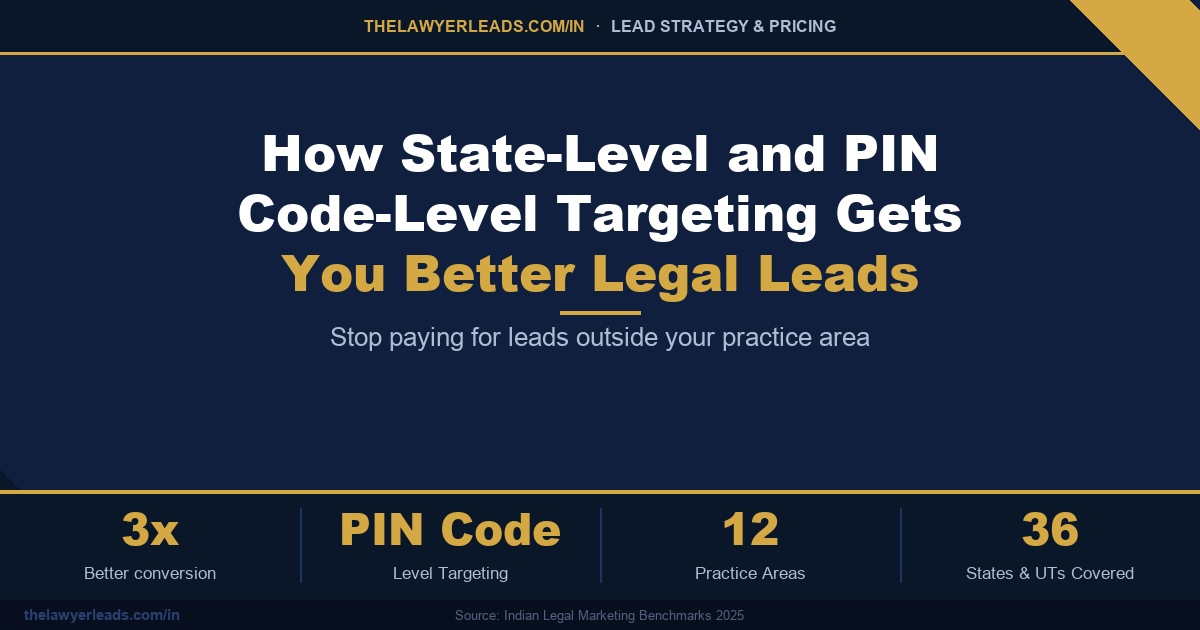
Advocates using tightly filtered PIN code and practice-area targeting report roughly 3x better conversion compared to leads bought from broad, unfiltered directory listings, according to Indian Legal Marketing Benchmarks 2025.
State-Specific Pricing Reflects Real Market Conditions
Legal lead pricing should not be a flat national rate. Competition among advocates, cost of living, and case volumes vary widely between, say, Maharashtra and a smaller state, and lead pricing should reflect that. ThelawyerLeads IN prices leads by state so that firms in less competitive markets are not overpaying for the same targeting precision available to firms in metro hubs — while firms in high-demand markets get leads priced fairly for that level of competition.
This is only possible because we cover 36 states and Union Territories with granular targeting infrastructure already built in. Whether your firm operates from a state capital or a smaller district town, the same PIN code-level precision and state-adjusted pricing applies.
What advocates should check before buying leads from any provider
- Can you set your service area down to specific PIN codes, or only a whole city or state?
- Are practice area and location filters combined, or applied separately?
- Is pricing adjusted by state, or is it a flat national rate regardless of local competition?
- Are leads exclusive to your firm, or resold to multiple advocates in the same area?
- Is there a long-term contract, or can you adjust your targeting and volume month to month?
Setting Up Precise Targeting for Your Firm
Getting this right takes a few minutes. Start by mapping your actual service radius — not the state you are registered to practise in, but the districts and PIN codes where you genuinely take on new clients. Layer your practice areas on top, choosing only the categories your firm is equipped to handle well. Then set your budget against that narrower, higher-quality pool rather than spreading it across a broad, unfiltered list.
Firms that make this switch typically see fewer total leads per month — but a noticeably higher share of those leads turning into consultations and retained matters. For most advocates, that trade-off is a clear win: fewer, better leads beat a larger volume of mismatched enquiries every time.
How State-Level and PIN Code-Level Targeting Gets You Better Legal Leads — Summary
- Broad targeting wastes budget — leads outside your service jurisdiction rarely convert, no matter how cheap they appear per lead.
- PIN code-level targeting is the sharpest tool available — it restricts enquiries to your genuine catchment area, not just your city or state.
- Practice area filtering must be combined with geography — location alone is not enough to guarantee a qualified lead.
- State-specific pricing reflects local competition — across all 36 states and Union Territories we cover, so you are not overpaying for your market.
- Tighter targeting means fewer, better leads — advocates using it report roughly 3x better conversion than broad, unfiltered lead sources.
Precision targeting is not a luxury feature — it is the difference between a lead generation spend that grows your practice and one that quietly leaks money on enquiries you were never going to convert. For Indian advocates evaluating where to invest their next marketing rupee, state and PIN code-level targeting should be the first thing you ask about.
See Lead Pricing for Your State
We offer transparent, state-specific lead pricing across all major practice areas — with no contracts, no recycled contacts, and full exclusivity options.