
Not every personal injury lead is worth the same to your firm. A motor accident enquiry from a claimant still in the hospital converts very differently from a general “can I sue?” query typed into a search bar at midnight — and knowing the difference before you pay for the lead is what separates a profitable PI practice from a frustrated one.
Personal injury is one of the most competitive practice areas for Singapore lawyers buying leads, and also one of the most rewarding when the targeting is right. Claimants rarely go looking for a lawyer casually — an accident, a workplace injury, or a road traffic collision forces the search, which means PI leads tend to carry real urgency. The question for any Advocate & Solicitor is not whether personal injury leads are worth buying, but which ones are, and how to convert them once they land in your inbox.
What Makes a Personal Injury Lead Worth Buying
Not all personal injury leads are created equal, and firms that treat every enquiry the same way tend to overpay for the weak ones and undervalue the strong ones. Before you commit budget to a PI lead source, check it against these markers of quality:
- Recency of the incident — a claimant enquiring within days of an accident is far more likely to instruct a firm than one asking about something that happened months ago.
- Injury severity and documentation — leads that already reference a police report, medical certificate, or hospital admission convert at a noticeably higher rate.
- Postal district proximity — a claimant based near your office, or near the accident site your firm regularly handles, is easier to onboard and meet in person.
- Exclusivity — a lead sold to three other firms simultaneously is a lead you are racing to call first, not a lead you are converting on merit.
- Liability clarity — enquiries where fault is not seriously disputed (e.g. rear-end collisions, workplace falls with a clear hazard) tend to settle faster and convert better.
A cheap lead that never converts costs more per case won than an expensive lead that does. Judge PI lead sources on cost per case, not cost per lead.
PI Lead Cost Benchmarks
| Metric | Singapore Benchmark |
|---|---|
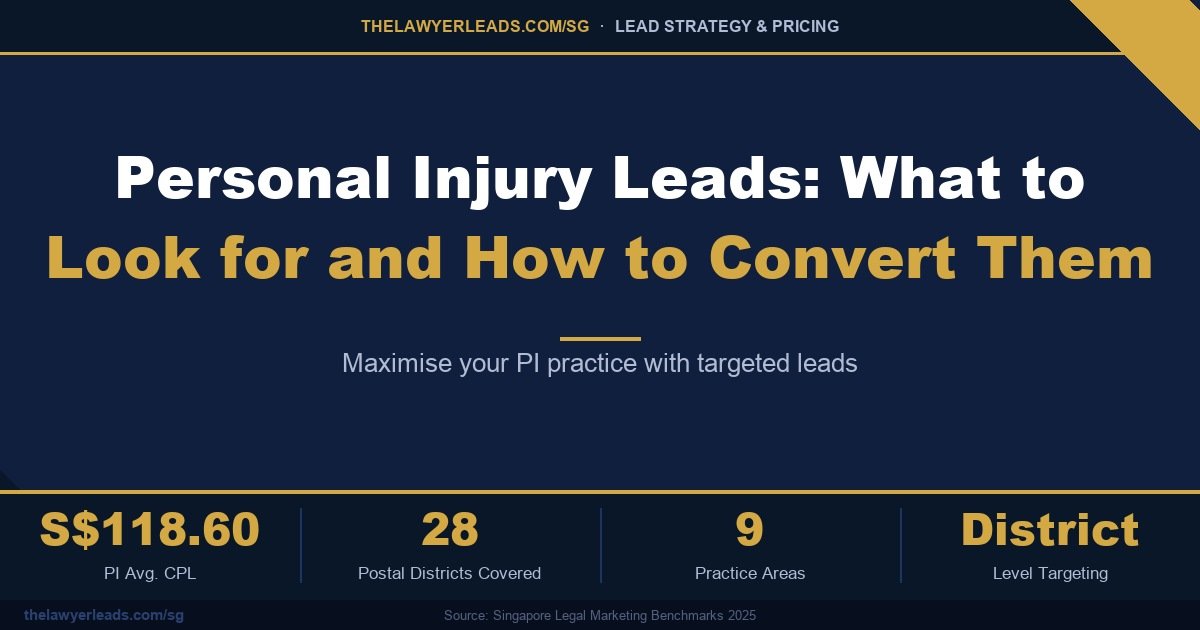
| PI Average Cost Per Lead | S$118.60 |
| Overall Legal Average CPL | S$102.30 |
| Postal districts covered | 28 |
| Recommended firm response time | Under 15 minutes |
PI leads sit slightly above the overall legal average CPL, which reflects the higher intent and case value behind them — a converted PI case is typically worth many multiples of the lead cost. Firms that treat the higher price as a reason to hesitate are usually the ones leaving the best claimants to a faster-moving competitor.
How to Convert a Personal Injury Lead
Buying the right PI lead is only half the job — conversion depends on what your firm does in the minutes and days after the enquiry arrives. A few practices consistently separate firms that convert well from those that do not:
1. Call first, not last
Claimants in genuine distress rarely wait around. If a lead is exclusive to your firm, the advantage disappears the moment you let it sit in an inbox overnight. Assign PI enquiries to whoever is fastest to respond, not whoever is next in a rota.
2. Lead with empathy, not paperwork
The first call should establish that the claimant is being heard, not that they are being processed. Firms that open with a compliance checklist convert noticeably worse than those that open with a genuine question about the claimant’s condition.
3. Make the first meeting easy to reach
This is where postal district-level targeting pays off twice — once in lead cost, and again in conversion. A claimant who does not have to cross the island to see you is a claimant far more likely to actually turn up.
▶ Key Insight
Firms buying PI leads filtered to their own postal districts consistently report faster first-meeting turnaround and higher instruction rates than firms buying unfiltered, island-wide leads at a lower headline price.
Why Postal District Targeting Matters for PI Practices
Singapore’s 28 postal districts each carry a different mix of accident types, commuting patterns, and competition among firms. A firm based in the Central Business District handling workplace injury claims from Tuas or Jurong is fighting geography as much as it is fighting for the case. District-level targeting lets a PI practice buy leads only from the districts it can realistically serve — the districts near its office, near the courts it appears in, or near the industrial and transport corridors where the accidents its practice specialises in actually happen.
This is also where exclusivity compounds the advantage. A PI lead that is both district-matched and exclusive to your firm removes the two biggest reasons a strong claimant slips away: distance, and a faster-calling competitor.
Personal Injury Leads: What to Look for and How to Convert Them — Summary
- Judge leads on recency, documentation, and liability clarity — not just on price.
- Insist on exclusivity — a shared PI lead is a race you may not win.
- Respond within minutes, not hours — speed to contact is the single biggest driver of PI conversion.
- Buy by postal district — leads near your office and case corridors convert and meet in person far more reliably.
- Track cost per case, not cost per lead — the S$118.60 PI average CPL is justified by higher case value when conversion practices are sound.
See Lead Pricing for Your District
We offer transparent, district-specific lead pricing across all major practice areas — with no contracts, no recycled contacts, and full exclusivity options.