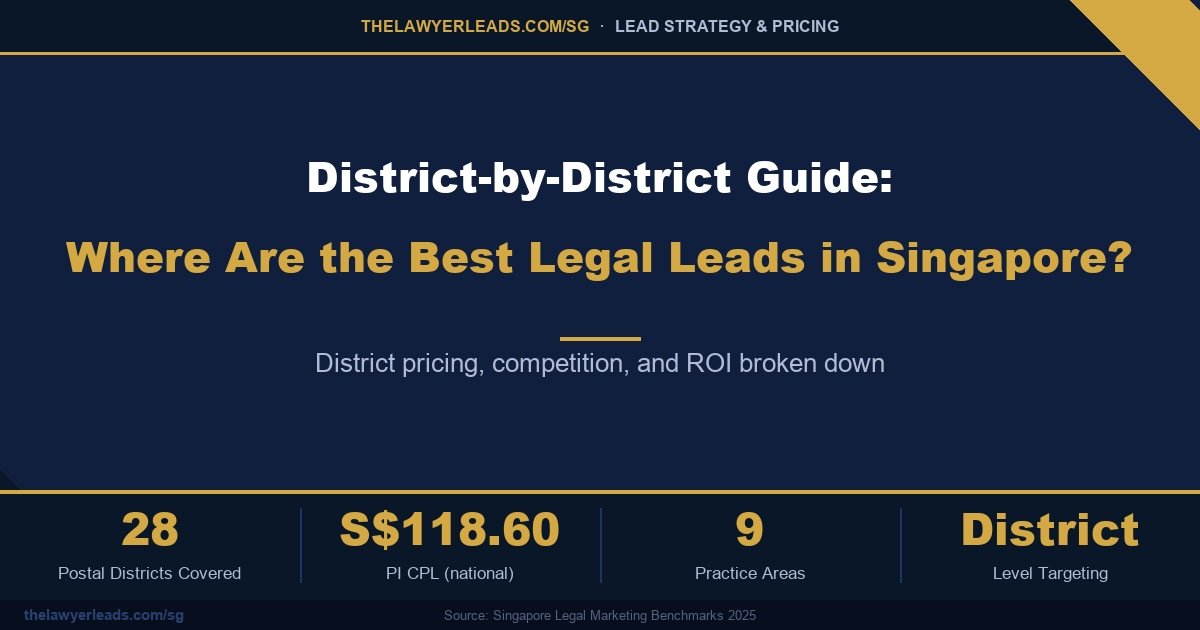
District-by-District Guide: Where Are the Best Legal Leads in Singapore?

District-by-District Guide: Where Are the Best Legal Leads in Singapore?

Not every postal district in Singapore produces the same quality of legal leads — and paying the same price for all of them is one of the most common mistakes law firms make when buying leads.

Singapore is divided into 28 postal districts, and each one behaves differently when it comes to legal demand. A conveyancing enquiry from District 9 (Orchard, River Valley) carries a very different case value than one from District 27 (Yishun, Sembawang). A personal injury lead from the industrial belt around District 22 (Jurong) looks nothing like a family law enquiry from District 15 (East Coast, Katong). If your firm buys leads without accounting for these differences, you’re almost certainly overpaying for some districts and underexposed in others. This guide breaks down where the best legal leads in Singapore actually come from — district by district — and how district-level targeting changes the maths on your lead spend.


Why District-Level Targeting Matters for Singapore Law Firms

Most legal directories and ad platforms sell leads at the national level — every enquiry costs the same, regardless of postal district. That flat pricing model ignores a basic reality of the Singapore legal market: demand, competition, and case value all shift sharply across the island’s 28 postal districts. A firm practising conveyancing near the CBD is competing with a completely different set of firms — and a completely different budget ceiling — than one serving heartland estates in the north-east.

District-level targeting means you only pay for enquiries generated in the postal districts that actually match your practice — your office location, your court appearances, or the client profile you want to serve. It is the single biggest lever for improving return on ad spend when buying legal leads in Singapore.

Firms using postal district-level targeting typically see up to 3x better conversion compared to firms buying undifferentiated, island-wide leads — because the enquiries that reach them are already geographically and practically relevant.

District-by-District: Where Legal Demand Clusters

Legal enquiries in Singapore tend to cluster around a handful of recognisable zones. Here’s a general breakdown of how demand, competition among firms, and typical practice-area fit shift across the island’s postal districts:

District Cluster Firm Competition Best-Fit Practice Areas
Districts 1–6 (CBD, Marina, Tanjong Pagar) High Corporate, commercial disputes
Districts 9–11 (Orchard, Bukit Timah, Holland) High Conveyancing, private wealth, family law
Districts 15–16 (East Coast, Katong, Bedok) Moderate Family law, personal injury
Districts 19–20 (Serangoon, Bishan, Toa Payoh) Moderate Conveyancing, family law, employment
Districts 21–23 (Clementi, Jurong, Bukit Batok) Low–Moderate Personal injury, employment disputes
Districts 25–28 (Woodlands, Yishun, Sembawang) Low Family law, debt/bankruptcy, conveyancing

The lower-competition districts on this table are often where the best value sits — not because case values are higher, but because fewer firms are actively bidding for attention there, so your cost per lead drops while enquiry quality stays consistent.

A National Benchmark, District by District

Across all 28 postal districts, the average legal cost-per-lead in Singapore sits at S$102.30, with personal injury enquiries — typically the highest-value case type — averaging S$118.60 nationally. But that national average masks real variation: a firm targeting only high-competition CBD districts will pay well above that figure, while a firm with district-level targeting across the north-east or west can bring its blended cost per lead down substantially without sacrificing volume.

▶ Key Insight

The cheapest districts aren’t always the best value, and the most expensive districts aren’t always worth the premium. The right approach is matching your firm’s practice areas and capacity to the districts where demand and competition align in your favour — not simply chasing the lowest cost-per-lead figure in isolation.

How to Choose the Right Districts for Your Firm

Before you commit lead spend to any district, run through a few basic checks:

  • Map your existing client base by postal district — you may already have an untapped concentration worth doubling down on.
  • Match districts to the practice areas you actually want more of — a district strong in conveyancing enquiries is wasted spend if your firm is built around litigation.
  • Factor in your firm’s capacity to travel for court appearances or client meetings — proximity still matters for conversion.
  • Test lower-competition districts alongside your core districts before scaling spend — this is where district-level targeting typically pays off fastest.
  • Revisit your district mix quarterly — competition and demand shift as other firms adjust their own targeting.

This is exactly the targeting layer that most legal directories and generic ad platforms in Singapore don’t offer. ThelawyerLeads SG builds district-level targeting into every campaign from the start, across all 9 of our practice areas, so your firm only pays for enquiries from the postal districts that actually fit your practice.

District-by-District Guide — Summary

  1. Demand isn’t uniform — legal enquiries cluster differently across Singapore’s 28 postal districts, and flat, island-wide lead pricing ignores that.
  2. Competition drives cost — high-density districts like the CBD and Orchard carry a premium; north-east and west districts often offer better value.
  3. National averages hide variation — the S$102.30 average cost-per-lead (S$118.60 for personal injury) shifts meaningfully once you break it down by district.
  4. Match districts to practice areas — the best-value district for your firm depends on what you practise, not just where you’re located.
  5. District-level targeting is the lever — it’s the most direct way to improve ROI on legal lead spend in Singapore’s 9 major practice areas.

See Lead Pricing for Your District

We offer transparent, district-specific lead pricing across all major practice areas — with no contracts, no recycled contacts, and full exclusivity options.
View Lead Pricing →

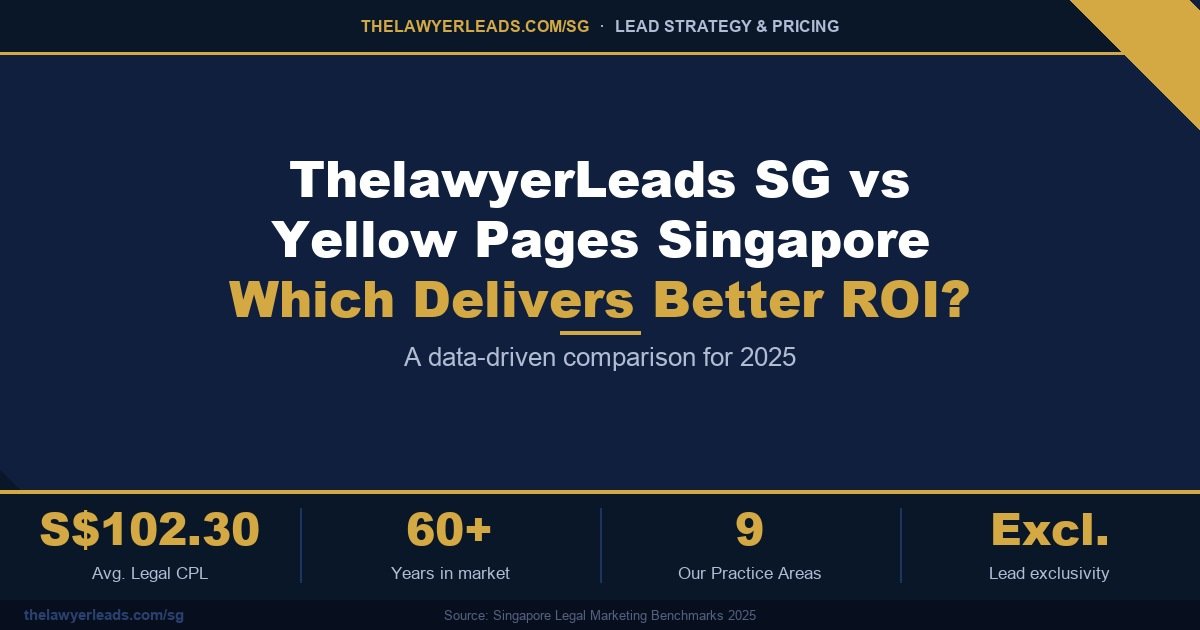
ThelawyerLeads SG vs Yellow Pages Singapore: Which Legal Lead Service Is Worth Your Money?

ThelawyerLeads SG vs Yellow Pages Singapore: Which Legal Lead Service Is Worth Your Money?

Yellow Pages Singapore has been a fixture of local business discovery for six decades — but for lawyers trying to turn a directory listing into paying clients, “well known” and “well targeted” are two very different things. Here’s how a legal-specific lead service stacks up.

For many Advocates & Solicitors in Singapore, a Yellow Pages listing is inherited rather than chosen — a legacy line item renewed each year out of habit. It puts your firm’s name in front of anyone flipping through a general business directory, but it does nothing to filter for the one thing that actually matters: whether the person looking at your listing needs a lawyer, and needs one in your postal district, for your practice area, right now. That’s the gap ThelawyerLeads SG was built to close, and it’s worth putting the two approaches side by side.

Two Different Products, Not Two Competitors

Yellow Pages Singapore is a directory. It lists your firm alongside every other business category imaginable — plumbers, restaurants, accountants, and law firms all compete for the same browsing attention. ThelawyerLeads SG is a lead generation service built specifically around legal practice areas. The distinction matters because a directory listing is passive: it waits for someone to search and scroll past dozens of other listings before reaching yours. A lead generation service is active: it identifies someone who has already indicated they need legal help, in a specific postal district, for a specific matter, and routes that contact straight to you.

In other words, a directory sells visibility. A legal lead service sells intent. For a solo practitioner or small firm with a limited marketing budget, intent converts a great deal faster than visibility does.

ThelawyerLeads SG vs Yellow Pages Singapore: The Comparison

Factor ThelawyerLeads SG Yellow Pages Singapore
What you pay for A qualified lead — someone actively seeking legal help A listing slot — no guarantee of enquiries
Targeting Postal district-level, by practice area None — general business category only
Lead exclusivity Exclusive lead options available Not applicable — passive listing
Contract terms No long-term contracts Typically annual renewal commitments
Practice area coverage 9 dedicated legal practice areas Generic “Lawyers” category
Cost per outcome S$102.30 avg. cost per lead Fixed listing fee regardless of results

A Yellow Pages listing costs the same whether it generates one enquiry or none. A qualified lead only costs you money when someone with an actual legal need is delivered to your firm — the risk of paying for nothing shifts off your side of the ledger.


Why Postal District Targeting Changes the Economics

Singapore doesn’t have states or counties — but it does have 28 postal districts, and where a prospective client is located relative to your office matters enormously for conversion. Someone in District 9 searching for a conveyancing lawyer is far more likely to instruct a firm they can reach easily than one on the other side of the island. Yellow Pages has no mechanism to filter for this at all — your listing shows to everyone browsing the “Lawyers” category regardless of where they are or what they actually need. ThelawyerLeads SG lets you set district-level targeting so the leads reaching your inbox are ones you can realistically win and service.

Nine Practice Areas, Not One Generic Category

Directories tend to lump every lawyer into a single broad category. But a firm doing family law and a firm doing personal injury litigation are chasing completely different clients with completely different search behaviour. ThelawyerLeads SG separates leads across 9 distinct practice areas — including family law, personal injury, conveyancing, and more — so the enquiries you receive already match what your firm actually practises, rather than being a generic “someone needs a lawyer” contact you then have to qualify yourself.

▶ Key Insight

Legal marketing benchmarks put the average cost per legal lead in Singapore at around S$102.30. A well-targeted lead at that price, matched to your practice area and postal district, is a far more efficient use of budget than an untargeted directory listing that may sit unclicked for months.

Where Yellow Pages Still Has a Place

To be fair, a Yellow Pages listing isn’t worthless. It contributes a small amount of general brand presence and can occasionally pick up an enquiry from someone specifically browsing local directories out of habit. For a firm with an existing marketing budget and nothing better to spend a modest amount on, it’s a low-effort supplement. But as a primary client acquisition channel — the thing a growing firm relies on to keep the pipeline full — it lacks the targeting, exclusivity, and measurability that a dedicated legal lead service provides.

No Long-Term Lock-In Either Way

One advantage ThelawyerLeads SG offers that many firms don’t expect: no long-term contracts. You’re not locked into a 12-month renewal the way many directory listings work. You can scale up or pause based on your firm’s actual capacity to take on new matters, which matters especially for smaller practices where caseload fluctuates.

ThelawyerLeads SG vs Yellow Pages Singapore — Summary

  1. Intent beats visibility — a directory listing waits to be found; a qualified lead is already looking for a lawyer.
  2. Postal district targeting — Yellow Pages has none; ThelawyerLeads SG lets you focus on districts you can actually serve.
  3. Practice area precision — 9 dedicated categories versus one generic “Lawyers” listing.
  4. Flexible commitment — no long-term contracts, so spend follows your firm’s actual capacity.
  5. Exclusivity options — reduce the number of firms competing for the same contact.

If your firm’s growth still depends on a directory listing renewed out of habit, it may be time to redirect that budget toward leads that arrive already qualified, already local, and already looking for exactly what you offer.

See Lead Pricing for Your District

We offer transparent, district-specific lead pricing across all major practice areas — with no contracts, no recycled contacts, and full exclusivity options.
View Lead Pricing →

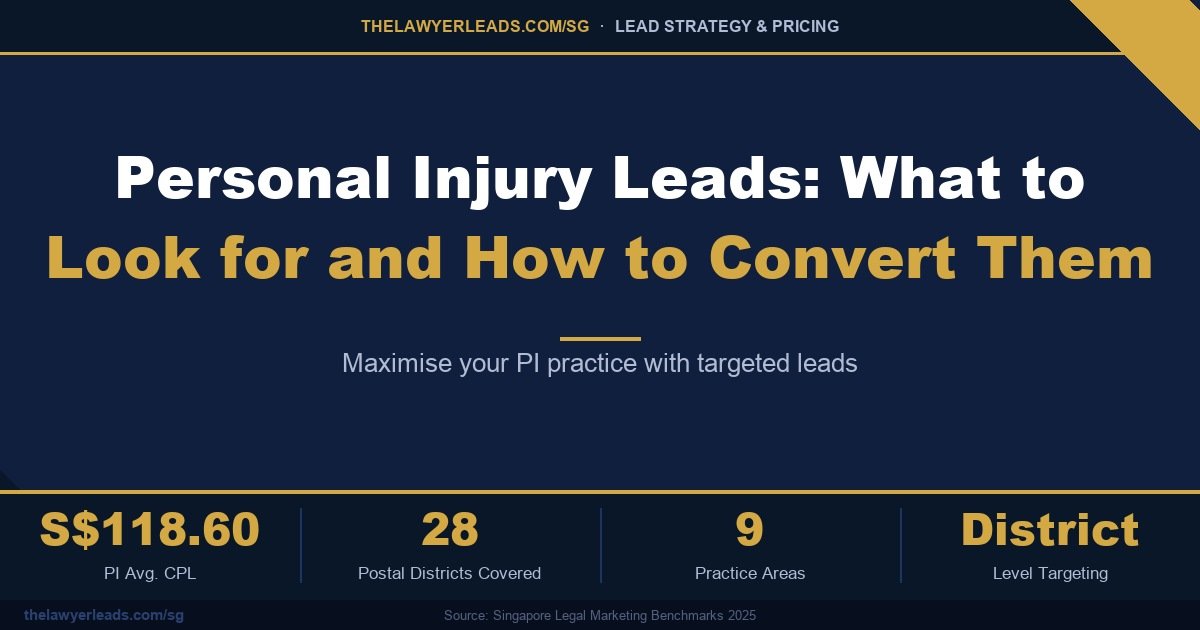
Personal Injury Leads: What to Look for and How to Convert Them

Personal Injury Leads: What to Look for and How to Convert Them

Not every personal injury lead is worth the same to your firm. A motor accident enquiry from a claimant still in the hospital converts very differently from a general “can I sue?” query typed into a search bar at midnight — and knowing the difference before you pay for the lead is what separates a profitable PI practice from a frustrated one.

Personal injury is one of the most competitive practice areas for Singapore lawyers buying leads, and also one of the most rewarding when the targeting is right. Claimants rarely go looking for a lawyer casually — an accident, a workplace injury, or a road traffic collision forces the search, which means PI leads tend to carry real urgency. The question for any Advocate & Solicitor is not whether personal injury leads are worth buying, but which ones are, and how to convert them once they land in your inbox.


What Makes a Personal Injury Lead Worth Buying

Not all personal injury leads are created equal, and firms that treat every enquiry the same way tend to overpay for the weak ones and undervalue the strong ones. Before you commit budget to a PI lead source, check it against these markers of quality:

  • Recency of the incident — a claimant enquiring within days of an accident is far more likely to instruct a firm than one asking about something that happened months ago.
  • Injury severity and documentation — leads that already reference a police report, medical certificate, or hospital admission convert at a noticeably higher rate.
  • Postal district proximity — a claimant based near your office, or near the accident site your firm regularly handles, is easier to onboard and meet in person.
  • Exclusivity — a lead sold to three other firms simultaneously is a lead you are racing to call first, not a lead you are converting on merit.
  • Liability clarity — enquiries where fault is not seriously disputed (e.g. rear-end collisions, workplace falls with a clear hazard) tend to settle faster and convert better.

A cheap lead that never converts costs more per case won than an expensive lead that does. Judge PI lead sources on cost per case, not cost per lead.

PI Lead Cost Benchmarks

Metric Singapore Benchmark
PI Average Cost Per Lead S$118.60
Overall Legal Average CPL S$102.30
Postal districts covered 28
Recommended firm response time Under 15 minutes

PI leads sit slightly above the overall legal average CPL, which reflects the higher intent and case value behind them — a converted PI case is typically worth many multiples of the lead cost. Firms that treat the higher price as a reason to hesitate are usually the ones leaving the best claimants to a faster-moving competitor.


How to Convert a Personal Injury Lead

Buying the right PI lead is only half the job — conversion depends on what your firm does in the minutes and days after the enquiry arrives. A few practices consistently separate firms that convert well from those that do not:

1. Call first, not last

Claimants in genuine distress rarely wait around. If a lead is exclusive to your firm, the advantage disappears the moment you let it sit in an inbox overnight. Assign PI enquiries to whoever is fastest to respond, not whoever is next in a rota.

2. Lead with empathy, not paperwork

The first call should establish that the claimant is being heard, not that they are being processed. Firms that open with a compliance checklist convert noticeably worse than those that open with a genuine question about the claimant’s condition.

3. Make the first meeting easy to reach

This is where postal district-level targeting pays off twice — once in lead cost, and again in conversion. A claimant who does not have to cross the island to see you is a claimant far more likely to actually turn up.

▶ Key Insight

Firms buying PI leads filtered to their own postal districts consistently report faster first-meeting turnaround and higher instruction rates than firms buying unfiltered, island-wide leads at a lower headline price.


Why Postal District Targeting Matters for PI Practices

Singapore’s 28 postal districts each carry a different mix of accident types, commuting patterns, and competition among firms. A firm based in the Central Business District handling workplace injury claims from Tuas or Jurong is fighting geography as much as it is fighting for the case. District-level targeting lets a PI practice buy leads only from the districts it can realistically serve — the districts near its office, near the courts it appears in, or near the industrial and transport corridors where the accidents its practice specialises in actually happen.

This is also where exclusivity compounds the advantage. A PI lead that is both district-matched and exclusive to your firm removes the two biggest reasons a strong claimant slips away: distance, and a faster-calling competitor.

Personal Injury Leads: What to Look for and How to Convert Them — Summary

  1. Judge leads on recency, documentation, and liability clarity — not just on price.
  2. Insist on exclusivity — a shared PI lead is a race you may not win.
  3. Respond within minutes, not hours — speed to contact is the single biggest driver of PI conversion.
  4. Buy by postal district — leads near your office and case corridors convert and meet in person far more reliably.
  5. Track cost per case, not cost per lead — the S$118.60 PI average CPL is justified by higher case value when conversion practices are sound.

See Lead Pricing for Your District

We offer transparent, district-specific lead pricing across all major practice areas — with no contracts, no recycled contacts, and full exclusivity options.
View Lead Pricing →

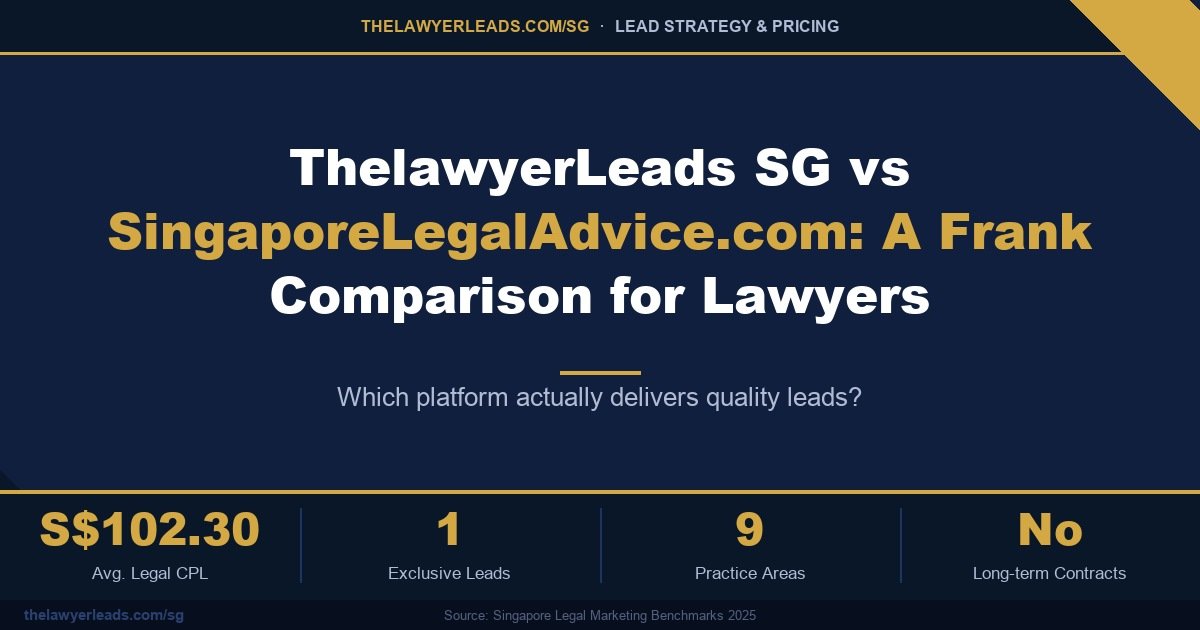
ThelawyerLeads SG vs SingaporeLegalAdvice.com: A Frank Comparison for Lawyers

ThelawyerLeads SG vs SingaporeLegalAdvice.com: A Frank Comparison for Lawyers

Every Singapore law firm weighing where to spend its marketing budget eventually runs into SingaporeLegalAdvice.com. It’s a familiar name — but familiar isn’t the same as effective. Here’s an honest, side-by-side look at how it compares to ThelawyerLeads SG for firms that actually want new instructed matters, not just directory traffic.

SingaporeLegalAdvice.com built its reputation as a legal information portal — a place where the public can browse articles and submit general enquiries. Lawyers pay to be listed, and enquiries get distributed to whichever firms are subscribed in that category. It’s a reasonable way to appear “findable” online. But for firms that need a predictable, exclusive stream of leads for their practice areas — legal lead generation built around Singapore’s own postal district structure is a fundamentally different model, and it converts differently too.


How the Two Models Actually Work

SingaporeLegalAdvice.com operates as a shared-enquiry directory. A member of the public submits a general legal question or enquiry, and it’s typically routed — sometimes simultaneously — to multiple subscribed lawyers in the relevant category. You’re competing with other firms for the same enquiry, often before you’ve even had a chance to call back.

ThelawyerLeads SG works differently. Every lead is generated from a targeted campaign built around a specific practice area and postal district, and — unless you choose otherwise — delivered to one firm only. There’s no race to be the first to respond to a shared contact. The person who submitted their details is expecting to hear from you, and only you.

A shared lead isn’t really a lead — it’s a lottery ticket shared with three or four other firms. Exclusivity is what turns a contact into a genuine business opportunity.

Side-by-Side Comparison

Factor SingaporeLegalAdvice.com ThelawyerLeads SG
Lead exclusivity Often shared with several firms 1 firm per lead
Targeting granularity General category listing Postal district-level
Practice areas covered Broad, mixed categories 9 dedicated practice areas
Contract commitment Ongoing subscription/listing fee No long-term contracts
Avg. cost per lead Varies, bundled into listing fee S$102.30 (practice-area dependent)

Why Postal District Targeting Matters

Singapore doesn’t have states or counties — it’s organised into 28 postal districts, and where a client is based genuinely affects which firm they want to instruct. A firm based near the CBD handling corporate and commercial disputes has very different targeting needs from a family law practice serving heartland districts. A directory listing puts you in front of everyone in a category, everywhere. District-level targeting puts your budget only where your ideal client actually is.

▶ Key Insight

Directory listings optimise for visibility. Postal district-targeted lead generation optimises for conversion — because the person reaching out is already close to the right firm, in the right area, for the right matter.

The Cost of “Free” Shared Leads

A subscription-based directory can feel cheaper on paper, since the fee is fixed regardless of how many enquiries come in. But when three or four firms are chasing the same contact, your actual cost per won case rises fast — you’re paying the same fee whether you convert 1 enquiry or 10, and speed-to-call becomes the deciding factor rather than the quality of your advice. With exclusive, district-targeted leads, every dollar spent maps to a contact that is yours alone to convert, with none of the response-time race.

There’s also the matter of commitment. Many directory listings lock firms into ongoing subscription periods to maintain placement. ThelawyerLeads SG runs on a pay-per-lead model with no long-term contracts — firms scale spend up or down by district and practice area as caseload allows, without being tied to a renewal cycle.

ThelawyerLeads SG vs SingaporeLegalAdvice.com — Summary

  1. Exclusivity wins conversions — a lead shared across several firms converts far less reliably than one delivered to a single firm.
  2. District-level targeting beats category listings — Singapore’s 28 postal districts let you focus spend on the areas that matter to your practice.
  3. No long-term contracts — pay-per-lead pricing means you scale spend to caseload, not to a renewal calendar.
  4. 9 dedicated practice areas — leads are matched to your specific area of law, not a general enquiry bucket.

Directory listings still have a place in a firm’s broader visibility strategy. But for firms that want a dependable, exclusive pipeline of new matters — matched to the districts and practice areas they actually serve — ThelawyerLeads SG is built for that job specifically, not as a side effect of being a legal information site.

See Lead Pricing for Your District

We offer transparent, district-specific lead pricing across all major practice areas — with no contracts, no recycled contacts, and full exclusivity options.
View Lead Pricing →

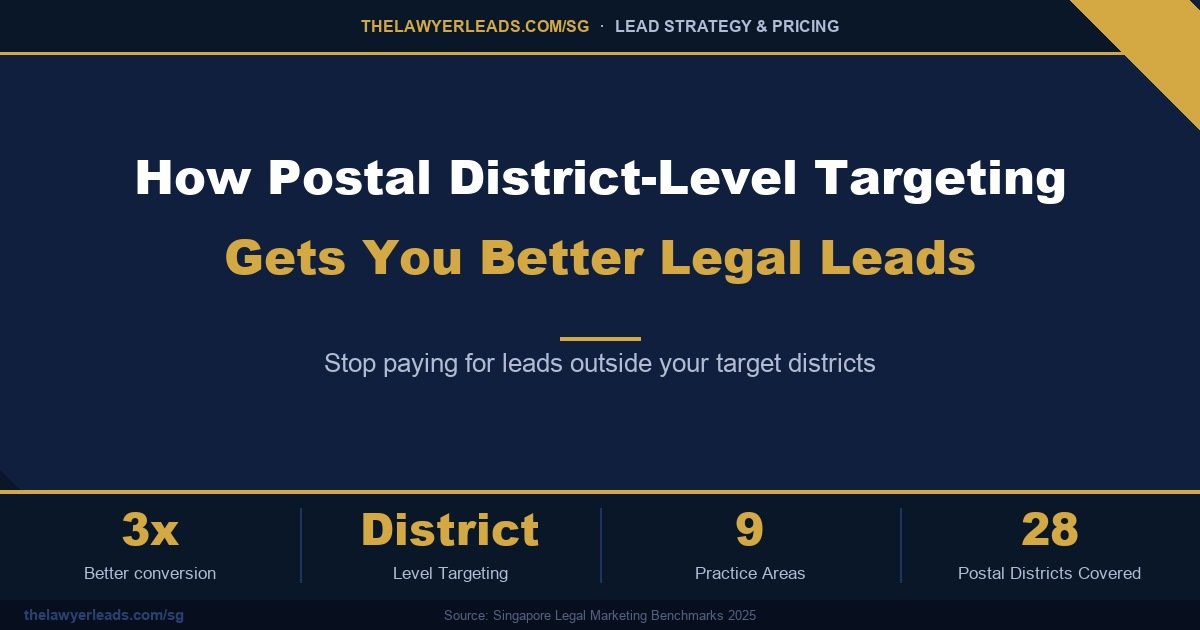
How Postal District-Level Targeting Gets You Better Legal Leads

How Postal District-Level Targeting Gets You Better Legal Leads

A prospective client in Jurong is not the same lead as one in Tanjong Pagar — not if your firm only takes instructions in the Central Business District. Postal district-level targeting is the difference between a lead you can actually convert and one you paid for and had to turn away.

Most legal lead generation in Singapore is sold the same way advertising has always been sold: broadly. A firm pays for “Singapore leads” and hopes enough of them happen to live or work near its office. But Singapore is a small, dense market split into 28 postal districts, each with its own client profile, competition level, and commute tolerance. Postal district-level targeting fixes the mismatch — it lets a firm buy leads from the specific districts it can realistically serve, instead of paying full price for leads it will politely decline.


Why Broad Targeting Wastes Legal Marketing Budget

When a lead generation service doesn’t filter by postal district, a Singapore lawyer ends up paying for three categories of leads: the ones they can serve well, the ones that are technically reachable but inconvenient, and the ones that are simply outside any realistic radius. Only the first category converts reliably. The other two still cost the same per lead, but they rarely turn into signed clients — the prospect finds a firm closer to home, or the initial call reveals the commute is a dealbreaker.

For an Advocate & Solicitor running a lean practice, that waste compounds fast. A firm buying 20 leads a month without district filtering might see a third of them fall outside a workable catchment area. Over a year, that’s months of marketing spend directed at people who were never going to walk through the door.

A lead’s value isn’t just its practice area — it’s whether the prospect can realistically become your client. Postal district filtering answers that question before you ever pick up the phone.

How Postal District-Level Targeting Works

Singapore’s 28 postal districts each cover a distinct catchment — from the financial core of District 1 to the residential heartlands of Districts 17 through 28. District-level targeting means a firm’s lead campaign is configured against the specific districts it wants to serve, and only prospects located in those districts are routed to it. A conveyancing practice based near Districts 9 and 10 can choose to receive leads only from those areas and their immediate neighbours, rather than fielding enquiries from Woodlands or Pasir Ris.

This isn’t a cosmetic filter. It changes the underlying economics of buying leads, because every lead that reaches the firm is one it can plausibly close — not one it has to screen out before the first conversation even starts.

Targeting Approach Typical Outcome
Island-wide, no filtering Leads from districts the firm can’t realistically serve; higher waste rate
Postal district-level targeting Leads matched to catchment; up to 3x better conversion
Single-district office directory Firm visible, but no active matching — prospect must find you first

▶ Key Insight

Firms using postal district-level targeting report up to 3x better conversion compared with unfiltered, island-wide lead campaigns — because every lead that lands in the inbox is already within a workable catchment.


Matching Districts to Practice Area

District-level targeting works best when it’s paired with practice area. A personal injury practice may want broader coverage, since clients will travel for the right representation after an accident. A conveyancing or family law practice, by contrast, often benefits from tight geographic focus, since clients tend to prefer a firm near their home, workplace, or the property in question.

Questions to ask before setting your districts

  • Where is your office, and how far will a client realistically travel for your practice area?
  • Are there districts where you already have strong referral relationships or brand recognition?
  • Does your practice area demand more geographic reach (litigation, PI) or less (conveyancing, family)?
  • Which districts have the lead volume and competition level that fits your capacity?

ThelawyerLeads SG applies this same logic across all 9 practice areas we serve. Every campaign is configured at the postal district level, so a firm sets its own catchment rather than inheriting a generic, island-wide net.

Targeting isn’t just about saving money on unusable leads — it’s about spending your entire budget on prospects your firm can actually win.

What This Means for Your Cost Per Lead

Targeting doesn’t just improve conversion — it changes how a firm should think about cost per lead. A lead that costs slightly more but converts three times as often is cheaper, in real terms, than a low-cost, unfiltered lead that rarely turns into a signed client. District-level targeting is what makes that trade-off work in the firm’s favour, rather than the lead vendor’s.

It also gives firms more control over growth. A firm expanding into a new area of Singapore can simply add districts to its campaign; a firm consolidating around its home base can narrow them. Either way, the firm — not the vendor — decides where its marketing budget goes.

How Postal District-Level Targeting Gets You Better Legal Leads — Summary

  1. Broad, unfiltered targeting wastes budget — leads outside your catchment cost the same but rarely convert.
  2. Postal district-level targeting matches leads to your catchment — across all 28 of Singapore’s postal districts.
  3. Results follow — firms using district-level targeting report up to 3x better conversion than island-wide campaigns.
  4. Match districts to practice area — wider catchments for litigation and PI, tighter ones for conveyancing and family law.
  5. ThelawyerLeads SG applies this across 9 practice areas — with district-specific pricing and no long-term contracts.

See Lead Pricing for Your District

We offer transparent, district-specific lead pricing across all major practice areas — with no contracts, no recycled contacts, and full exclusivity options.
View Lead Pricing →

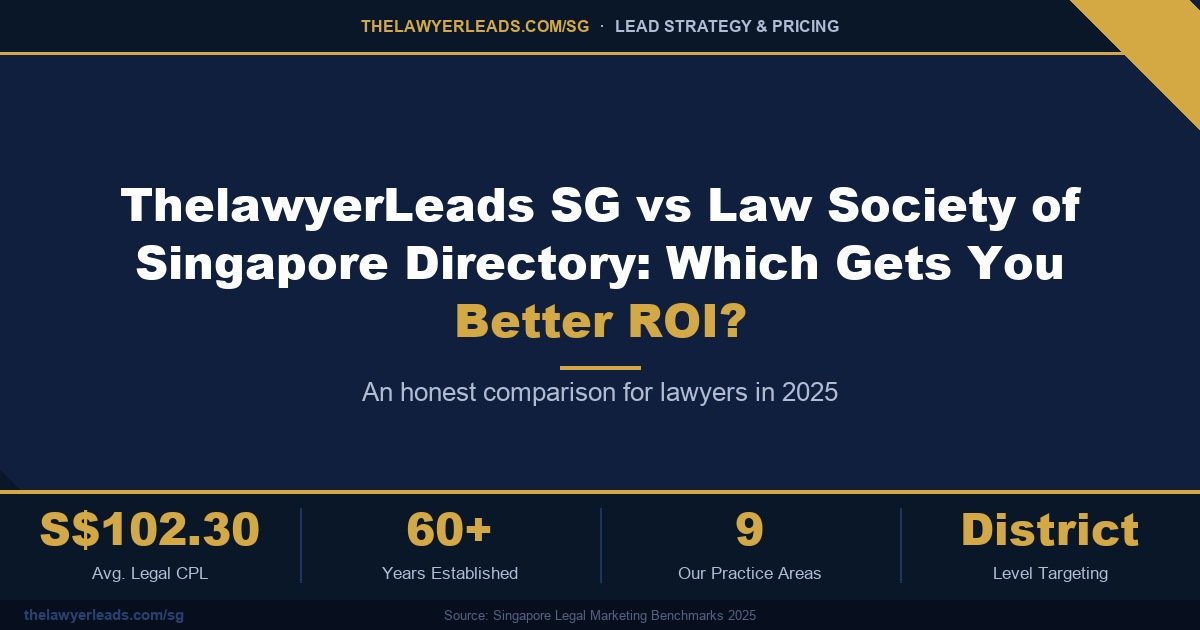
ThelawyerLeads SG vs Law Society of Singapore Directory: Which Gets You Better ROI?

ThelawyerLeads SG vs Law Society of Singapore Directory: Which Gets You Better ROI?

Every Advocate & Solicitor in Singapore knows the Law Society directory listing. Far fewer stop to ask whether it’s actually generating clients — or just sitting there as a digital business card. We put ThelawyerLeads SG head-to-head against the directory model to see which one actually delivers ROI.

If you’re a Singapore lawyer weighing where to invest your marketing budget, the choice usually comes down to two very different models: a passive listing in the Law Society of Singapore directory, or an active, targeted legal lead generation service like ThelawyerLeads SG. Both put your firm in front of potential clients — but only one is built to convert. This comparison breaks down cost, targeting, and exclusivity so you can decide which approach actually grows your practice.


How the Law Society Directory Works

The Law Society of Singapore directory is a public listing of registered Advocates & Solicitors, searchable by name, firm, or practice area. It’s a useful credibility check for clients who already know who they’re looking for — but it wasn’t designed as a lead generation tool. There’s no postal district filtering, no lead notification, and no way to control how many other firms appear alongside yours in a search. A prospective client searching “personal injury lawyer” in the directory sees an alphabetical or unranked list, not a curated match to their case and location.

For firms that already have strong referral networks or brand recognition, the directory listing is a fine supplement. But for a firm actively trying to grow its client base — especially newer firms or those expanding into new practice areas — a passive listing rarely moves the needle on its own.

How ThelawyerLeads SG Works

ThelawyerLeads SG takes the opposite approach. Instead of waiting for a client to search a directory and find you, we generate active, ready-to-speak-with-a-lawyer leads and route them directly to firms based on postal district and practice area. A lawyer purchasing family law leads in Districts 9 to 11 receives contacts specifically from those districts — not a nationwide pool diluted with prospects who were never going to walk through the door.

A directory listing is discovered. A ThelawyerLeads SG lead is delivered — already interested, already matched to your practice area and district.

Head-to-Head Comparison

Factor Law Society Directory ThelawyerLeads SG
Lead delivery Passive — client must find you Active — leads delivered to you
Postal district targeting None All 28 postal districts
Practice area matching Self-listed category only 9 practice areas, actively matched
Lead exclusivity Unlimited firms visible per search Exclusivity options available
Contract commitment N/A (free listing) No long-term contracts
Avg. cost per lead Free, but low conversion S$102.30, high intent

Why “Free” Isn’t the Same as “Cheap”

A directory listing costs nothing beyond your Law Society membership, which makes it tempting to treat as the default marketing channel. But the real cost of a passive channel is the opportunity cost of the clients it never brings you. A firm that spends nothing on lead generation but also converts nothing is not saving money — it’s simply not growing. ThelawyerLeads SG’s average cost per lead of S$102.30 needs to be measured against a single new client’s lifetime value, not against a free listing that produces uncertain results.

▶ Key Insight

Directories rank on alphabetical order or self-reported categories. ThelawyerLeads SG ranks on district-level relevance and practice-area fit — meaning the lawyer who receives the lead is the one best positioned to win the case, not just the one whose surname comes first.

Which One Should Your Firm Use?

The honest answer: both have a place. Keep your Law Society directory listing current — it’s a baseline credibility signal that costs nothing to maintain. But if your firm’s growth depends on a steady, predictable flow of new client enquiries, a directory listing alone won’t get you there. ThelawyerLeads SG is built specifically to fill that gap with district-targeted, practice-area-matched leads that arrive ready to speak with a lawyer.

ThelawyerLeads SG vs Law Society Directory — Summary

  1. Passive vs active — the directory waits to be found; ThelawyerLeads SG delivers leads directly to your firm.
  2. Targeting — no postal district filtering in the directory versus targeting across all 28 postal districts with ThelawyerLeads SG.
  3. Competition — directory searches show unlimited firms; ThelawyerLeads SG offers exclusivity options.
  4. Commitment — no long-term contracts required with ThelawyerLeads SG, so you can scale spend up or down as needed.
  5. Cost vs value — a S$102.30 average cost per lead is measured against real client acquisition, not a free but low-converting listing.

See Lead Pricing for Your District

We offer transparent, district-specific lead pricing across all major practice areas — with no contracts, no recycled contacts, and full exclusivity options.
View Lead Pricing →

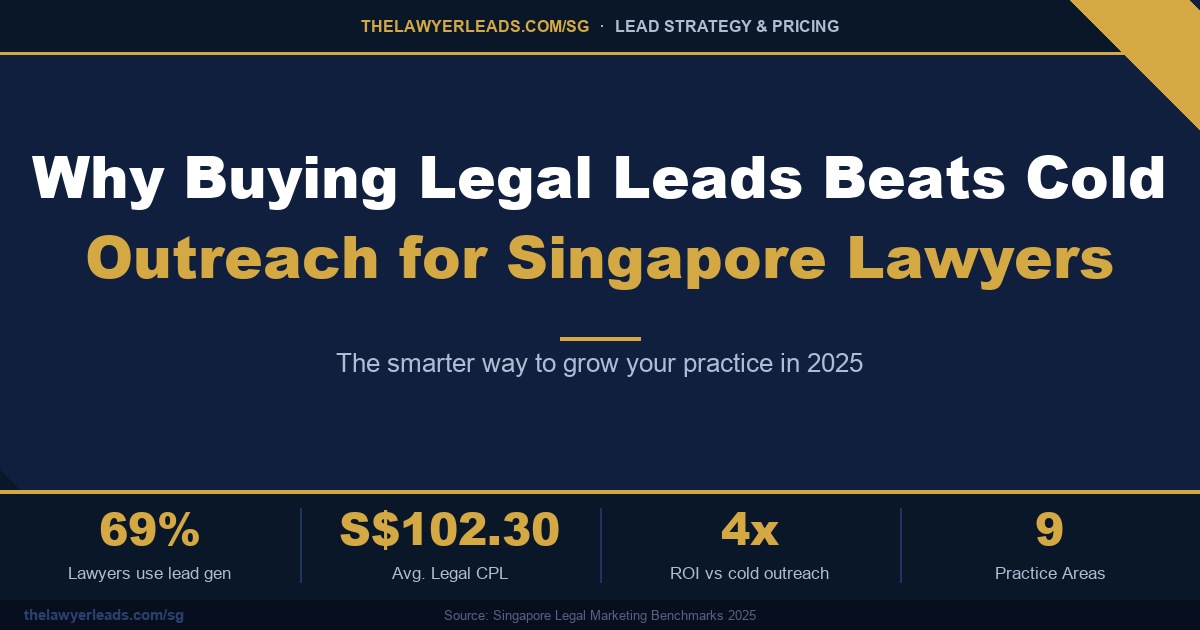
Why Buying Legal Leads Beats Cold Outreach for Singapore Lawyers

Why Buying Legal Leads Beats Cold Outreach for Singapore Lawyers

Every dollar spent chasing a lawyer who isn’t looking for representation is a dollar that could have gone to a client who’s ready to sign. Yet cold outreach remains the default growth strategy for many Singapore law firms — even as legal lead generation quietly outperforms it on every meaningful metric.

If you’re an Advocate & Solicitor weighing how to fill your pipeline this year, the choice between cold outreach and buying legal leads isn’t close. According to the Singapore Legal Marketing Benchmarks 2025, 69% of lawyers now use some form of lead generation to supplement their practice — and the ones who do report faster case intake and lower acquisition costs than firms relying solely on referrals and cold calling.

Why Cold Outreach Struggles for Singapore Law Firms

Cold outreach — whether cold calling, cold emailing, or unsolicited LinkedIn messages — asks a stranger to trust you with a legal matter before they’ve expressed any interest in hiring anyone. For most practice areas, that’s a hard sell. The person on the other end of the line isn’t actively searching for a lawyer; you’re interrupting them, and interruption-based marketing converts poorly compared to intent-based marketing.

There’s also a hidden cost that rarely shows up in a firm’s marketing spreadsheet: associate and partner time. Every hour spent dialling unqualified prospects is an hour not spent on billable client work. When you buy legal leads instead, you’re paying only for people who have already raised their hand — a fundamentally more efficient use of a fee-earner’s time.

The Numbers Behind the Shift

Legal lead generation in Singapore now averages S$102.30 per lead across practice areas, according to the same benchmark study. That figure looks high in isolation — until you compare it against the fully-loaded cost of cold outreach, which includes staff time, CRM tooling, call volume needed to book a single consultation, and the opportunity cost of billable hours diverted to prospecting.

Growth Channel Typical Cost Per Case Time to First Consultation
Cold outreach High (staff hours + tooling) Weeks
Purchased legal leads S$102.30 avg. CPL Same day
Legal directories Moderate (flat annual fee, shared exposure) Days to weeks

▶ Key Insight

Firms that switched from cold outreach to purchased leads report an average 4x return on ad spend, driven mainly by higher conversion rates — people who fill out an intake form are already looking for a lawyer, unlike someone who picks up an unexpected phone call.


What Makes a Good Legal Lead Source

Not all legal leads are created equal, and the quality gap between providers is where most of the ROI difference actually lives. When evaluating a lead generation service, Singapore lawyers should look for a few non-negotiables:

  • Postal district-level targeting — leads filtered to the postal districts where you actually practise, not a blanket nationwide dump.
  • Exclusivity — a lead sold to one firm only, not recycled across five competing practices.
  • Practice area specificity — a personal injury lead is a different animal from a conveyancing lead, and pricing and screening should reflect that.
  • No long-term contracts — the flexibility to scale spend up or down as your caseload allows.

Where ThelawyerLeads SG Fits In

ThelawyerLeads SG was built around exactly this checklist. We offer postal district-level targeting across all 9 of our supported practice areas, so a firm based in the Central Business District isn’t paying for leads generated in Woodlands. Every lead is exclusive to the firm that purchases it, pricing is transparent and district-specific, and there are no long-term contracts locking you in if your caseload or budget changes.

A firm that replaces even half its cold outreach budget with targeted, exclusive leads typically sees case intake accelerate within the first month — because the leads are already warm.

Making the Switch Without Disrupting Your Pipeline

You don’t need to abandon cold outreach overnight to see the benefit of legal lead generation. Most firms run both in parallel for a quarter, tracking cost per case and time-to-consultation side by side. Within a few months, the data almost always makes the case for itself — purchased leads convert faster and cost less per signed client, freeing up fee-earner time that cold outreach was quietly consuming.

The firms that adapt fastest tend to treat lead generation as a core acquisition channel rather than a top-up — allocating a fixed monthly budget, tracking conversion by practice area and postal district, and adjusting spend toward whichever combination performs best.

Why Buying Legal Leads Beats Cold Outreach — Summary

  1. Intent beats interruption — leads from people actively searching for a lawyer convert far better than cold contacts.
  2. The real cost of cold outreach is hidden — staff time and diverted billable hours often exceed the S$102.30 average cost of a purchased lead.
  3. Quality signals matter — postal district targeting, exclusivity, and practice area specificity separate good lead sources from poor ones.
  4. ROI compounds — firms switching to targeted lead generation report roughly 4x return versus cold outreach.
  5. Flexibility protects margins — no long-term contracts means you can scale spend to match actual caseload capacity.

See Lead Pricing for Your District

We offer transparent, district-specific lead pricing across all major practice areas — with no contracts, no recycled contacts, and full exclusivity options.

View Lead Pricing →

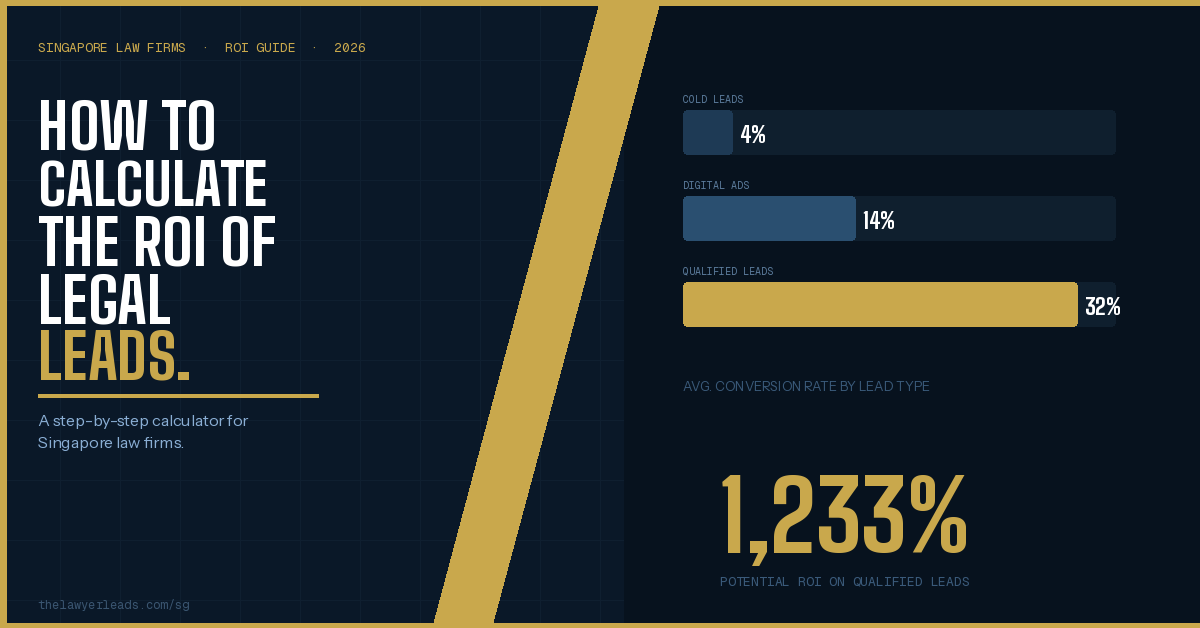
How to Calculate the ROI of Legal Leads for Your Singapore Law Firm

How to Calculate the ROI of Legal Leads for Your Singapore Law Firm

Most Singapore law firms have no idea how much a new client is actually worth to them. Not in vague terms — but as a real number. And without that number, it is impossible to make a rational decision about how much to spend acquiring one.

This guide walks you through a simple framework for calculating the return on investment of legal lead generation — so you can approach it as a business decision, not a leap of faith.

Step 1 — Know Your Average Client Value

The first number you need is your Average Client Value (ACV) — the average fee revenue generated per client engagement, across your practice area.

To calculate it:

  • Take your total fee revenue from the last 12 months
  • Divide by the number of client matters you handled
  • That is your ACV

For example, a family law firm that billed S$480,000 across 60 matters last year has an ACV of S$8,000.

If your clients often return for related matters — a divorce leading to a will, or an EP application followed by a PR application — factor in the lifetime value, not just the first engagement. This makes your ACV significantly higher and changes the entire ROI picture.

📊 Typical ACV Ranges — Singapore Law Firms

Practice Area Typical ACV (SGD)
Family Law (Divorce) S$5,000 – S$25,000+
Criminal Defence S$3,500 – S$30,000+
Immigration (EP / S Pass / PR) S$1,500 – S$6,000
Wills & LPA S$800 – S$3,500
Bankruptcy S$2,500 – S$8,000

Figures are illustrative estimates based on general Singapore market rates. Your firm’s ACV will vary.

Step 2 — Know Your Lead-to-Client Conversion Rate

Not every lead becomes a client. Your conversion rate is the percentage of leads your firm actually retains as paying clients. This is the second critical variable in your ROI calculation.

If you do not currently track this, start now. A simple spreadsheet logging every inquiry and its outcome (retained, no response, lost to competitor, not qualified) will give you this number within a month or two.

Typical conversion rates vary widely:

  • Cold or unqualified leads: 1% – 5%
  • General digital marketing leads: 8% – 15%
  • Pre-screened, qualified leads (like those from The Lawyer Leads): 20% – 40%

The gap between cold and qualified is not marginal — it is transformative. A lead that has already been screened for intent, practice area fit, and urgency arrives halfway to a decision. Your job is to close, not to convince.

Step 3 — Run the ROI Calculation

Now you have everything you need. Here is the formula:

ROI Formula

Revenue per lead = ACV × Conversion Rate

Gross profit per lead = Revenue per lead − Cost per lead

ROI (%) = (Gross profit per lead ÷ Cost per lead) × 100

Worked example — Family Law firm:

  • ACV: S$8,000
  • Conversion rate on qualified leads: 25%
  • Revenue per lead: S$8,000 × 25% = S$2,000
  • Cost per qualified lead: S$150
  • Gross profit per lead: S$2,000 − S$150 = S$1,850
  • ROI: (S$1,850 ÷ S$150) × 100 = 1,233%

“At a 25% conversion rate and an S$8,000 average client value, every S$150 lead generates over S$1,800 in gross profit. That is not a marketing expense — that is a business investment with a 12× return.”

— The Lawyer Leads, Singapore

Step 4 — Factor In What You Are Currently Spending

Before comparing lead generation to your current marketing spend, you need to be honest about what your current efforts actually cost — including hidden costs.

Add up:

  • Monthly agency or SEO retainer fees
  • Google or Meta ad spend
  • Directory listings (e.g. Lawyers.sg, FindALawyer)
  • The hourly cost of your own time spent on networking, referral management, and chasing unqualified enquiries

That last item is the one most firms undercount. If you bill at S$400/hour and spend 10 hours a month on marketing activities, that is S$4,000 in opportunity cost — every month. Against that benchmark, a pay-per-lead model with zero time overhead looks very different.

The comparison is not just lead cost vs lead cost. It is total cost per acquired client, including your time.

Step 5 — Set a Maximum Acceptable Cost Per Lead

Now that you know your ACV and conversion rate, you can work backwards to calculate the maximum you should be willing to pay per lead while still making a healthy profit.

The formula:

Max CPL = ACV × Conversion Rate × (1 − Target Profit Margin)

Example: ACV S$8,000 × 25% conversion × 70% margin = maximum CPL of S$600

If leads are available at S$150–S$200, you have substantial headroom. This means you can profitably scale — buying more leads while maintaining healthy margins — rather than treating lead generation as a cautious experiment.

The Bottom Line

Legal lead generation is not a cost — it is an investment with a calculable return. Once you know your ACV and conversion rate, the decision to buy qualified leads becomes straightforward arithmetic.

The firms that treat client acquisition this way — as a system with measurable inputs and outputs — are the ones that scale predictably. The ones that treat it as an expense to minimise are the ones perpetually dependent on referral luck.

Run the numbers for your own firm. The ROI may surprise you.

See what qualified leads cost for your practice area.

Browse our pricing and available lead categories for Singapore law firms.

View Pricing & Practice Areas →

thelawyerleads.com/sg  •  Singapore’s Legal Lead Generation Platform  •  Exclusive  •  Pre-Qualified  •  Pay-Per-Lead

Why Cold Calling Is Dead: How Singapore Law Firms Are Finding Clients in 2026

Why Cold Calling Is Dead: How Singapore Law Firms Are Finding Clients in 2026

If your law firm is still relying on cold calls, referral luck, or waiting for the phone to ring — you are already behind. Singapore’s legal market has shifted. The firms growing fastest in 2026 are not the ones with the biggest budgets or the most prominent addresses. They are the ones who figured out one thing early: where serious clients actually come from, and how to reach them before a competitor does.

This post breaks down why traditional client acquisition methods are failing Singapore lawyers, what the data says about how people find legal help today, and how forward-thinking firms are using qualified lead generation to fill their pipelines consistently — without the guesswork.

The Old Playbook Is Broken

Ask a senior partner at most Singapore law firms how they built their practice, and you will hear the same story: referrals from former colleagues, contacts made at Bar events, a reputation built over years of good work. That model worked — in a different era.

Today, the person who needs a divorce lawyer, a criminal defence attorney, or help with an Employment Pass application is not calling their golf buddy for a recommendation. They are opening Google. They are comparing options within minutes. And they are contacting two or three firms before deciding.

Cold calling has an even grimmer record. Unsolicited outreach in the legal context is not just ineffective — it risks running afoul of the Law Society of Singapore’s advertising guidelines. And even where permissible, conversion rates are vanishingly low. You are interrupting a stranger who did not ask for your help, about a service they may not need right now.

The bottom line: the old playbook is expensive in time, inconsistent in output, and largely disconnected from how clients actually make decisions today.

“The way clients find lawyers has changed permanently. The firms winning new business in Singapore today are the ones who meet clients where they already are — online, searching for help.”

— The Lawyer Leads, Singapore

How Singapore Residents Actually Find Legal Help

The shift to online search for legal services is not a future trend — it is already the dominant behaviour. When a Singapore resident faces a legal problem, the journey almost always starts the same way: a search query.

They are not browsing directories. They are not relying solely on word of mouth. They are typing “divorce lawyer Singapore” or “criminal lawyer Raffles Place” and clicking through to whoever appears credible, responsive, and relevant to their specific situation.

What this means for law firms:

  • Visibility online is now a prerequisite for client acquisition, not a bonus
  • Speed matters — the first firm to respond to an inquiry has a significant conversion advantage
  • Generic outreach fails; clients want to feel their situation is understood from the first touchpoint
  • The quality of the lead matters as much as the volume — one high-intent, pre-qualified inquiry is worth ten cold contacts

What “Qualified” Actually Means — And Why It Changes Everything

Not all leads are equal. Any marketing agency can send you a list of email addresses or a stream of web form submissions. The problem most Singapore law firms face is not a lack of contacts — it is a lack of qualified contacts.

A qualified legal lead means someone who:

  • Has an actual, specific legal problem — not a vague curiosity
  • Is actively looking to engage a lawyer — not just researching options indefinitely
  • Matches your practice area and the type of cases your firm handles
  • Is based in Singapore or requires Singapore legal services
  • Has not already retained another firm

When you receive a lead that checks all five boxes, your conversion rate transforms. You are no longer selling — you are simply the right lawyer for someone who already needs one. The conversation starts from a completely different position.

This is exactly the gap that modern legal lead generation fills — and why the firms using it are consistently outperforming those who are not.

The Firms Winning in 2026: What They Do Differently

The law firms growing fastest in Singapore right now share several traits. They are not necessarily the largest or the most established. What they share is a systematic approach to client acquisition.

1. They treat client acquisition as a system, not an event

Rather than hoping for referrals or running occasional ad campaigns, growing firms have a repeatable pipeline. Leads come in, get contacted quickly, and are moved through a consistent intake process. There is no reliance on luck.

2. They filter ruthlessly for fit

Time is a lawyer’s most valuable asset. The firms winning new business are not chasing every possible inquiry — they are selective. They use filters to ensure that every lead they pursue fits their practice focus, their capacity, and their ideal client profile. They pass on the rest.

3. They respond fast

In legal lead conversion, speed is one of the single biggest differentiators. A person in distress — facing criminal charges, a divorce, an immigration deadline — will contact the first firm that responds meaningfully. The firms that follow up within the hour convert at dramatically higher rates than those that respond the next day.

4. They pay for performance, not promises

Retainer-based marketing agencies charge you whether results come or not. The most efficient firms have shifted to pay-per-lead models: you pay only when a qualified inquiry lands in your inbox. No subscriptions, no lock-in, no wasted budget on brand awareness that never converts.

How The Lawyer Leads Works for Singapore Law Firms

At The Lawyer Leads, we generate legal inquiries from Singaporeans who are actively seeking legal help — across practice areas including family law, immigration, criminal defence, bankruptcy, wills and estate planning, and more.

Before any lead reaches your inbox, it goes through our screening process. Every inquiry is checked for legitimacy, intent, and relevance. But we go further than that — our advanced filtering system lets you specify exactly what kind of cases you want.

You can filter by:

  • Practice area and case type
  • Geographic region within Singapore
  • Case urgency and timeline
  • Client immigration status (citizen, PR, EP holder, S Pass, etc.)
  • Documents already filed or prepared
  • Family structure (for family law matters)
  • Employment sector (for employment disputes)

Every lead is exclusive — sent to one firm only. Never recycled. Never shared.

There are no subscriptions and no lock-in contracts. You pay per lead, on your terms.

The Takeaway

Cold calling is not coming back. Waiting for referrals is not a growth strategy. The Singapore law firms that will thrive over the next five years are those building reliable, efficient pipelines — where qualified clients come to them, consistently and on demand.

That is what legal lead generation does when it is done right. And it is available to your firm today.

Ready to see which practice areas have leads available for your firm?

Browse our practice areas and start receiving qualified Singapore legal leads today.

Browse Practice Areas →

thelawyerleads.com/sg  •  Singapore’s Legal Lead Generation Platform  •  Exclusive  •  Pre-Qualified  •  Pay-Per-Lead

SIMILAR ARTICLES

How to Run Google Ads for Singapore Law Firms Without Violating Guidelines

How to Run Google Ads for Singapore Law Firms Without Violating Guidelines

Estimated Reading Time: 7 minutes


Introduction

Google Ads is one of the fastest ways for Singapore law firms to attract high-intent legal enquiries. However, it’s also one of the easiest ways to get campaigns disapproved, limited, or suspended if guidelines are misunderstood.

Many law firms struggle not because Google Ads don’t work—but because their ads, landing pages, or claims don’t comply with Google’s policies for legal services.

This post explains how Singapore law firms can run Google Ads safely, compliantly, and profitably.


Why Google Ads Are Effective for Legal Leads in Singapore


Legal searches are typically problem-driven and urgent. When someone searches “divorce lawyer Singapore” or “LPA lawyer near me,” they’re already looking to engage professional help.

Google Ads allow law firms to:

  1. Appear at the exact moment of intent
  2. Control practice-area targeting
  3. Generate real-time enquiries
  4. Scale lead volume predictably

But only when campaigns are set up correctly.


Common Google Ads Mistakes Law Firms Make


Using Prohibited or Risky Claims

Examples that trigger disapproval:

  1. “Guaranteed results”
  2. “Best lawyer in Singapore”
  3. “100% success rate”

Google requires ads to avoid misleading or unverifiable claims.


Poor Landing Page Transparency

Landing pages must clearly display:

  1. Law firm identity
  2. Services offered
  3. Contact details
  4. Privacy policy

Generic or vague pages are often flagged or restricted.


Targeting Broad or Low-Intent Keywords

Keywords like “divorce advice” or “legal help” often bring low-quality traffic and high costs.

High-performing firms focus on service-specific, intent-driven keywords instead.


Google Ads Compliance Tips for Singapore Law Firms


  1. ✔ Use factual, neutral ad copy
  2. ✔ Match ad text closely with landing page content
  3. ✔ Avoid exaggerated language
  4. ✔ Clearly explain services and process
  5. ✔ Include proper disclaimers where necessary

Compliance improves not only approvals—but also Quality Score and cost efficiency.


Practice Areas That Perform Best on Google Ads


From lead data and campaign performance, the following categories perform consistently well in Singapore:

  1. Lasting Power of Attorney (LPA)
  2. Divorce & family law
  3. Conveyancing & property transactions
  4. PR & citizenship applications
  5. Employment disputes

These areas attract high-intent searches and convert better when campaigns are tightly structured.


Why Many Law Firms Prefer Lead-Based Models


Running Google Ads in-house requires:

  1. Policy knowledge
  2. Ongoing optimisation
  3. Budget control
  4. Conversion tracking

Many Singapore law firms prefer lead-based acquisition models where campaigns, compliance, and optimisation are handled professionally—allowing firms to focus on client work instead of ad management.


How TheLawyerLeads.com Supports Compliant Lead Generation


At TheLawyerLeads Singapore, campaigns are:

  1. Built around Google Ads policies
  2. Structured by practice area and intent
  3. Continuously monitored for compliance
  4. Designed to deliver exclusive legal leads

This removes the risk and complexity of managing ads internally.


Conclusion


Google Ads can be a powerful growth channel for Singapore law firms—but only when run correctly. Understanding compliance, intent-based targeting, and landing page standards is critical to long-term success.

Firms that prioritise policy-safe campaigns and high-intent targeting consistently outperform those chasing volume.