
A personal injury firm in Dallas doubled its Google Ads budget going into 2026, expecting signed cases to double with it. Instead, cost per signed case crept up 18% and two intake staff quit from burnout chasing unqualified calls. The spend wasn’t the problem. The system around it was.
Every managing partner watches marketing spend. Far fewer watch client acquisition cost for law firms — the actual dollars it takes to turn a stranger into a signed client, all-in. Ad spend, staff hours, software, follow-up calls, the works. When firms only track spend and case count, they miss the leaks that quietly inflate CAC: slow callbacks, unfiltered leads, and intake processes built for a smaller, slower practice.
This matters more in 2026 than it did two years ago. Cost-per-click on legal keywords keeps climbing in nearly every practice area, and firms that don’t actively manage CAC are effectively paying more each quarter for the same pipeline. The firms pulling ahead aren’t spending more — they’re spending smarter, and they’re treating client acquisition cost as a metric to manage weekly, not review once a year.
What Client Acquisition Cost Really Measures
Most firms calculate CAC as “marketing spend divided by new clients.” That formula hides more than it reveals. A firm that spends $40,000 a month and signs 20 clients looks identical, on paper, to a firm that spends $40,000 and signs 20 clients after burning through 400 unqualified leads and three exhausted intake staff. Same CAC number. Completely different business.
The Formula Firms Skip
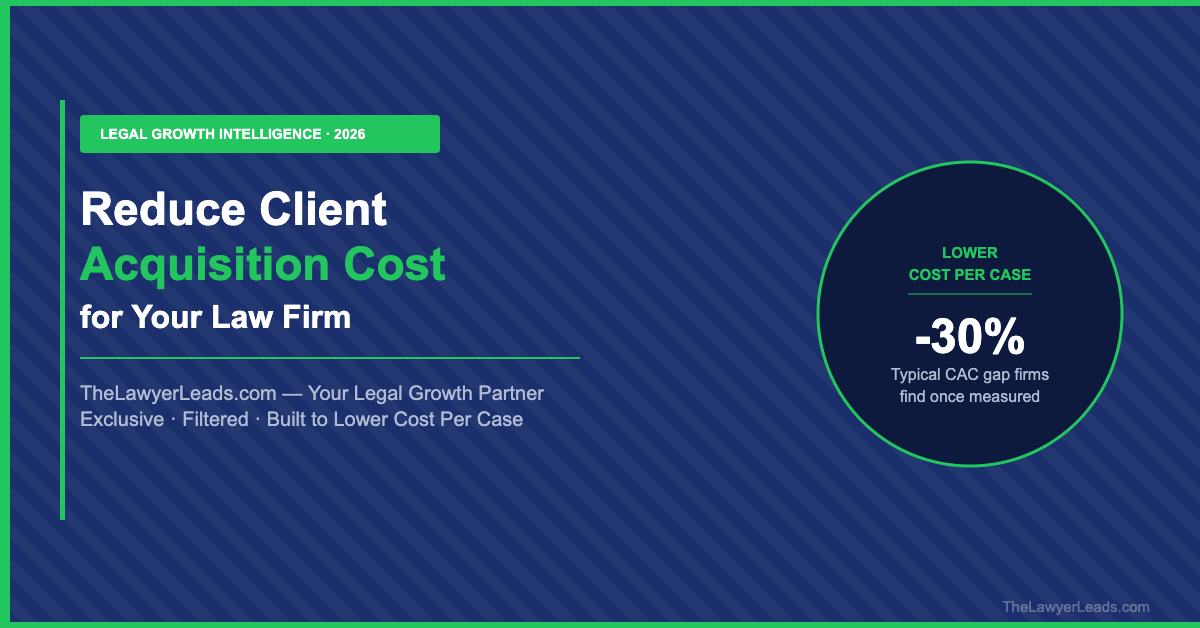
A more honest calculation adds intake labor, follow-up software, and the opportunity cost of staff time spent on leads that were never going to convert. Once firms include those hidden costs, true CAC is often 30-50% higher than the number in the marketing dashboard. That gap is exactly where growth-focused firms find room to cut — not by spending less, but by spending on inputs that convert.
Firms that track fully-loaded CAC — not just ad spend per client — typically find their real acquisition cost is 30-50% higher than what shows up in a marketing report.
Five Levers That Actually Lower CAC for Law Firms
Cutting client acquisition cost for law firms rarely comes from a single fix. It comes from tightening several parts of the pipeline at once. The firms that move the needle fastest tend to focus on the same five areas, in roughly this order of impact: lead quality and exclusivity, response time, intake scripting, follow-up cadence, and case-type filtering. Get the first two right and the rest becomes far easier to manage.
Lead quality is the biggest lever because it changes the denominator, not just the numerator. A firm buying shared, unfiltered leads is competing with three to five other firms for the same prospect — driving up both ad cost and staff hours spent on calls that end in “I already hired someone.” Exclusive, pre-filtered leads matched to practice area and jurisdiction remove that competition entirely, which is where a dedicated growth partner earns its keep.
Traditional Marketing vs. a Managed Growth Pipeline
| Metric | Traditional Approach | With TheLawyerLeads.com |
|---|---|---|
| Lead exclusivity | Shared with 3-5 firms | 100% exclusive to your firm |
| Filtering | Basic form fields only | Matched to practice area & jurisdiction |
| Intake staff hours per signed case | High — chasing dead-end calls | Lower — pre-qualified pipeline |
| Cost per signed case trend | Rises as ad costs climb | Stabilizes with predictable volume |
| Reporting | Ad platform dashboards only | Practice-area growth reporting |
Intake Speed: The Hidden CAC Multiplier
Response time is the fastest way to inflate or deflate CAC without changing a single dollar of ad spend. A prospect who fills out a form is typically comparing two to three firms simultaneously. Firms that call back within five minutes sign meaningfully more of those prospects than firms that call back within an hour — meaning the same lead costs less per signed case simply because it converts more often. Slow follow-up doesn’t just lose the case; it makes every lead in the pipeline more expensive.
Key Insight
Reducing average callback time from 60 minutes to under 5 minutes is often the single cheapest CAC improvement available to a firm — it requires a process change, not a bigger budget.
Building a 90-Day CAC Reduction Plan
Firms that make real progress on client acquisition cost treat it as a quarterly project, not a one-time audit. The first 30 days go toward measurement: calculating true, fully-loaded CAC by practice area and identifying where leads are shared versus exclusive. The next 30 focus on process — callback speed, intake scripting, and cutting sources that produce high volume but low conversion. The final 30 shift budget toward the channels and lead sources that proved cheapest per signed case, and lock in reporting so the whole cycle repeats every quarter instead of once a year.
Quick Summary
- Calculate true CAC — include intake labor and software, not just ad spend.
- Prioritize lead exclusivity — shared leads inflate cost by forcing you to compete for the same prospect.
- Fix response time first — it’s the cheapest lever and often the most impactful.
- Filter by practice area and jurisdiction — reduces wasted intake hours.
- Review CAC quarterly — treat it as an ongoing growth metric, not an annual audit.
Ready to Lower Your Cost Per Signed Case?
TheLawyerLeads.com builds exclusive, pre-filtered client pipelines by practice area — so every dollar goes toward prospects who are ready to hire.