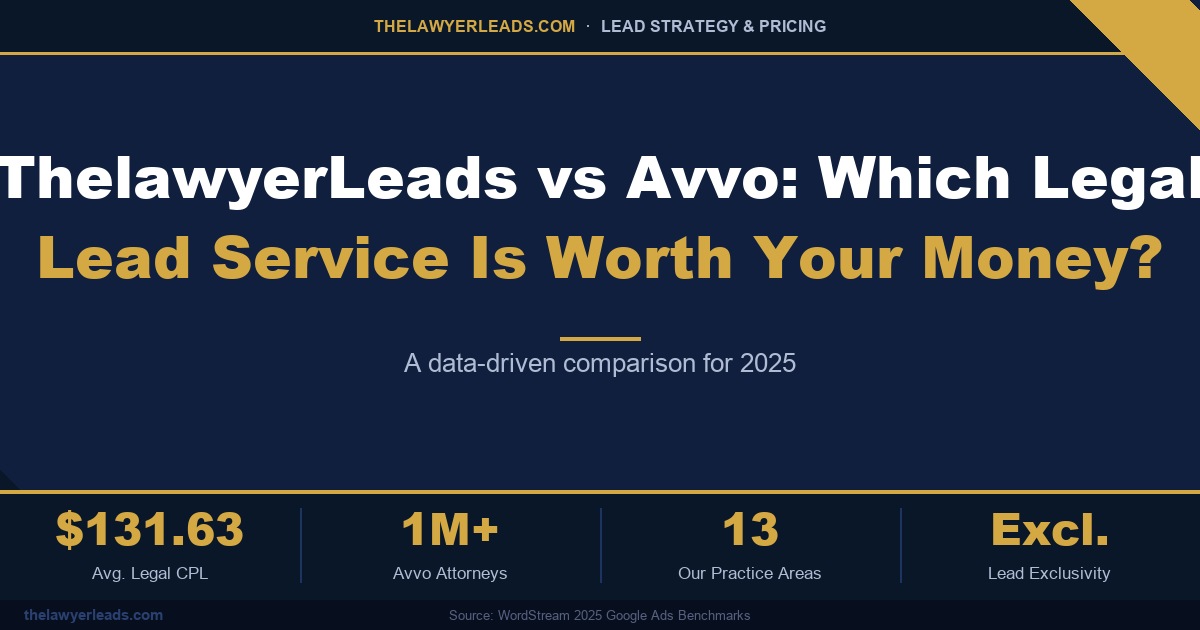
ThelawyerLeads vs Avvo: Which Legal Lead Service Is Worth Your Money?

ThelawyerLeads vs Avvo: Which Legal Lead Service Is Worth Your Money?

Avvo built its name on attorney directories and free Q&A — but a household brand isn’t the same thing as a source of cases you can actually close. If you’re weighing legal lead generation options in 2025, here’s an honest, numbers-first look at how Avvo stacks up against ThelawyerLeads.

Attorneys searching for legal lead generation almost always run into Avvo first — it’s one of the oldest and most recognizable names in the space. But recognition and results aren’t the same thing. Avvo was built primarily as a directory and reputation platform, with lead generation added on top. ThelawyerLeads was built from day one as a dedicated legal lead generation service, with targeting, exclusivity, and pricing structured specifically around what converts for attorneys.

Before you commit ad budget to either platform, it helps to understand exactly what you’re paying for, how leads are distributed, and what the real cost per case looks like once you factor in shared versus exclusive leads.


How Avvo’s Lead Model Actually Works

Avvo’s core business is the attorney directory and its “Avvo Rating” system, ranking over 1 million attorneys nationwide. Lead generation runs as a paid add-on layered onto that directory — attorneys pay to appear more prominently and to receive client contact requests. Because Avvo’s scale is built around volume and directory listings rather than granular targeting, leads are often distributed to multiple attorneys in the same practice area and region, and filtering options for location and case type are comparatively limited.

That scale can work in your favor if you want visibility across a huge attorney marketplace. But it also means your leads are competing in a crowded directory environment, and many of the same consumer inquiries get surfaced to several attorneys before anyone picks up the phone.

Avvo’s strength is brand recognition and directory volume. Its weakness for lead buyers is precision — you’re one of many attorneys competing for the same shared inquiries.

Where ThelawyerLeads Is Built Differently

ThelawyerLeads focuses on exclusivity and targeting rather than directory scale. Leads can be filtered down to the ZIP code and county level, so you’re only paying for inquiries that come from the areas you actually serve — not a state-wide or nationwide pool shared across dozens of listings. Coverage spans 13 practice areas, from personal injury and family law to bankruptcy and workers’ compensation, and pricing is transparent and state-specific with no long-term contracts locking you in.

The exclusivity model matters most here. When a lead is exclusive, you’re not racing three or four other attorneys to be the first callback — you’re the only one with that inquiry, which changes both your conversion rate and how you can structure your intake process.

Side-by-Side Comparison

Factor Avvo ThelawyerLeads
Core model Attorney directory + paid leads Dedicated lead generation
Lead exclusivity Often shared Exclusive options available
Geographic targeting State / metro level County & ZIP-code level
Practice areas covered Broad, directory-wide 13 focused practice areas
Contract terms Often tiered subscriptions No long-term contracts
Pricing transparency Varies by placement tier State-specific, published pricing

What This Means for Cost Per Case

The average cost per lead for legal services sits around $131.63 across the industry, according to WordStream’s 2025 Google Ads benchmarks. That number alone doesn’t tell you much — what matters is how many of those leads actually convert into signed clients. A shared lead split three or four ways effectively multiplies your real cost per case, even if the sticker price per lead looks similar.

This is the calculation attorneys frequently miss when comparing directory-based platforms like Avvo against dedicated lead generation services. A $130 exclusive lead that converts at a higher rate is often cheaper in practice than a $90 shared lead that three other firms are also calling.

▶ Key Insight

Directory platforms optimize for attorney visibility across a huge pool of listings. Dedicated lead services optimize for case acquisition per dollar spent. If your goal is signed clients rather than profile views, the second model is usually the better fit for your budget.

Questions to Ask Before You Commit Budget

  • Are leads exclusive to my firm, or shared with competitors in my area?
  • Can I filter by ZIP code or county, or only by state and metro?
  • Am I locked into a subscription tier, or can I adjust spend month to month?
  • Does the platform specialize in my practice area, or treat it as one of hundreds of categories?

Which One Fits Your Practice?

Avvo can still be worth maintaining as a directory presence — it’s free to claim a basic profile, and reviews there carry some SEO and credibility value. But as a primary lead generation strategy, its shared-lead structure and broad targeting make it harder to control cost per acquired case, especially for solo practitioners and small firms working with a defined budget and service area.

ThelawyerLeads is built for attorneys who want to know exactly what ZIP codes and counties their spend is targeting, want exclusivity so they’re not racing competitors to the same inquiry, and want the flexibility to adjust or pause without being locked into a contract.

ThelawyerLeads vs Avvo — Summary

  1. Avvo is a directory first, lead source second — its scale comes from 1M+ listed attorneys, not from precision targeting.
  2. Shared leads inflate real cost per case — the average $131.63 CPL means little if the same inquiry reaches multiple firms.
  3. ThelawyerLeads offers ZIP and county-level targeting — you only pay for leads in the areas you actually serve.
  4. Exclusivity options change the conversion math — being the only attorney contacted matters more than a lower sticker price.
  5. No long-term contracts — flexibility to scale spend up or down as your caseload changes.

If your firm has relied on directory platforms like Avvo without seeing the case volume you expected, it may be worth testing a dedicated, exclusivity-focused lead source alongside it and comparing real conversion numbers over a full quarter.

See Lead Pricing for Your State

We offer transparent, state-specific lead pricing across all major practice areas — with no contracts, no recycled contacts, and full exclusivity options.
View Lead Pricing →

8 Red Flags When Buying Legal Leads (And What to Ask Before You Sign)

8 Red Flags When Buying Legal Leads (And What to Ask Before You Sign)

A managing partner at a mid-size PI firm signs a six-month contract with a new lead provider after a slick sales call. Three weeks in, half the “exclusive” leads are already represented by other firms, the case types don’t match the practice’s intake criteria, and there’s no way to pause the flow. The contract runs another five months.

This scenario repeats itself constantly in the legal industry, and it is almost always avoidable. Knowing the red flags when buying legal leads before you sign anything is the difference between a pipeline that compounds your growth and one that quietly drains your marketing budget. Below are the eight warning signs every firm should check for, and the questions that separate a real growth partner from a volume reseller.


Why Red Flags When Buying Legal Leads Get Missed

Most attorneys evaluate a lead provider the same way they evaluate a vendor: price per lead, sample volume, maybe a demo. But the metrics that actually predict ROI — exclusivity enforcement, filtering logic, source verification, and contract flexibility — rarely show up in a sales pitch. They only surface after intake staff start working the leads, which is usually 30 to 60 days into a signed agreement.

By then, the firm has already paid for a batch of underperforming leads and is locked into renewal terms. A short intake checklist run before signing catches almost all of the problems firms discover later the hard way.

Firms that vet a lead provider against a written checklist before signing report significantly fewer disputed-lead credits and lower effective cost per retained client over a 12-month contract.

The Eight Red Flags to Check Before You Sign

1. “Exclusive” isn’t defined in writing

If exclusivity isn’t spelled out as a contractual term — including how many firms can receive the same contact and what happens if it’s violated — assume it isn’t enforced. Ask for the exact clause, not a verbal assurance.

2. No filtering by practice area or case criteria

A provider that can’t filter by injury type, case value threshold, geography, or statute of limitations is selling volume, not fit. Every lead that doesn’t match your intake criteria is a wasted follow-up call.

3. Vague answers about lead source

Quality providers can tell you exactly where a lead originated — paid search, a specific landing page, referral network — and show you the consent language the prospect agreed to. “Multiple channels” as an answer should raise concern about TCPA compliance and lead quality alike.

4. No credit or replacement policy for bad leads

Disconnected numbers, duplicate submissions, and out-of-criteria leads happen even with good providers. What matters is whether there’s a documented, no-argument process for crediting them. If that policy isn’t in writing, it doesn’t exist when you need it.

5. Long lock-in with no volume flexibility

Case load fluctuates. A provider that requires a fixed monthly volume regardless of your intake capacity is optimizing for their revenue, not your growth. Look for month-to-month terms or clear off-ramps.

6. Delivery speed isn’t guaranteed

Contact-to-close rates fall sharply after the first hour, and drop further after 24 hours. If a provider can’t commit to real-time delivery — phone, email, and CRM push simultaneously — assume some leads are going stale before your intake team ever sees them.

7. No visibility into pricing logic

Cost per lead should track with case value and competitiveness of the practice area. A flat rate across every practice area, regardless of complexity, usually signals a reseller marking up leads bought elsewhere.

8. References aren’t offered or verifiable

A provider confident in their client results will connect you with current firms in a non-competing market. Reluctance here, or references that can’t be independently verified, is one of the clearest signals to walk away.

How the Two Models Actually Compare

Metric Shared / Volume Lead Sellers With TheLawyerLeads.com
Exclusivity Often resold to 3-5 firms Contractually 100% exclusive
Filtering Basic geography only Practice area, case value, criteria
Delivery speed Batched, delayed Real-time, multi-channel push
Bad-lead credits Case-by-case negotiation Documented, standard policy
Contract terms Fixed volume, long lock-in Flexible to your intake capacity

Key Insight

The cheapest lead is rarely the cheapest client. A $40 shared lead that converts at 2% costs more per signed case than a $120 exclusive, filtered lead that converts at 12%. Evaluate providers on cost per retained client, not cost per lead.

Questions to Ask Before You Sign

Bring these into any sales conversation: How is exclusivity enforced, and what happens if it’s violated? What filtering criteria are available, and can they be adjusted mid-contract? What’s the average time from lead capture to delivery? What’s the credit policy for disqualified leads, in writing? Can volume flex up or down with case load? A provider that answers all five clearly and without hedging has likely built real infrastructure — not just a resale operation.

Before You Sign: The Checklist

  1. Get exclusivity in writing — not a verbal promise.
  2. Confirm filtering criteria match your actual intake standards.
  3. Verify the lead source and consent language directly.
  4. Confirm a documented credit policy for disqualified leads.
  5. Check contract flexibility before committing to fixed volume.
  6. Request verifiable references from non-competing firms.

Build Your Pipeline With a Partner, Not a Reseller

See exactly how exclusivity, filtering, and delivery work before you commit a single dollar.

Browse Practice Areas

How to Verify Legal Lead Exclusivity Before You Buy (And Why Most Firms Get It Wrong)

How to Verify Legal Lead Exclusivity Before You Buy (And Why Most Firms Get It Wrong)

A managing partner at a mid-size personal injury firm signed a contract for “100% exclusive” leads at $85 each — only to find, three days later, that two competing firms had called the same claimant within the hour. The word “exclusive” was in the contract. It just wasn’t true.

This happens more often than most attorneys realize. As firms compete harder for client acquisition in 2026, the term exclusive lead has become one of the most misused phrases in legal marketing. Before you commit budget to any provider, you need a way to verify legal lead exclusivity — not just take a sales rep’s word for it. This guide walks through what verified exclusivity actually looks like, the contract language that should raise a flag, and the questions that separate a real growth partner from a reseller wearing an exclusivity label.


Why “Exclusive” Is the Most Misused Word in Legal Lead Buying

Most lead vendors know that “exclusive” sells better than “shared,” so the word gets attached loosely. In practice, a lead can be labeled exclusive if it was sold to only one firm at the moment of sale — while the same consumer’s information sits in a database that gets resold, aged, and recirculated to a second or third buyer within days. Technically the vendor didn’t lie. Practically, your firm is competing for the same client anyway.

The result is a client acquisition strategy built on a false premise: you’re pricing your cost-per-case as if you have a monopoly on the conversation, when in reality you might be the second or third call the prospect receives. That gap shows up later as inflated cost-per-acquisition, lower answer rates, and frustrated intake staff who can’t figure out why conversion is dropping.

The Contract Language That Should Raise a Flag

Read the fine print before you sign. Phrases like “exclusive at time of delivery,” “limited distribution,” or “quality-controlled exclusivity” are often signals that the provider is protecting itself, not your pipeline. A genuine growth partner will put the actual mechanics in writing: how many buyers per lead (it should say one), how the lead is filtered to your criteria, and how fast it reaches you after the consumer submits their information.

Metric Reseller / Shared Model Verified Exclusive (TheLawyerLeads.com)
Buyers per lead 3–8 firms, often undisclosed 1 firm, contractually guaranteed
Delivery window Batched, sometimes hours or days later Real-time, typically under 60 seconds
Prior contact before you call Unknown, unverifiable Zero — you are the first call
Practice-area filtering Generic intake form, loosely matched Filtered to your case criteria and geography
Source documentation Not disclosed on request Fully documented, available on request

Firms that verify delivery timestamps and lead source before buying report meaningfully higher contact and retention rates — largely because they’re the first call a prospect receives, not the third or fourth.


Four Questions to Ask Before You Buy Legal Leads

You don’t need a legal background to vet a lead provider — you need the right questions and a willingness to walk away from vague answers. Before signing with any vendor, ask directly:

1. Can you show me the delivery timestamp? A provider running real-time exclusive delivery can show you, to the second, when a lead reached your firm relative to when the consumer submitted their information. If they can’t produce this, treat the exclusivity claim as unverified.

2. How many firms received this same consumer’s information? The answer should be one — your firm. Ask them to state it in writing, not just verbally on a sales call.

3. What criteria filter leads to my practice area? A quality growth partner filters by case type, geography, injury severity, or matter specifics before the lead ever reaches you — not after you’ve already paid for it.

4. Can I see a sample lead record? Reputable providers will show you an anonymized example of the data fields, source, and timestamp format before you commit budget.

Building a Verification Habit Into Your Intake Process

Key Insight

The fastest way to expose a reseller is to ask for delivery timestamps down to the second. A genuine exclusive-lead partner can produce this instantly. A reseller will stall, deflect, or offer a vague “within minutes” answer.

Verification shouldn’t be a one-time exercise you do before signing a contract — it should be a habit built into your intake workflow. Track first-contact time on every lead you buy. Compare close rates by source monthly, not annually. If a vendor’s leads consistently convert below your other channels, that’s a data point worth investigating, not ignoring. A growth partner worth keeping will welcome this scrutiny; a reseller will resist it.

This is also where practice-area specificity matters. A personal injury firm and an immigration firm need entirely different filtering logic, geographic radius, and qualification criteria. Providers who apply the same generic intake form across every practice area are optimizing for volume, not for your firm’s actual pipeline.

Before You Buy: A Quick Checklist

  1. Get delivery timestamps in writing — real-time delivery should be measurable in seconds, not hours.
  2. Confirm buyer count per lead — one firm, contractually stated, not implied.
  3. Ask for practice-area filtering details — generic intake forms produce generic results.
  4. Request a sample record — data fields and source transparency should be available before you pay.
  5. Track contact time internally — make verification an ongoing habit, not a one-time check.

Work With Leads You Can Actually Verify

TheLawyerLeads.com delivers real-time, single-buyer leads filtered to your practice area — with the documentation to prove it.

Browse Practice Areas

How to Reduce Client Acquisition Cost for Law Firms in 2026

How to Reduce Client Acquisition Cost for Law Firms in 2026

A personal injury firm in Dallas doubled its Google Ads budget going into 2026, expecting signed cases to double with it. Instead, cost per signed case crept up 18% and two intake staff quit from burnout chasing unqualified calls. The spend wasn’t the problem. The system around it was.

Every managing partner watches marketing spend. Far fewer watch client acquisition cost for law firms — the actual dollars it takes to turn a stranger into a signed client, all-in. Ad spend, staff hours, software, follow-up calls, the works. When firms only track spend and case count, they miss the leaks that quietly inflate CAC: slow callbacks, unfiltered leads, and intake processes built for a smaller, slower practice.

This matters more in 2026 than it did two years ago. Cost-per-click on legal keywords keeps climbing in nearly every practice area, and firms that don’t actively manage CAC are effectively paying more each quarter for the same pipeline. The firms pulling ahead aren’t spending more — they’re spending smarter, and they’re treating client acquisition cost as a metric to manage weekly, not review once a year.


What Client Acquisition Cost Really Measures

Most firms calculate CAC as “marketing spend divided by new clients.” That formula hides more than it reveals. A firm that spends $40,000 a month and signs 20 clients looks identical, on paper, to a firm that spends $40,000 and signs 20 clients after burning through 400 unqualified leads and three exhausted intake staff. Same CAC number. Completely different business.

The Formula Firms Skip

A more honest calculation adds intake labor, follow-up software, and the opportunity cost of staff time spent on leads that were never going to convert. Once firms include those hidden costs, true CAC is often 30-50% higher than the number in the marketing dashboard. That gap is exactly where growth-focused firms find room to cut — not by spending less, but by spending on inputs that convert.

Firms that track fully-loaded CAC — not just ad spend per client — typically find their real acquisition cost is 30-50% higher than what shows up in a marketing report.

Five Levers That Actually Lower CAC for Law Firms

Cutting client acquisition cost for law firms rarely comes from a single fix. It comes from tightening several parts of the pipeline at once. The firms that move the needle fastest tend to focus on the same five areas, in roughly this order of impact: lead quality and exclusivity, response time, intake scripting, follow-up cadence, and case-type filtering. Get the first two right and the rest becomes far easier to manage.

Lead quality is the biggest lever because it changes the denominator, not just the numerator. A firm buying shared, unfiltered leads is competing with three to five other firms for the same prospect — driving up both ad cost and staff hours spent on calls that end in “I already hired someone.” Exclusive, pre-filtered leads matched to practice area and jurisdiction remove that competition entirely, which is where a dedicated growth partner earns its keep.

Traditional Marketing vs. a Managed Growth Pipeline

Metric Traditional Approach With TheLawyerLeads.com
Lead exclusivity Shared with 3-5 firms 100% exclusive to your firm
Filtering Basic form fields only Matched to practice area & jurisdiction
Intake staff hours per signed case High — chasing dead-end calls Lower — pre-qualified pipeline
Cost per signed case trend Rises as ad costs climb Stabilizes with predictable volume
Reporting Ad platform dashboards only Practice-area growth reporting

Intake Speed: The Hidden CAC Multiplier

Response time is the fastest way to inflate or deflate CAC without changing a single dollar of ad spend. A prospect who fills out a form is typically comparing two to three firms simultaneously. Firms that call back within five minutes sign meaningfully more of those prospects than firms that call back within an hour — meaning the same lead costs less per signed case simply because it converts more often. Slow follow-up doesn’t just lose the case; it makes every lead in the pipeline more expensive.

Key Insight

Reducing average callback time from 60 minutes to under 5 minutes is often the single cheapest CAC improvement available to a firm — it requires a process change, not a bigger budget.

Building a 90-Day CAC Reduction Plan

Firms that make real progress on client acquisition cost treat it as a quarterly project, not a one-time audit. The first 30 days go toward measurement: calculating true, fully-loaded CAC by practice area and identifying where leads are shared versus exclusive. The next 30 focus on process — callback speed, intake scripting, and cutting sources that produce high volume but low conversion. The final 30 shift budget toward the channels and lead sources that proved cheapest per signed case, and lock in reporting so the whole cycle repeats every quarter instead of once a year.

Quick Summary

  1. Calculate true CAC — include intake labor and software, not just ad spend.
  2. Prioritize lead exclusivity — shared leads inflate cost by forcing you to compete for the same prospect.
  3. Fix response time first — it’s the cheapest lever and often the most impactful.
  4. Filter by practice area and jurisdiction — reduces wasted intake hours.
  5. Review CAC quarterly — treat it as an ongoing growth metric, not an annual audit.

Ready to Lower Your Cost Per Signed Case?

TheLawyerLeads.com builds exclusive, pre-filtered client pipelines by practice area — so every dollar goes toward prospects who are ready to hire.

Browse Practice Areas

Lead Response Time: The Law Firm Growth Metric Most Firms Still Ignore

Lead Response Time: The Law Firm Growth Metric Most Firms Still Ignore

A managing partner at a mid-size personal injury firm once told us his intake team called back new inquiries “within a day, usually.” His conversion rate was 11%. After we measured his actual average lead response time at 14 hours, the number stopped being a mystery — and became the first thing his firm fixed.

Every law firm owner obsesses over where leads come from — Google Ads, SEO, referrals, a growth partner like TheLawyerLeads.com. Far fewer obsess over what happens in the first sixty minutes after a prospective client raises their hand. That gap is where firms quietly lose the majority of the cases they already paid to acquire. Lead response time is not a soft metric. It is one of the highest-leverage numbers in your entire client acquisition system, and most firms have never measured it.


Why Lead Response Time Decides Growth More Than Ad Spend

A prospective client who fills out a form or calls after an accident, an arrest, or a denied claim is rarely calling only your firm. Research on inbound sales response across professional services consistently shows the odds of making meaningful contact with a lead fall off a cliff after the first five minutes, and drop further with every additional hour. In legal intake specifically, the pattern is sharper: injury, immigration, and family law leads are almost always in an emotionally urgent moment, and they are almost always shopping two or three firms simultaneously.

This means your law firm lead response time functions as a multiplier on every dollar you already spend on marketing. A firm that cuts response time from four hours to four minutes does not need a bigger budget — it needs a faster intake process wrapped around the budget it already has.

Firms that respond to a new inquiry within 5 minutes are dramatically more likely to convert that inquiry into a signed client than firms that respond within an hour or later — the exact multiple varies by practice area, but the direction never reverses.

What Slows Intake Down (And It’s Rarely Staffing)

When we work with firms on pipeline building, the bottleneck is almost never a lack of people. It is almost always process: leads sitting in a shared inbox nobody owns, intake staff who only work daytime hours while inquiries arrive at 9pm, no defined handoff between marketing and intake, or a CRM that notifies the whole team instead of one accountable person. Each of these adds minutes or hours before anyone even sees the inquiry, long before a phone is dialed.

The Four Most Common Intake Delays

Firms auditing their own client acquisition process typically find delay in one of four places: after-hours coverage gaps, unclear lead ownership, manual data entry before a callback can happen, and no automated first-touch (a text or email confirming receipt) while a human callback is queued.


Building an Intake Process That Actually Wins the Client

Improving lead response time is a systems problem, not a motivation problem. The firms that consistently convert at a higher rate share a small set of habits: they assign a single owner to every inquiry within seconds of arrival, they staff intake coverage to match when their leads actually arrive (often evenings and weekends for PI and criminal defense), they automate an immediate acknowledgment so the prospect knows they’ve been heard while a callback is arranged, and they track response time as a KPI reviewed weekly — not an afterthought.

Intake Factor Traditional Approach Growth-Focused Approach
Lead ownership Shared inbox, no single owner One named owner assigned instantly
Coverage hours 9am–5pm weekdays only Matched to actual inquiry patterns, incl. evenings
First touch Manual callback only, hours later Automated acknowledgment in under 60 seconds
Lead source quality Shared or resold leads, multiple firms calling Exclusive leads, no competing callback race
Performance tracking Reviewed occasionally, if at all Response time reviewed weekly as a core KPI

Why Exclusivity Changes the Math

Response time discipline matters even more when a lead is being shared across multiple firms. A shared or resold lead effectively starts a countdown the moment it lands in several inboxes at once — the firm that calls first often wins the client regardless of who has the stronger case or better fee structure. This is one of the clearest arguments for building a client acquisition pipeline around exclusive inquiries rather than shared ones: it removes the race entirely and lets your intake quality, not your speed alone, decide the outcome.

Key Insight

A faster intake process compounds the value of every dollar already spent on marketing. Before increasing ad spend, audit response time first — it is almost always the cheaper fix with the bigger return.

Measuring What Matters This Quarter

Start simple: pull the timestamp of the last 50 inquiries and the timestamp of first outbound contact. Calculate the average and the median — the median usually tells the real story, since a handful of very fast responses can hide a long tail of slow ones. Set a target (five minutes during business hours is a reasonable first benchmark for most practice areas), assign clear ownership, and review the number every Monday alongside your other growth metrics.

Growth Checklist: Fixing Lead Response Time

  1. Measure your baseline — pull real timestamps for the last 50 inquiries, not estimates.
  2. Assign single ownership — every inquiry gets one named owner within seconds of arrival.
  3. Match staffing to demand — cover the evenings and weekends when your leads actually arrive.
  4. Automate the first touch — an instant acknowledgment buys time for a quality human callback.
  5. Favor exclusive pipelines — remove the multi-firm callback race wherever possible.
  6. Review weekly — treat response time as a standing KPI, not a one-time audit.

Build a Pipeline That Rewards a Fast Firm

Exclusive, real-time client inquiries filtered to your practice area — no shared leads, no callback race.

Browse Practice Areas

Law Firm Website Conversion Rate Optimization: Turn Clicks into Clients in 2025

Law Firm Website Conversion Rate Optimization: Turn Clicks into Clients in 2025

A family law attorney in Phoenix was spending $4,200 a month on Google Ads. Her traffic was solid — 1,800 monthly visitors. But only 11 people booked a consultation. That’s a conversion rate of 0.6%. After a structured law firm website conversion rate optimization audit, the same traffic produced 47 consultations the following month. Nothing changed about her ad spend. Everything changed about her website.

For US law firm owners, the instinct is to spend more on traffic — more ads, more SEO content, more backlinks. But if your website isn’t converting the visitors you already have, every dollar of new traffic spend is partially wasted. Law firm website conversion rate optimization (CRO) is the discipline of fixing that leak before you pour more water in.

This guide covers the highest-leverage CRO moves for law firm websites in 2025 — the ones that consistently move the needle for practices in personal injury, immigration, family law, criminal defense, and estate planning.


Why Most Law Firm Websites Convert Poorly

The legal industry has a structural CRO problem. Most law firm websites are designed by agencies that prioritize aesthetics over psychology. They look credible, but they don’t persuade. A prospective client landing on your site after a stressful injury, divorce filing, or immigration notice is not browsing — they are searching for a reason to trust someone fast.

The average law firm website converts at 1–2% of organic traffic and as low as 3–4% of paid traffic — well below what’s achievable. Firms that have invested in structured conversion optimization regularly hit 8–12% consultation rates from paid traffic. That’s 2–3x more clients from the same ad budget.

According to research by the National Law Review, 74% of potential legal clients visit a law firm website before making contact — but fewer than 1 in 10 actually reach out. The gap is not a traffic problem. It’s a conversion problem.


The 5 Highest-Impact Law Firm Website CRO Fixes

1. Above-the-Fold Clarity

Your homepage hero section has roughly 3–5 seconds to answer three questions a prospective client is silently asking: Do you handle my type of case? Are you near me? Can I contact you right now? Most law firm hero sections answer zero of these — they lead with a firm name, a stock photo of a courthouse, and a tagline like “Experienced. Dedicated. Results.”

The fix: replace vague taglines with specific, benefit-driven headlines. “Texas Truck Accident Attorney — Free Case Review, Available 24/7” outperforms “Fighting for Justice” every time. Add your city/region in the H1, your primary practice area, and a single prominent CTA button above the fold.

2. Friction-Free Contact Pathways

Every additional field on a contact form reduces submissions by approximately 10–15%. A six-field intake form asking for case details, incident date, opposing party, and preferred contact time is appropriate for post-qualification — it is not appropriate for first contact. Your initial form should ask for name, phone, and one sentence about their situation. That’s it.

Additionally, make your phone number click-to-call on mobile (where over 65% of legal searches now occur), add a persistent sticky CTA bar on scroll, and consider a floating chat widget — even a simple “Tell us about your case” prompt with a text field can double mobile conversions.

3. Trust Signals in the Right Places

Trust signals work — but placement matters enormously. A Google review badge buried in the footer is largely invisible. The same badge placed directly next to your primary CTA button increases click-through rates by up to 34% in A/B tests across legal landing pages. Place trust elements — bar admissions, case results, client testimonials, media mentions, years of experience — immediately before and after your call-to-action, not in sidebars or footers.

Key Insight

Video testimonials convert at 2–3x the rate of text testimonials. Even a 45-second phone-recorded clip of a real client describing how your firm helped them is more persuasive than a paragraph of pulled quotes. Low production value doesn’t hurt — authenticity does more work than polish in the legal space.

4. Practice Area Page Optimization

Most law firm traffic arrives on practice area pages, not the homepage — yet most firms invest 80% of their design effort on the homepage. Each practice area page should function as a standalone conversion unit: its own headline targeting a specific keyword, its own trust signals relevant to that case type, and its own CTA tailored to the emotional state of someone facing that legal issue.

A bankruptcy page should open by acknowledging financial stress and the fear of judgment — then immediately position a free consultation as a safe, confidential next step. A criminal defense page should emphasize speed, discretion, and the importance of acting before arraignment. Context-aware copy converts; generic copy does not.

5. Page Speed and Mobile Experience

Google’s Core Web Vitals data confirms what CRO practitioners have known for years: a 1-second delay in page load time reduces conversions by 7%. Legal websites frequently carry bloated plugins, uncompressed images, and render-blocking scripts inherited from DIY WordPress builds. Run your site through Google PageSpeed Insights and treat a mobile score below 70 as an emergency — not a nice-to-fix.


Law Firm Website Conversion Rate Optimization: By the Numbers

Metric Typical Law Firm (No CRO) After Structured CRO
Paid Traffic Conversion Rate 2–4% 8–12%
Contact Form Completion 18–25% 45–60%
Mobile Bounce Rate 65–75% 38–48%
Cost Per Acquired Client $800–$1,400 $280–$550
Monthly Consultations (1,500 visits) 9–18 36–72

Pairing CRO with a Stronger Client Pipeline

Website CRO and incoming client pipeline work in tandem. A highly optimized website maximizes the return on every lead source you use — paid search, SEO, referrals, and exclusive legal leads. Firms that pair strong conversion infrastructure with high-quality, pre-screened leads typically see the lowest cost-per-client of any client acquisition channel available.

When your intake page is properly optimized — fast, mobile-first, with clear CTAs and contextual trust signals — the close rate on exclusive legal leads rises significantly because prospective clients arrive already partially qualified and your website reinforces the decision to reach out rather than undermining it.

Key Insight

The attorneys who grow fastest in competitive markets aren’t just the ones with the biggest ad budgets — they’re the ones who convert more of what they already have, then scale intelligently. CRO is the multiplier that makes every other growth investment perform better.


Law Firm Website CRO — Action Checklist

  1. Audit your above-the-fold section — does it immediately state your practice area, location, and a single clear CTA?
  2. Simplify your first-contact form — strip it to name, phone, and one open field. Move detailed intake to after the first call.
  3. Reposition trust signals — move reviews, case results, and certifications to appear directly adjacent to your CTA buttons.
  4. Rewrite each practice area page as a standalone conversion unit with context-specific copy and its own tailored CTA.
  5. Fix mobile page speed — target a Google PageSpeed mobile score above 80 and eliminate render-blocking scripts.
  6. Add a video testimonial — one 45-second authentic clip from a real client will outperform a page of written testimonials.

Build a Client Pipeline That Compounds

Once your website is optimized to convert, pairing it with exclusive, practice-area-specific legal leads gives you a pipeline that keeps filling — without depending entirely on Google’s next algorithm update.

Browse Practice Areas

Local SEO Checklist for Law Firms 2026: Rank Higher on Google Maps

Local SEO Checklist for Law Firms 2026: Rank Higher on Google Maps

A personal injury firm in Phoenix had a polished website, solid reviews, and years of experience — yet a competitor with half the credentials was landing three times the inbound calls. The difference? Local SEO. That competitor owned Google Maps for ‘personal injury attorney Phoenix.’ The first firm was invisible where it mattered most.

For US law firms, local SEO for law firms in 2026 is no longer optional — it is the single highest-ROI channel available to most practices. Google’s local pack (the map results that appear above organic listings) now captures over 40% of clicks for legal searches, according to BrightLocal’s 2025 Local Search Report. If your firm isn’t optimised for local search, you’re ceding those clicks — and those clients — to competitors every single day.

This checklist gives you a concrete, step-by-step framework to improve your local search visibility, attract higher-intent prospects, and build a durable client pipeline that doesn’t depend entirely on paid advertising.


1. Claim and Optimise Your Google Business Profile

Your Google Business Profile (GBP) is the foundation of local SEO for law firms in 2026. It determines whether you appear in the map pack, what information prospective clients see, and how much trust Google places in your listing.

  • Verify ownership — If you haven’t verified your listing, do it now via postcard, phone, or video verification.
  • Choose the right primary category — Use the most specific legal category available (e.g., “Personal Injury Attorney” not just “Lawyer”). This single field has an outsized impact on which searches you appear for.
  • Write a keyword-rich business description — Include your practice areas, city/region, and a clear value proposition. Keep it under 750 characters.
  • Add all relevant service areas — List every city and county your firm serves, not just your office location.
  • Upload 20+ high-quality photos — Include office exterior, interior, team headshots, and any awards or accolades. Profiles with photos receive 42% more direction requests.
  • Post weekly updates — GBP posts signal activity to Google and give prospects fresh content to engage with.

Data point: Law firms with complete Google Business Profiles (all fields filled, regular posts, 20+ photos) rank in the local map pack for 2.7x more keywords than firms with incomplete profiles. (Source: Whitespark Local Ranking Factors Survey 2025)


2. Build and Maintain NAP Consistency Across Citations

NAP stands for Name, Address, Phone number. Google cross-references your firm’s NAP data across dozens of directories — Avvo, Justia, FindLaw, Yelp, Bing Places, Apple Maps, and more. Inconsistent information (different phone numbers, abbreviations like “St.” vs “Street”) sends mixed signals and suppresses your rankings.

  • Audit your current citations using a tool like BrightLocal or Moz Local — identify inconsistencies and duplicates.
  • Ensure your GBP, website footer, and all legal directories use exactly the same business name format.
  • Claim and update listings on the top five legal directories: Avvo, Justia, FindLaw, Lawyers.com, and Super Lawyers.
  • Add your firm to general directories: Yelp, Apple Maps, Bing Places, Chamber of Commerce, BBB.
Citation Source Domain Authority Impact on Local Rankings
Google Business Profile 100 Critical (primary signal)
Avvo 86 Very High
Justia 82 High
FindLaw 80 High
Yelp 70 Moderate
Local Chamber of Commerce Varies Moderate (boosts local trust)

3. Earn and Actively Manage Google Reviews

Reviews are the third pillar of local SEO for law firms 2026 — and the one most firms neglect. Google’s algorithm weights review quantity, recency, and sentiment heavily in map pack rankings. A firm with 80 four-star reviews will almost always outrank a competitor with 15 five-star reviews, all else being equal.

Building a Review Acquisition System

  • Identify the right moment — Ask for a review at case resolution, when the client expresses satisfaction, not at intake.
  • Send a direct link — Create a short URL that goes straight to your GBP review form. Tools like GatherUp or Birdeye automate this.
  • Follow up once — A single reminder email 48 hours after the initial request increases completion rates by 30%.
  • Respond to every review — Publicly responding to reviews (positive and negative) signals engagement to Google and builds trust with prospective clients.

Key Insight

Law firms that respond to 100% of their Google reviews rank 1.4 positions higher in the local map pack on average than firms that don’t respond. Responses also extend the SEO value of each review — Google indexes the content of both the review and your reply.


4. Optimise Your Website for Local Search Signals

Your website supports your GBP ranking — Google uses it to verify and reinforce what it finds in your profile. The following on-site elements have the highest impact on local SEO rankings for law firms:

  • LocalBusiness schema markup — Add structured data (JSON-LD) to your homepage and contact page. Include name, address, phone, practice areas, and opening hours. Schema helps Google understand your entity without guessing.
  • Location-specific service pages — If you serve multiple cities, create a dedicated page for each location (e.g., “/personal-injury-attorney-scottsdale/”). Thin, duplicate pages hurt — each page needs 500+ words of unique content.
  • Embed Google Maps on your contact page — This creates an explicit link between your website and your GBP listing, strengthening both.
  • Core Web Vitals — Page speed (LCP under 2.5s), interactivity (INP under 200ms), and layout stability (CLS under 0.1) are Google ranking factors. Use PageSpeed Insights to audit and fix issues.
  • Mobile-first design — Over 70% of legal searches happen on mobile. A site that loads slowly or renders poorly on phones will lose rankings and conversions.
Local SEO Factor Without Optimisation With Full Optimisation
Map Pack Position Outside top 10 Positions 1-3
Monthly Inbound Calls 3-5 15-30+
Cost Per Acquired Client $800-$2,000 (paid ads) $150-$400 (organic)
Lead Quality Score Mixed intent High intent (location-specific)

5. Accelerate Growth with a Dual-Channel Strategy

Local SEO builds a durable, compounding asset — but it takes 3-6 months to see significant map pack movement. Savvy law firm operators don’t wait. They combine an SEO foundation with a parallel client acquisition channel to generate cases in the short term while organic rankings mature.

The most effective complement to local SEO is a curated pipeline of exclusive, pre-screened leads matched to your specific practice area and geography. Unlike shared leads that get sold to five firms simultaneously, exclusive leads arrive in real time and have not been contacted by any other attorney — your intake team is the first call they make.

Key Insight

Firms that combine a strong local SEO presence with a structured exclusive-leads pipeline typically see 40-60% lower cost per signed client compared to firms relying solely on Google Ads. The SEO channel handles high-intent organic traffic; the pipeline channel fills intake gaps and supports growth targets month over month.


Your Local SEO Action Checklist for 2026

  1. Claim and fully complete your Google Business Profile — Choose the right category, add photos, and post weekly updates.
  2. Audit and fix NAP consistency — Every directory must match your GBP exactly. Start with Avvo, Justia, and FindLaw.
  3. Build a review acquisition system — Ask at the right moment, send a direct link, follow up once, and respond to every review.
  4. Optimise your website for local signals — Add LocalBusiness schema, create location-specific service pages, embed Google Maps, and pass Core Web Vitals.
  5. Complement SEO with a parallel client acquisition channel — Use exclusive leads to generate cases while your organic rankings build momentum.

Ready to Build a Predictable Client Pipeline?

While your local SEO compounds, TheLawyerLeads.com delivers exclusive, real-time leads filtered to your practice area and market — so your intake team is always working live opportunities.

Browse Practice Areas

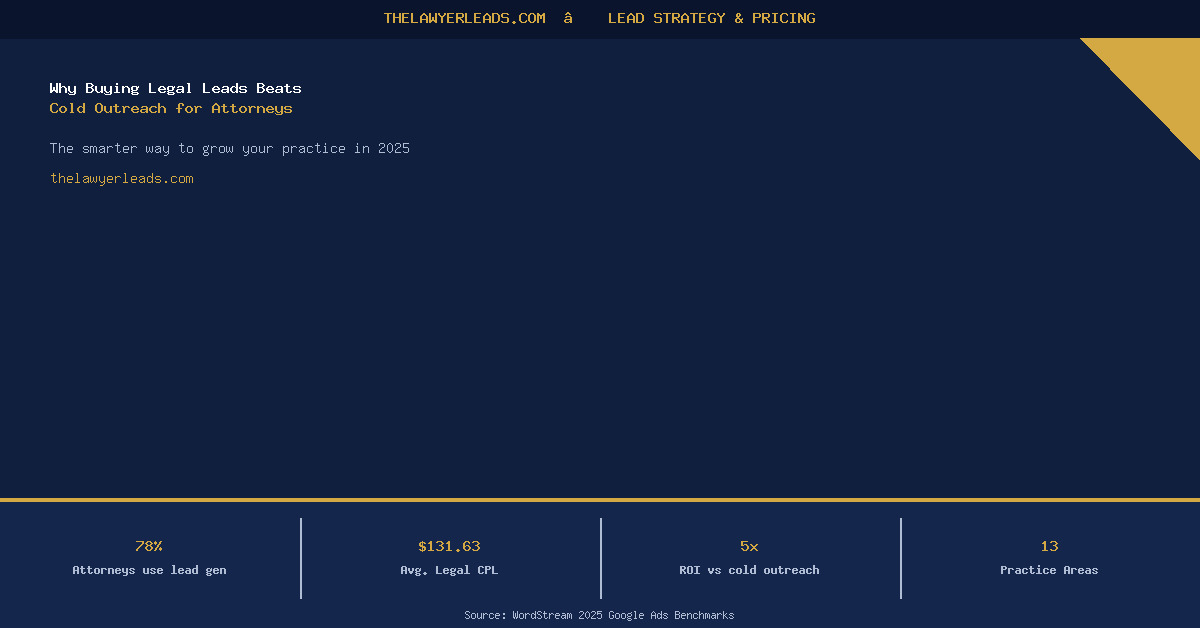
Why Buying Legal Leads Beats Cold Outreach for Attorneys

Why Buying Legal Leads Beats Cold Outreach for Attorneys

Buying legal leads has become the growth strategy of choice for US attorneys who want more clients without the grind of cold outreach — and the numbers explain exactly why.

If you’ve spent hours crafting cold emails, calling bar-association directories, or waiting for referrals that never come, you already know the problem: traditional outreach is slow, unpredictable, and expensive in both time and money. In 2025, 78% of US attorneys now use some form of lead generation rather than relying solely on word of mouth or cold contact. This guide breaks down why buying legal leads from a targeted provider — like ThelawyerLeads.com — beats cold outreach on every meaningful metric.


The Real Cost of Cold Outreach for Attorneys

Cold outreach sounds free — but it is not. Every hour you spend prospecting is an hour you are not billing. When you factor in staff time, email-tool subscriptions, bar-compliance research, and the opportunity cost of low response rates, cold outreach quickly exceeds what a quality lead would have cost.

Consider the math: the average attorney hourly rate in the US sits above $300. If you spend just 10 hours a month on cold outreach — drafting, following up, tracking responses — that is $3,000 in opportunity cost, often for fewer than 3 to 5 qualified conversations. Buying legal leads inverts that equation entirely.

The average cost-per-lead for legal services via paid channels is $131.63 (WordStream, 2025) — a fraction of the true cost of cold outreach once attorney time is factored in.


Why Buying Legal Leads Delivers a 5x ROI Advantage

Lead generation platforms connect you directly with prospects who have already expressed a legal need. These are not cold contacts — they are people actively searching for an attorney in your practice area and geography, often right now. The targeting precision alone explains the 5x ROI advantage that lead buyers report over cold-outreach campaigns.

Metric Cold Outreach Buying Legal Leads (ThelawyerLeads)
Lead intent None — unsolicited contact High — prospect has expressed need
Geographic targeting Manual list-building by state ZIP-code and county-level precision
Time to first contact Days to weeks Minutes — real-time delivery
Exclusivity N/A Exclusive options available
Contracts required N/A None — pay as you go
ROI vs cold outreach Baseline Up to 5x higher

What Makes ThelawyerLeads Different from Other Legal Lead Platforms

Not all legal lead providers are created equal. Many recycle leads across dozens of attorneys, use broad state-level targeting, and lock you into annual contracts. ThelawyerLeads.com was built to solve exactly those pain points for US attorneys.

13 Practice Areas, ZIP-Level Targeting

With coverage across 13 practice areas — from personal injury and bankruptcy to family law, immigration, and criminal defense — you only pay for leads that match your exact specialty. ZIP-code and county-level filters ensure every lead is a prospect who lives and searched within your serviceable area.

No Long-Term Contracts, State-Specific Pricing

The platform operates on a pay-as-you-go model. You can scale up in high-demand months, pause during vacations, and never worry about being locked into a commitment that outlasts your growth plan. Pricing is transparent and broken down by state, so you know exactly what a lead costs in your market before you buy.

Practice Area Avg. National CPL Exclusivity Option
Personal Injury $159.17 Yes
Bankruptcy $131.63 avg. Yes
Family Law $103.54 Yes
Immigration $131.63 avg. Yes
Criminal Defense $131.63 avg. Yes

Key Insight

Attorneys who switch from cold outreach to a targeted legal lead platform report converting at 2 to 3 times the rate — because the prospect already has a legal problem and is actively looking for help. Speed of response, not persuasion skill, becomes the primary conversion lever.


How to Maximize ROI When Buying Legal Leads

Buying legal leads is only half the equation. Speed and process determine whether a high-intent prospect becomes a paying client.

  • Call within 5 minutes. Conversion rates drop sharply if an inbound lead is not contacted within the first hour. Aim for under 5 minutes whenever possible.
  • Use a local number. Prospects are more likely to answer calls from area codes they recognise. ZIP-targeted leads pair naturally with local caller-ID solutions.
  • Have a follow-up sequence. Most leads need 2 to 5 touches before booking. A short email or SMS sequence prevents good leads from going cold.
  • Track CPL vs. cost-per-case. Cost-per-lead is the input metric; cost-per-signed-case is the one that matters for profitability. Monitor both monthly.

Why Buying Legal Leads Beats Cold Outreach — Summary

  1. Higher intent, faster close — purchased leads are actively seeking legal help, not being interrupted like cold-outreach targets.
  2. Real cost savings — at $131.63 average CPL versus hundreds in attorney time, the economics of buying leads are compelling.
  3. Precision targeting — ZIP- and county-level filters ensure you only pay for prospects in your service area.
  4. Scalability without contracts — grow or pause your lead volume on demand, with no long-term commitment.
  5. 5x ROI advantage — data from attorneys using lead platforms consistently shows returns far exceeding cold-outreach benchmarks.

See Lead Pricing for Your State

We offer transparent, state-specific lead pricing across all major practice areas — with no contracts, no recycled contacts, and full exclusivity options.
View Lead Pricing

Source: WordStream 2025 Google Ads Benchmarks. CPL figures represent legal industry averages across Google Ads campaigns.

How to Approach Law Firms About Legal Lead Generation: Scripts & Templates

How to Approach Law Firms About Legal Lead Generation: Scripts & Templates

The biggest mistake affiliates make when approaching attorneys is leading with the platform. Lead with the problem it solves instead. Most attorneys have been burned by lead gen — your job is to explain, in one sentence, why this is structurally different. These scripts do exactly that.

The One Sentence That Opens Every Door

Before any script, memorise this line. It works in every format — email, text, in person:

The pitch

“Unlike most lead gen companies, you filter what you buy before you pay — state, case type, urgency. So your first lead is already the right fit. No wasted budget, no testing phase.”

Once an attorney hears that, they want to know more. Everything below is built around that core argument.

Cold Email Script

Subject: Getting more [practice area] clients — quick question
Hi [NAME],

Most legal lead gen platforms make attorneys buy blind — you pay, you get a contact, and only find out if it fits afterwards.

I partner with The Lawyer Leads, which works differently. Attorneys filter every order before buying — by state, case type, and urgency — so the first lead already matches their practice. No testing phase, no wasted budget.

Exclusive leads, no contract, buy what you need when you need it.

Would it be worth a 10-minute call to see if it’s a fit for your [PRACTICE AREA] practice?

[YOUR NAME]
[YOUR LINK]

Warm Introduction (Via Mutual Contact)

Subject: [MUTUAL CONTACT] suggested I reach out
Hi [NAME],

[MUTUAL CONTACT] mentioned you’re always looking for ways to grow your client base — thought I’d reach out.

I partner with The Lawyer Leads. What makes it different from other platforms you may have tried: attorneys filter every order before they buy (state, case type, urgency), so there’s no guesswork and no wasted spend.

Exclusive leads, no subscription, no lock-in.

Happy to share more if useful — here’s the link:
[YOUR LINK]

[YOUR NAME]

WhatsApp / Text Message

Hi [NAME]! Hope you’re well.

Quick one — I partner with a legal lead gen platform that’s different from the rest. Attorneys filter every order before paying (state, case type, urgency), so the first lead already fits their practice. No contract.

Thought of you — here’s the link if you want to take a look: [YOUR LINK]

Handling Objections

“I tried lead gen before and it didn’t work.”
Most platforms sell you blind — you pay and hope it fits. Here you filter before you buy: state, case type, urgency. Your first lead is already the right type. No testing phase.

“How do I know the leads are good quality?”
They’re people who actively searched for a lawyer and submitted their details. Exclusive to one firm — not shared with five other attorneys. And you choose the specifics before you buy.

“I already have enough clients.”
Great — this is for when you need to fill gaps on demand. No subscription, no minimum. Buy what you need, when you need it. Dial it up or down.

“What’s the catch?”
No contract, no monthly minimum, no lock-in. Buy one lead to try it. The filters mean it already fits — so you’re not taking a blind risk.

More resources

Full guide with more templates in the affiliate portal

Including LinkedIn messages, follow-up emails, and a full FAQ — all copy-paste ready.

Read the Full Guide →

Which Types of Attorneys Buy Legal Leads Most?

Which Types of Attorneys Buy Legal Leads Most?

Not every attorney is an equally good referral target. Some practice areas have far higher lead demand than others — and understanding which types of attorneys buy most frequently means you can focus your outreach where it’s most likely to convert.

The High-Demand Practice Areas

#1
Personal Injury Attorneys
Highest Volume

PI attorneys live and die by client acquisition. A single signed client can represent tens of thousands in fees, so spending on leads has clear ROI. They buy regularly, in bulk, and tend to become repeat customers. Target: solo practitioners and small firms (1–5 attorneys) who don’t have a full marketing department.

#2
Criminal Defense Attorneys
High Urgency

Criminal cases are time-sensitive — defendants need representation fast. This urgency makes criminal defense attorneys particularly receptive to leads with urgency filters. They need a steady pipeline of clients and often can’t rely on referrals alone. Target: DUI specialists, drug offense attorneys, and general criminal defense firms.

#3
Immigration Attorneys
High Repeat

Immigration law has constant demand across the US. Visa applications, green cards, deportation defence, asylum cases — the volume of people needing help is enormous and doesn’t slow down. Immigration attorneys who find a reliable lead source tend to buy consistently. Target: firms in major metro areas with large immigrant populations.

#4
Family Law Attorneys

Divorce, custody, and family law cases are emotionally driven — people search actively when they need help. Family law attorneys often see strong lead-to-consult conversion because prospects are motivated. Target: solo family law practitioners and small firms.

#5
Traffic Ticket & DUI Attorneys
High Volume

Traffic and DUI cases are high volume, lower fee — which means these attorneys need a constant stream of new clients to maintain revenue. They’re often actively looking for lead sources and respond well to the filter system (they can filter by violation type, state, urgency). Target: dedicated traffic/DUI firms and general criminal defense attorneys who handle traffic cases.

Who to Prioritise in Your Outreach

The ideal referral target
✓ Solo practitioner or small firm (1–10 attorneys)
✓ Practice area in the high-demand list above
✓ No in-house marketing or SEO team
✓ Based in a high-population state (CA, TX, FL, NY, IL)
✓ Has tried lead gen before and was disappointed — the filter argument resonates most with these attorneys

For a full guide on how to find and approach attorneys — including LinkedIn search tips, email scripts, and objection handling — see our scripts & templates post and the affiliate getting started guide.

Ready to start referring?

Join the affiliate programme — free, instant access

Your referral link is ready immediately. Start with the attorneys you already know.

Become an Affiliate →