
A managing partner at a four-attorney firm in Phoenix noticed something odd. Three of the prospects her intake team called last month said, “Oh, you’re the fourth lawyer to phone me today.” Every inquiry had been sold to her as exclusive.
The word “exclusive” appears on nearly every provider’s website, yet it means very different things depending on who is using it. If your firm is serious about client acquisition, learning how to verify exclusive legal leads is one of the highest-return habits you can build. A prospect who has already spoken to three other firms converts at a fraction of the rate of one who is only speaking to you, and you are paying a premium for that difference.
This guide gives you a practical audit you can run in under a month, with no technical background required.
What “Exclusive” Actually Means in Practice
In the legal market, the label is applied to at least three different products. True exclusivity means one inquiry is delivered to one firm, once, and never resold. Time-limited exclusivity means you get the inquiry first for a short window, after which it is resold to others. Capped sharing means the inquiry goes to a fixed number of firms, usually two to four, but is still described as “limited” or “semi-exclusive.”
None of these is necessarily dishonest, but only the first justifies exclusive pricing. The first step in any evaluation is to get the provider to state, in writing, which of the three it sells.
| Question | Typical Vague Answer | Answer You Should Expect |
|---|---|---|
| Resale policy | “Limited distribution” | Never resold, stated in the contract |
| Delivery timing | “Fast turnaround” | Timestamp on every record, in real time |
| Duplicate handling | “We filter obvious repeats” | Credit issued for any duplicate or shared inquiry |
| Consent proof | “Opt-in verified” | Consent record and source page available on request |
The Five-Step Audit to Verify Exclusive Legal Leads
1. Put the exclusivity promise in the contract
Marketing copy is not a commitment. Ask for a clause that defines exclusivity, prohibits resale, and gives you a credit if a prospect reports contacting other firms. Providers that are genuinely exclusive agree without hesitation. Hesitation tells you what you need to know.
2. Add one question to your intake script
Train your intake team to ask every new prospect: “Have you spoken with any other law firms about this matter?” Log the answer in your CRM beside the source. After 40 to 50 inquiries you will have a real “shared rate” for each provider, and it is far more reliable than any claim on a sales deck.
Key Insight
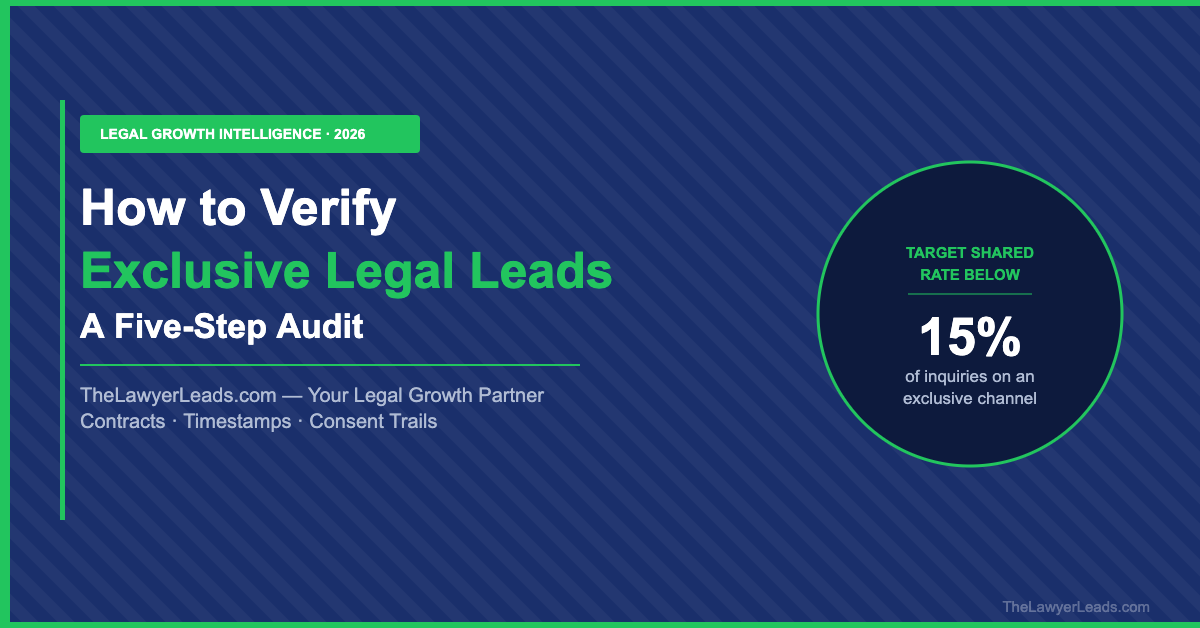
A shared rate above roughly 15 percent on a supposedly exclusive channel is a signal to open a conversation with the provider. Above 30 percent, you are almost certainly paying exclusive prices for shared inquiries.
3. Compare timestamps against first contact
Every record should carry the time the prospect submitted their request. Compare that to the time your team first reached them. If prospects regularly describe calls from other firms that arrived before yours, even though you called within minutes, the inquiry was distributed elsewhere first.
4. Test for duplicates across channels
Run a monthly check for matching phone numbers and emails across every source you use, including your own website and other vendors. If the same person appears from two paid channels, you have paid twice for one prospect. Ask each provider how it prevents this and whether credits apply.
5. Request the consent and source trail
A reputable partner can show the page where the prospect submitted their details, the consent language they agreed to, and the date. This protects you under the Telephone Consumer Protection Act and state advertising rules, and it confirms the prospect asked to hear from your firm rather than from “partners.”
Compliance note: Rules on solicitation and client communication vary by state bar. Confirm that your acquisition channels meet your jurisdiction’s requirements with ethics counsel before scaling spend.
Turning Audit Results into Better Decisions
Once you have 30 to 60 days of data, compare providers on signed cases per exclusive inquiry, not on price per inquiry. A channel charging 40 percent more but with a shared rate near zero often produces a lower cost per signed case, because your intake team is not competing against three other firms for the same phone call.
Share findings with your provider as well. The best growth partners treat an audit as useful feedback and tighten their processes in response. Those that dispute the data without examining it have shown you how they will behave when problems arise later.
One more habit worth adopting: review the numbers quarterly with your intake lead and your marketing owner in the same room. Intake sees what prospects say on the phone, marketing sees what the invoices say, and exclusivity problems usually only become obvious when those two views are placed side by side.
Exclusivity Audit Summary
- Define the term — get the provider to state which kind of exclusivity it sells, in writing.
- Write it into the contract — prohibit resale and require credits for shared inquiries.
- Ask every prospect — log whether they have contacted other firms, and track the shared rate.
- Check timestamps and duplicates — compare submission times and match records across channels.
- Demand the consent trail — source page, consent language, and date for every inquiry.
- Judge on signed cases — compare providers on cost per signed case, not cost per inquiry.
Build a Pipeline You Can Actually Verify
TheLawyerLeads.com delivers filtered, exclusive client inquiries matched to your practice area and geography, with transparent records behind every one.