A three-attorney firm in Texas ran a broad “consumer protection” campaign for a year and signed a handful of lemon law cases. When the partners narrowed their focus to newer vehicles with repeated repair attempts, intake calls dropped by half, but signed matters doubled.
Lemon law is one of the most specialised consumer practice areas in the country, and lemon law client acquisition rewards precision far more than volume. Statutes differ by state, manufacturers defend aggressively, and many cases are paid through fee-shifting provisions, so the economics hinge on one thing: signing the right matters early. This guide walks through how growth-minded firms build a steady lemon law pipeline without wasting spend on inquiries that never qualify.
Why Lemon Law Client Acquisition Is Different
Most practice areas are driven by a sudden event. Lemon law is driven by frustration that builds over months. A driver has been to the dealership three, four, five times for the same defect, and eventually searches for answers. That changes how you reach them and what they need to hear.
Three factors shape every campaign. First, eligibility is statutory: vehicle age, mileage, the number of repair attempts, and days out of service all matter, and the thresholds vary by state. Second, fee-shifting in many states means manufacturers may pay the attorney’s fees on a successful claim, which lets firms accept clients without upfront cost. Third, timing is unforgiving: warranty periods and statutes of limitation can quietly close the window on a strong claim.
Rule of thumb: in lemon law, a smaller number of well-qualified inquiries beats a large number of general ones. Every unqualified call consumes intake time that a signable matter needed.
Building a Lemon Law Case Pipeline Around Qualification
Define a qualifying case before you spend a dollar
Write down your minimum criteria and share them with everyone who touches intake. A practical baseline includes a vehicle bought or leased within your state’s statutory window, a defect that is covered by warranty, at least two or three documented repair attempts (or a safety-related defect), and repair orders the client can produce. Cases that fail these tests are rarely worth the fight.
Match your geography to your statute
Lemon law is a state-by-state discipline. Firms that concentrate on the two or three states where they are licensed and where the statute favours consumers see better returns than firms casting a wide net. Pair that with county-level targeting so your client acquisition spend follows population density and vehicle registrations, not guesswork.
Build an intake script that captures the facts
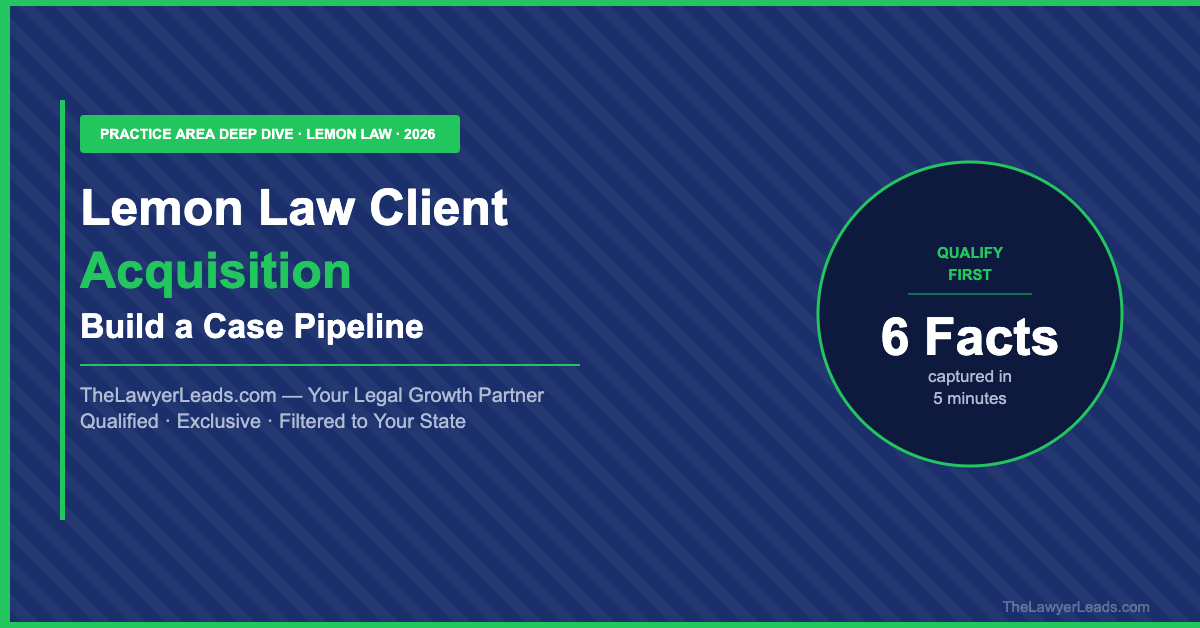
Your first call should collect the make, model, and year, the purchase date, the mileage, the defect, the number of dealer visits, and whether the client still has repair orders. Intake staff who gather those six facts in under five minutes allow attorneys to decide on the spot, while the client is still motivated.
Content and referral relationships extend the pipeline. Owner-focused guides on repair-order records, warranty rights, and what counts as a reasonable number of attempts attract the right audience, while relationships with independent repair shops and consumer groups produce well-documented referrals. These sources build slowly, so treat them as a base layer beneath a predictable, filtered stream of new inquiries.
Also plan for seasonality and manufacturer cycles. Recalls, widely reported defects, and new-model launches can create spikes in owner frustration. Firms with a ready intake process and capacity can respond to those windows, while firms without it lose the opportunity to a competitor who answered first.
Lemon Law Client Acquisition Channels Compared
Most firms mix several channels. The comparison below shows how a typical scattershot approach differs from a qualified, filtered pipeline.
| Metric | Traditional Approach | With TheLawyerLeads.com |
|---|---|---|
| Targeting | Broad “car problem” audiences | State, county, and defect-specific filters |
| Exclusivity | Shared with several firms | One inquiry, one firm |
| Qualification | Screened by your staff after the call | Pre-filtered on vehicle and repair history |
| Speed to contact | Hours or next day | Real-time delivery for immediate follow-up |
| Cost visibility | Hard to tie to signed cases | Trackable to cost per signed case |
Key Insight
Speed matters more here than in many practice areas. A frustrated owner who has just left the dealership is comparing firms right now. The first attorney to respond with a clear, informed answer is usually the one who signs the case.
Converting Lemon Law Inquiries Into Signed Cases
Once the inquiry arrives, conversion is an operations problem. Reply within minutes, ask for photos of the repair orders, and explain the no-upfront-cost structure where your state permits it. Many owners assume suing a manufacturer is expensive, so addressing that concern directly lifts signing rates.
Follow-up discipline also matters. Clients who cannot find paperwork on the first call often become strong cases once they request records from the dealership. A short sequence of text and email reminders over the following week recovers matters that would otherwise be lost.
Finally, measure outcomes by cost per signed case, not cost per inquiry. A channel that looks expensive per call may be the cheapest per retained client once qualification is accounted for.
Lemon Law Pipeline Checklist
- Define a qualifying case — write down vehicle age, mileage, defect, and repair-attempt thresholds for your state.
- Focus your geography — concentrate on the states and counties where your statute and licence align.
- Standardise intake — capture six facts in under five minutes and decide while the client is engaged.
- Respond fast — contact new inquiries within minutes, not hours.
- Track the right metric — measure cost per signed case and refine filters from the results.
Build a Lemon Law Pipeline That Signs
Exclusive, filtered inquiries matched to your practice area and territory, delivered in real time.