
When a potential client searches “personal injury lawyer near me” at 10pm from their phone, one of three things happens: your firm appears at the top, a competitor does, or nobody local shows up and they call whoever Google suggests. Local SEO determines which of those outcomes you get.
Local SEO is the single highest-ROI marketing investment most law firms aren’t taking seriously enough. Unlike paid ads that stop the moment you stop paying, a well-optimised local presence compounds over time — delivering leads month after month at no additional cost per click.
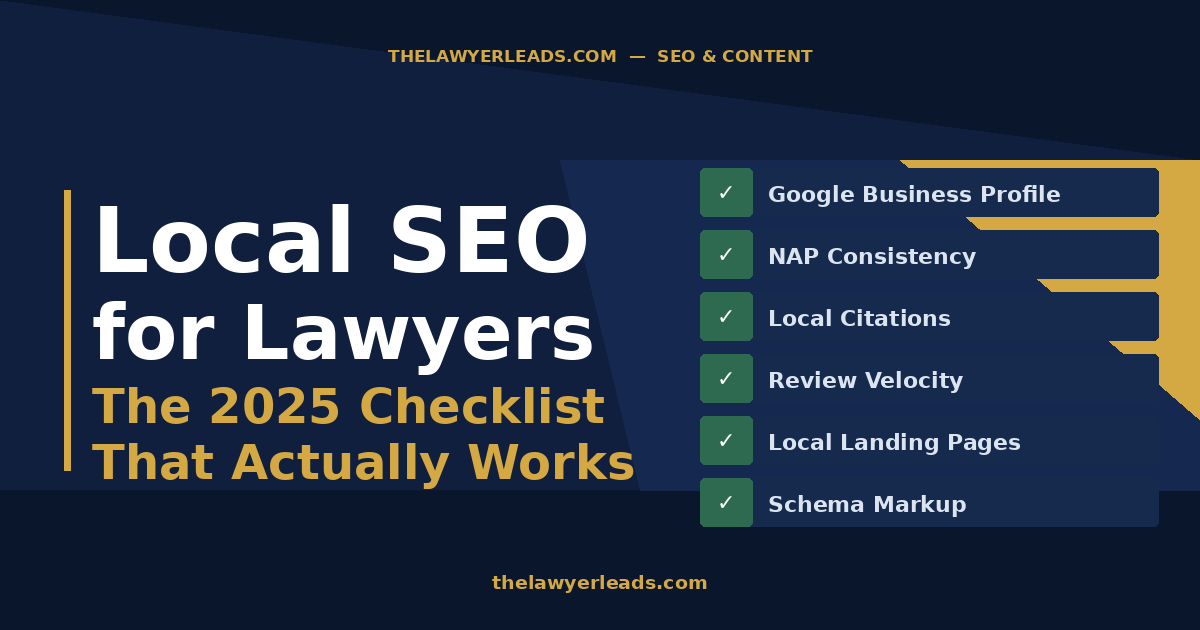
This checklist covers every lever that matters for law firm local SEO in 2025. Work through it section by section and you’ll be ahead of the majority of your competitors by the time you’re done.
1. Google Business Profile Optimisation
Your Google Business Profile (GBP) is the single most important local SEO asset your firm has. It’s what powers the map pack — those three listings that appear above organic results when someone searches for a local attorney. If you’re not in the map pack, you’re invisible to a huge portion of potential clients.
Most law firms claim their GBP listing and then forget about it. That’s a significant missed opportunity.
Google Business Profile checklist:
- Claim and verify your listing if you haven’t already — go to business.google.com
- Choose the correct primary category — e.g. “Personal Injury Attorney”, not just “Lawyer”
- Add all secondary categories relevant to your practice areas
- Write a keyword-rich business description — include your city, practice areas, and what makes your firm different. 750 characters maximum.
- Upload 10+ real photos — interior, exterior, team, office. Listings with photos receive significantly more clicks than those without.
- Add your services with descriptions for each practice area
- Set accurate business hours — including special hours for holidays
- Enable messaging so prospects can contact you directly from Google
- Post weekly updates — events, blog posts, offers. Active listings rank higher than dormant ones.
▶ Quick Win
If you do nothing else this week, log into your Google Business Profile and check that your phone number, address, and website URL are all 100% correct. A single incorrect digit in your phone number is silently costing you leads every day.
2. NAP Consistency Across the Web
NAP stands for Name, Address, Phone number. Google uses your NAP data — pulled from dozens of websites across the internet — to verify that your business is legitimate and correctly located. Inconsistent NAP data is one of the most common and damaging local SEO mistakes law firms make.
It sounds trivial, but “Suite 200” vs “Ste. 200” vs “#200” in your address across different listings can genuinely hurt your local rankings. Google sees these as potential contradictions and reduces confidence in your location data.
NAP consistency checklist:
- Decide on one exact format for your firm name, address, and phone number — write it down
- Check your listing on Yelp, Avvo, FindLaw, Justia, and your state bar directory — update any that differ
- Search Google for your firm name and audit the first 2 pages of results for any inconsistencies
- Use a tool like Moz Local or BrightLocal (both have free tiers) to run a full citation audit
- Make sure your website footer and contact page use the exact same NAP format as your GBP
3. Local Citations
A local citation is any mention of your firm’s name, address, and phone number on another website. Citations from authoritative, relevant directories signal to Google that your firm is a legitimate local business — and help establish your location and practice area.
You don’t need hundreds of citations. You need the right ones — authoritative legal and local directories that Google already trusts.
Priority citation sources for law firms:
| Directory | Type | Priority |
|---|---|---|
| Google Business Profile | Legal / Local | Essential |
| State Bar Association | Legal | Essential |
| Avvo | Legal | High |
| Justia | Legal | High |
| FindLaw | Legal | High |
| Yelp | Local | Medium |
| Apple Maps / Bing Places | Local | Medium |
| Local Chamber of Commerce | Local | Medium |
4. Review Velocity
Google reviews are one of the top local ranking signals — and they’re also the first thing a potential client looks at when deciding whether to call you. Review velocity (how consistently you’re earning new reviews) matters as much as your total count. A firm with 40 reviews all from 2021 is being outranked by one with 25 reviews earned steadily over the past 12 months.
Review generation checklist:
- Create a direct review link — go to your GBP dashboard, click “Get more reviews” and copy the short URL. Add this to your email signature, post-case follow-up emails, and your website.
- Ask at the right moment — the best time is when a case resolves successfully and the client expresses gratitude. Don’t ask upfront.
- Follow up by SMS — a simple text message with the direct link has a significantly higher response rate than email
- Respond to every review — positive and negative. Google rewards engagement, and responding to negative reviews publicly demonstrates professionalism.
- Set a monthly goal — even 2 new reviews per month compounds significantly over a year
Important: Never offer incentives for reviews — this violates Google’s policies and can result in your listing being suspended. Always ask ethically, and let the review be the client’s genuine experience.
5. Local Landing Pages
If your firm serves multiple cities or suburbs, a single homepage is not enough. Google ranks pages, not websites — and a dedicated page for each location you serve gives you a separate opportunity to appear in local search results for each one.
A local landing page for “personal injury lawyer in [suburb]” should feel genuinely relevant to that location — not a copy-paste template with the city name swapped out. Google is sophisticated enough to detect thin, duplicate content, and it will not rank it.
What a strong local landing page includes:
- The target city or suburb in the H1 heading and page title
- Genuine local content — mention local courts, highways, landmarks relevant to the practice area
- An embedded Google Map showing your office location
- Reviews or testimonials from clients in that specific area
- A clear CTA with a phone number that is clickable on mobile
- The page linked from your main navigation or a “locations” section of your site
6. Schema Markup (Legal Business)
Schema markup is structured data you add to your website that helps Google understand exactly what your business is — its name, address, phone number, practice areas, hours, and more. It’s invisible to site visitors but highly valuable to search engines.
For law firms, the most important schema types are LocalBusiness (specifically LegalService or Attorney) and Review schema. Implementing these correctly can help your listing earn star ratings in search results — a significant click-through rate advantage.
Schema checklist:
- Add LegalService schema to your homepage and all practice area pages
- Include your NAP, hours, service area, and practice areas in the schema
- Add FAQ schema to any page with a Q&A section — this can earn expanded search result snippets
- Use Google’s Rich Results Test (search.google.com/test/rich-results) to validate your markup
- If you use WordPress, plugins like Rank Math or Yoast Local SEO can add schema without touching code
Your 2025 Local SEO Master Checklist
Google Business Profile
- ☐ Listing claimed and verified
- ☐ Correct primary and secondary categories
- ☐ Keyword-rich business description (750 chars)
- ☐ 10+ real photos uploaded
- ☐ Services listed with descriptions
- ☐ Weekly posts active
NAP & Citations
- ☐ Exact NAP format defined and documented
- ☐ All major legal directories checked and updated
- ☐ Citation audit completed (Moz Local / BrightLocal)
- ☐ State bar directory listing accurate
Reviews
- ☐ Direct review link created and shared with team
- ☐ Post-case review request process in place
- ☐ Monthly review goal set
- ☐ All reviews responded to within 48 hours
Website
- ☐ Local landing pages created for each service area
- ☐ LegalService schema implemented
- ☐ FAQ schema on relevant pages
- ☐ Schema validated in Google Rich Results Test
- ☐ Mobile speed score above 70 (PageSpeed Insights)
The Bottom Line
Local SEO is not a one-time project — it’s an ongoing process of maintaining and improving your visibility in local search. But the checklist above represents the foundation. Get these fundamentals right and you’ll outrank the majority of law firms in your market who are either ignoring local SEO entirely or doing it inconsistently.
The best part? Unlike paid advertising, every improvement you make to your local SEO continues working for you long after the work is done. It compounds.
If you’d rather skip the DIY process and get qualified leads flowing to your firm immediately while your SEO builds, that’s exactly what our lead generation service is designed for.
Get Leads While Your SEO Builds
Local SEO takes 3–6 months to show results. Our pre-qualified leads start delivering cases from day one — no waiting, no guesswork.