
Law Firm Website Conversion Rate Optimization: Turn Clicks into Clients in 2025

Law Firm Website Conversion Rate Optimization: Turn Clicks into Clients in 2025

A family law attorney in Phoenix was spending $4,200 a month on Google Ads. Her traffic was solid — 1,800 monthly visitors. But only 11 people booked a consultation. That’s a conversion rate of 0.6%. After a structured law firm website conversion rate optimization audit, the same traffic produced 47 consultations the following month. Nothing changed about her ad spend. Everything changed about her website.

For US law firm owners, the instinct is to spend more on traffic — more ads, more SEO content, more backlinks. But if your website isn’t converting the visitors you already have, every dollar of new traffic spend is partially wasted. Law firm website conversion rate optimization (CRO) is the discipline of fixing that leak before you pour more water in.

This guide covers the highest-leverage CRO moves for law firm websites in 2025 — the ones that consistently move the needle for practices in personal injury, immigration, family law, criminal defense, and estate planning.


Why Most Law Firm Websites Convert Poorly

The legal industry has a structural CRO problem. Most law firm websites are designed by agencies that prioritize aesthetics over psychology. They look credible, but they don’t persuade. A prospective client landing on your site after a stressful injury, divorce filing, or immigration notice is not browsing — they are searching for a reason to trust someone fast.

The average law firm website converts at 1–2% of organic traffic and as low as 3–4% of paid traffic — well below what’s achievable. Firms that have invested in structured conversion optimization regularly hit 8–12% consultation rates from paid traffic. That’s 2–3x more clients from the same ad budget.

According to research by the National Law Review, 74% of potential legal clients visit a law firm website before making contact — but fewer than 1 in 10 actually reach out. The gap is not a traffic problem. It’s a conversion problem.


The 5 Highest-Impact Law Firm Website CRO Fixes

1. Above-the-Fold Clarity

Your homepage hero section has roughly 3–5 seconds to answer three questions a prospective client is silently asking: Do you handle my type of case? Are you near me? Can I contact you right now? Most law firm hero sections answer zero of these — they lead with a firm name, a stock photo of a courthouse, and a tagline like “Experienced. Dedicated. Results.”

The fix: replace vague taglines with specific, benefit-driven headlines. “Texas Truck Accident Attorney — Free Case Review, Available 24/7” outperforms “Fighting for Justice” every time. Add your city/region in the H1, your primary practice area, and a single prominent CTA button above the fold.

2. Friction-Free Contact Pathways

Every additional field on a contact form reduces submissions by approximately 10–15%. A six-field intake form asking for case details, incident date, opposing party, and preferred contact time is appropriate for post-qualification — it is not appropriate for first contact. Your initial form should ask for name, phone, and one sentence about their situation. That’s it.

Additionally, make your phone number click-to-call on mobile (where over 65% of legal searches now occur), add a persistent sticky CTA bar on scroll, and consider a floating chat widget — even a simple “Tell us about your case” prompt with a text field can double mobile conversions.

3. Trust Signals in the Right Places

Trust signals work — but placement matters enormously. A Google review badge buried in the footer is largely invisible. The same badge placed directly next to your primary CTA button increases click-through rates by up to 34% in A/B tests across legal landing pages. Place trust elements — bar admissions, case results, client testimonials, media mentions, years of experience — immediately before and after your call-to-action, not in sidebars or footers.

Key Insight

Video testimonials convert at 2–3x the rate of text testimonials. Even a 45-second phone-recorded clip of a real client describing how your firm helped them is more persuasive than a paragraph of pulled quotes. Low production value doesn’t hurt — authenticity does more work than polish in the legal space.

4. Practice Area Page Optimization

Most law firm traffic arrives on practice area pages, not the homepage — yet most firms invest 80% of their design effort on the homepage. Each practice area page should function as a standalone conversion unit: its own headline targeting a specific keyword, its own trust signals relevant to that case type, and its own CTA tailored to the emotional state of someone facing that legal issue.

A bankruptcy page should open by acknowledging financial stress and the fear of judgment — then immediately position a free consultation as a safe, confidential next step. A criminal defense page should emphasize speed, discretion, and the importance of acting before arraignment. Context-aware copy converts; generic copy does not.

5. Page Speed and Mobile Experience

Google’s Core Web Vitals data confirms what CRO practitioners have known for years: a 1-second delay in page load time reduces conversions by 7%. Legal websites frequently carry bloated plugins, uncompressed images, and render-blocking scripts inherited from DIY WordPress builds. Run your site through Google PageSpeed Insights and treat a mobile score below 70 as an emergency — not a nice-to-fix.


Law Firm Website Conversion Rate Optimization: By the Numbers

Metric Typical Law Firm (No CRO) After Structured CRO
Paid Traffic Conversion Rate 2–4% 8–12%
Contact Form Completion 18–25% 45–60%
Mobile Bounce Rate 65–75% 38–48%
Cost Per Acquired Client $800–$1,400 $280–$550
Monthly Consultations (1,500 visits) 9–18 36–72

Pairing CRO with a Stronger Client Pipeline

Website CRO and incoming client pipeline work in tandem. A highly optimized website maximizes the return on every lead source you use — paid search, SEO, referrals, and exclusive legal leads. Firms that pair strong conversion infrastructure with high-quality, pre-screened leads typically see the lowest cost-per-client of any client acquisition channel available.

When your intake page is properly optimized — fast, mobile-first, with clear CTAs and contextual trust signals — the close rate on exclusive legal leads rises significantly because prospective clients arrive already partially qualified and your website reinforces the decision to reach out rather than undermining it.

Key Insight

The attorneys who grow fastest in competitive markets aren’t just the ones with the biggest ad budgets — they’re the ones who convert more of what they already have, then scale intelligently. CRO is the multiplier that makes every other growth investment perform better.


Law Firm Website CRO — Action Checklist

  1. Audit your above-the-fold section — does it immediately state your practice area, location, and a single clear CTA?
  2. Simplify your first-contact form — strip it to name, phone, and one open field. Move detailed intake to after the first call.
  3. Reposition trust signals — move reviews, case results, and certifications to appear directly adjacent to your CTA buttons.
  4. Rewrite each practice area page as a standalone conversion unit with context-specific copy and its own tailored CTA.
  5. Fix mobile page speed — target a Google PageSpeed mobile score above 80 and eliminate render-blocking scripts.
  6. Add a video testimonial — one 45-second authentic clip from a real client will outperform a page of written testimonials.

Build a Client Pipeline That Compounds

Once your website is optimized to convert, pairing it with exclusive, practice-area-specific legal leads gives you a pipeline that keeps filling — without depending entirely on Google’s next algorithm update.
Browse Practice Areas

Local SEO Checklist for Law Firms 2026: Rank Higher on Google Maps

Local SEO Checklist for Law Firms 2026: Rank Higher on Google Maps

A personal injury firm in Phoenix had a polished website, solid reviews, and years of experience — yet a competitor with half the credentials was landing three times the inbound calls. The difference? Local SEO. That competitor owned Google Maps for ‘personal injury attorney Phoenix.’ The first firm was invisible where it mattered most.

For US law firms, local SEO for law firms in 2026 is no longer optional — it is the single highest-ROI channel available to most practices. Google’s local pack (the map results that appear above organic listings) now captures over 40% of clicks for legal searches, according to BrightLocal’s 2025 Local Search Report. If your firm isn’t optimised for local search, you’re ceding those clicks — and those clients — to competitors every single day.

This checklist gives you a concrete, step-by-step framework to improve your local search visibility, attract higher-intent prospects, and build a durable client pipeline that doesn’t depend entirely on paid advertising.


1. Claim and Optimise Your Google Business Profile

Your Google Business Profile (GBP) is the foundation of local SEO for law firms in 2026. It determines whether you appear in the map pack, what information prospective clients see, and how much trust Google places in your listing.

  • Verify ownership — If you haven’t verified your listing, do it now via postcard, phone, or video verification.
  • Choose the right primary category — Use the most specific legal category available (e.g., “Personal Injury Attorney” not just “Lawyer”). This single field has an outsized impact on which searches you appear for.
  • Write a keyword-rich business description — Include your practice areas, city/region, and a clear value proposition. Keep it under 750 characters.
  • Add all relevant service areas — List every city and county your firm serves, not just your office location.
  • Upload 20+ high-quality photos — Include office exterior, interior, team headshots, and any awards or accolades. Profiles with photos receive 42% more direction requests.
  • Post weekly updates — GBP posts signal activity to Google and give prospects fresh content to engage with.

Data point: Law firms with complete Google Business Profiles (all fields filled, regular posts, 20+ photos) rank in the local map pack for 2.7x more keywords than firms with incomplete profiles. (Source: Whitespark Local Ranking Factors Survey 2025)


2. Build and Maintain NAP Consistency Across Citations

NAP stands for Name, Address, Phone number. Google cross-references your firm’s NAP data across dozens of directories — Avvo, Justia, FindLaw, Yelp, Bing Places, Apple Maps, and more. Inconsistent information (different phone numbers, abbreviations like “St.” vs “Street”) sends mixed signals and suppresses your rankings.

  • Audit your current citations using a tool like BrightLocal or Moz Local — identify inconsistencies and duplicates.
  • Ensure your GBP, website footer, and all legal directories use exactly the same business name format.
  • Claim and update listings on the top five legal directories: Avvo, Justia, FindLaw, Lawyers.com, and Super Lawyers.
  • Add your firm to general directories: Yelp, Apple Maps, Bing Places, Chamber of Commerce, BBB.
Citation Source Domain Authority Impact on Local Rankings
Google Business Profile 100 Critical (primary signal)
Avvo 86 Very High
Justia 82 High
FindLaw 80 High
Yelp 70 Moderate
Local Chamber of Commerce Varies Moderate (boosts local trust)

3. Earn and Actively Manage Google Reviews

Reviews are the third pillar of local SEO for law firms 2026 — and the one most firms neglect. Google’s algorithm weights review quantity, recency, and sentiment heavily in map pack rankings. A firm with 80 four-star reviews will almost always outrank a competitor with 15 five-star reviews, all else being equal.

Building a Review Acquisition System

  • Identify the right moment — Ask for a review at case resolution, when the client expresses satisfaction, not at intake.
  • Send a direct link — Create a short URL that goes straight to your GBP review form. Tools like GatherUp or Birdeye automate this.
  • Follow up once — A single reminder email 48 hours after the initial request increases completion rates by 30%.
  • Respond to every review — Publicly responding to reviews (positive and negative) signals engagement to Google and builds trust with prospective clients.

Key Insight

Law firms that respond to 100% of their Google reviews rank 1.4 positions higher in the local map pack on average than firms that don’t respond. Responses also extend the SEO value of each review — Google indexes the content of both the review and your reply.


4. Optimise Your Website for Local Search Signals

Your website supports your GBP ranking — Google uses it to verify and reinforce what it finds in your profile. The following on-site elements have the highest impact on local SEO rankings for law firms:

  • LocalBusiness schema markup — Add structured data (JSON-LD) to your homepage and contact page. Include name, address, phone, practice areas, and opening hours. Schema helps Google understand your entity without guessing.
  • Location-specific service pages — If you serve multiple cities, create a dedicated page for each location (e.g., “/personal-injury-attorney-scottsdale/”). Thin, duplicate pages hurt — each page needs 500+ words of unique content.
  • Embed Google Maps on your contact page — This creates an explicit link between your website and your GBP listing, strengthening both.
  • Core Web Vitals — Page speed (LCP under 2.5s), interactivity (INP under 200ms), and layout stability (CLS under 0.1) are Google ranking factors. Use PageSpeed Insights to audit and fix issues.
  • Mobile-first design — Over 70% of legal searches happen on mobile. A site that loads slowly or renders poorly on phones will lose rankings and conversions.
Local SEO Factor Without Optimisation With Full Optimisation
Map Pack Position Outside top 10 Positions 1-3
Monthly Inbound Calls 3-5 15-30+
Cost Per Acquired Client $800-$2,000 (paid ads) $150-$400 (organic)
Lead Quality Score Mixed intent High intent (location-specific)

5. Accelerate Growth with a Dual-Channel Strategy

Local SEO builds a durable, compounding asset — but it takes 3-6 months to see significant map pack movement. Savvy law firm operators don’t wait. They combine an SEO foundation with a parallel client acquisition channel to generate cases in the short term while organic rankings mature.

The most effective complement to local SEO is a curated pipeline of exclusive, pre-screened leads matched to your specific practice area and geography. Unlike shared leads that get sold to five firms simultaneously, exclusive leads arrive in real time and have not been contacted by any other attorney — your intake team is the first call they make.

Key Insight

Firms that combine a strong local SEO presence with a structured exclusive-leads pipeline typically see 40-60% lower cost per signed client compared to firms relying solely on Google Ads. The SEO channel handles high-intent organic traffic; the pipeline channel fills intake gaps and supports growth targets month over month.


Your Local SEO Action Checklist for 2026

  1. Claim and fully complete your Google Business Profile — Choose the right category, add photos, and post weekly updates.
  2. Audit and fix NAP consistency — Every directory must match your GBP exactly. Start with Avvo, Justia, and FindLaw.
  3. Build a review acquisition system — Ask at the right moment, send a direct link, follow up once, and respond to every review.
  4. Optimise your website for local signals — Add LocalBusiness schema, create location-specific service pages, embed Google Maps, and pass Core Web Vitals.
  5. Complement SEO with a parallel client acquisition channel — Use exclusive leads to generate cases while your organic rankings build momentum.

Ready to Build a Predictable Client Pipeline?

While your local SEO compounds, TheLawyerLeads.com delivers exclusive, real-time leads filtered to your practice area and market — so your intake team is always working live opportunities.

Browse Practice Areas

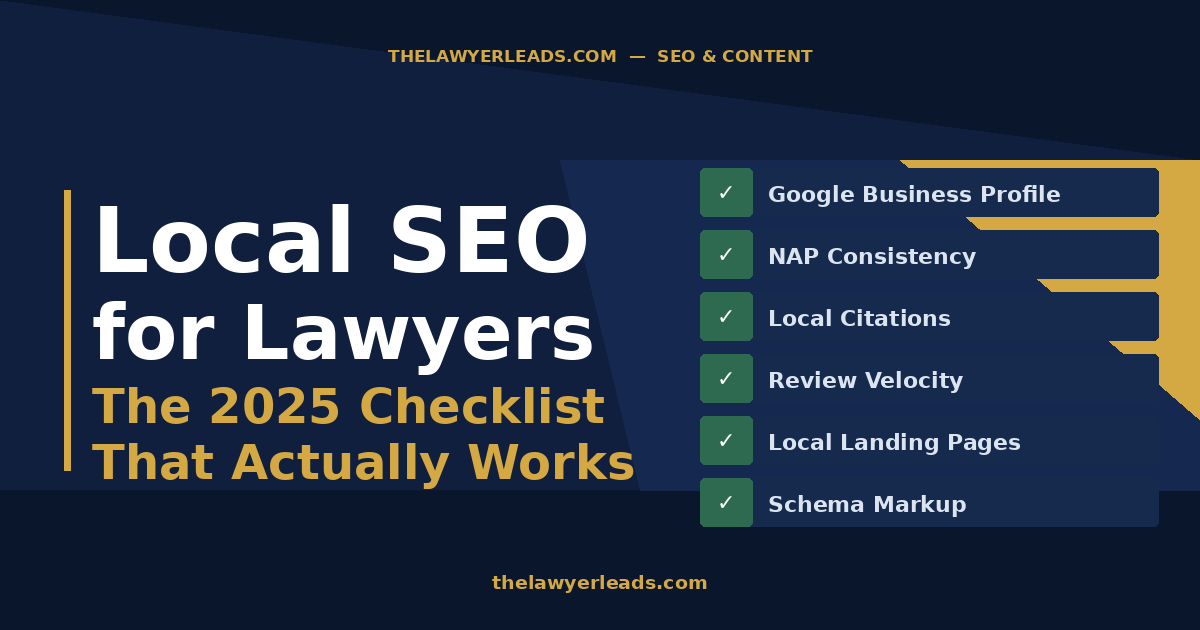
Local SEO for Lawyers: The 2025 Checklist That Actually Works

Local SEO for Lawyers: The 2025 Checklist That Actually Works

When a potential client searches “personal injury lawyer near me” at 10pm from their phone, one of three things happens: your firm appears at the top, a competitor does, or nobody local shows up and they call whoever Google suggests. Local SEO determines which of those outcomes you get.

Local SEO is the single highest-ROI marketing investment most law firms aren’t taking seriously enough. Unlike paid ads that stop the moment you stop paying, a well-optimised local presence compounds over time — delivering leads month after month at no additional cost per click.

This checklist covers every lever that matters for law firm local SEO in 2025. Work through it section by section and you’ll be ahead of the majority of your competitors by the time you’re done.


1. Google Business Profile Optimisation

Your Google Business Profile (GBP) is the single most important local SEO asset your firm has. It’s what powers the map pack — those three listings that appear above organic results when someone searches for a local attorney. If you’re not in the map pack, you’re invisible to a huge portion of potential clients.

Most law firms claim their GBP listing and then forget about it. That’s a significant missed opportunity.

Google Business Profile checklist:

  • Claim and verify your listing if you haven’t already — go to business.google.com
  • Choose the correct primary category — e.g. “Personal Injury Attorney”, not just “Lawyer”
  • Add all secondary categories relevant to your practice areas
  • Write a keyword-rich business description — include your city, practice areas, and what makes your firm different. 750 characters maximum.
  • Upload 10+ real photos — interior, exterior, team, office. Listings with photos receive significantly more clicks than those without.
  • Add your services with descriptions for each practice area
  • Set accurate business hours — including special hours for holidays
  • Enable messaging so prospects can contact you directly from Google
  • Post weekly updates — events, blog posts, offers. Active listings rank higher than dormant ones.

▶ Quick Win

If you do nothing else this week, log into your Google Business Profile and check that your phone number, address, and website URL are all 100% correct. A single incorrect digit in your phone number is silently costing you leads every day.

2. NAP Consistency Across the Web

NAP stands for Name, Address, Phone number. Google uses your NAP data — pulled from dozens of websites across the internet — to verify that your business is legitimate and correctly located. Inconsistent NAP data is one of the most common and damaging local SEO mistakes law firms make.

It sounds trivial, but “Suite 200” vs “Ste. 200” vs “#200” in your address across different listings can genuinely hurt your local rankings. Google sees these as potential contradictions and reduces confidence in your location data.

NAP consistency checklist:

  • Decide on one exact format for your firm name, address, and phone number — write it down
  • Check your listing on Yelp, Avvo, FindLaw, Justia, and your state bar directory — update any that differ
  • Search Google for your firm name and audit the first 2 pages of results for any inconsistencies
  • Use a tool like Moz Local or BrightLocal (both have free tiers) to run a full citation audit
  • Make sure your website footer and contact page use the exact same NAP format as your GBP

3. Local Citations

A local citation is any mention of your firm’s name, address, and phone number on another website. Citations from authoritative, relevant directories signal to Google that your firm is a legitimate local business — and help establish your location and practice area.

You don’t need hundreds of citations. You need the right ones — authoritative legal and local directories that Google already trusts.

Priority citation sources for law firms:

Directory Type Priority
Google Business Profile Legal / Local Essential
State Bar Association Legal Essential
Avvo Legal High
Justia Legal High
FindLaw Legal High
Yelp Local Medium
Apple Maps / Bing Places Local Medium
Local Chamber of Commerce Local Medium

4. Review Velocity

Google reviews are one of the top local ranking signals — and they’re also the first thing a potential client looks at when deciding whether to call you. Review velocity (how consistently you’re earning new reviews) matters as much as your total count. A firm with 40 reviews all from 2021 is being outranked by one with 25 reviews earned steadily over the past 12 months.

Review generation checklist:

  • Create a direct review link — go to your GBP dashboard, click “Get more reviews” and copy the short URL. Add this to your email signature, post-case follow-up emails, and your website.
  • Ask at the right moment — the best time is when a case resolves successfully and the client expresses gratitude. Don’t ask upfront.
  • Follow up by SMS — a simple text message with the direct link has a significantly higher response rate than email
  • Respond to every review — positive and negative. Google rewards engagement, and responding to negative reviews publicly demonstrates professionalism.
  • Set a monthly goal — even 2 new reviews per month compounds significantly over a year

Important: Never offer incentives for reviews — this violates Google’s policies and can result in your listing being suspended. Always ask ethically, and let the review be the client’s genuine experience.

5. Local Landing Pages

If your firm serves multiple cities or suburbs, a single homepage is not enough. Google ranks pages, not websites — and a dedicated page for each location you serve gives you a separate opportunity to appear in local search results for each one.

A local landing page for “personal injury lawyer in [suburb]” should feel genuinely relevant to that location — not a copy-paste template with the city name swapped out. Google is sophisticated enough to detect thin, duplicate content, and it will not rank it.

What a strong local landing page includes:

  • The target city or suburb in the H1 heading and page title
  • Genuine local content — mention local courts, highways, landmarks relevant to the practice area
  • An embedded Google Map showing your office location
  • Reviews or testimonials from clients in that specific area
  • A clear CTA with a phone number that is clickable on mobile
  • The page linked from your main navigation or a “locations” section of your site

6. Schema Markup (Legal Business)

Schema markup is structured data you add to your website that helps Google understand exactly what your business is — its name, address, phone number, practice areas, hours, and more. It’s invisible to site visitors but highly valuable to search engines.

For law firms, the most important schema types are LocalBusiness (specifically LegalService or Attorney) and Review schema. Implementing these correctly can help your listing earn star ratings in search results — a significant click-through rate advantage.

Schema checklist:

  • Add LegalService schema to your homepage and all practice area pages
  • Include your NAP, hours, service area, and practice areas in the schema
  • Add FAQ schema to any page with a Q&A section — this can earn expanded search result snippets
  • Use Google’s Rich Results Test (search.google.com/test/rich-results) to validate your markup
  • If you use WordPress, plugins like Rank Math or Yoast Local SEO can add schema without touching code

Your 2025 Local SEO Master Checklist

Google Business Profile

  • ☐ Listing claimed and verified
  • ☐ Correct primary and secondary categories
  • ☐ Keyword-rich business description (750 chars)
  • ☐ 10+ real photos uploaded
  • ☐ Services listed with descriptions
  • ☐ Weekly posts active

NAP & Citations

  • ☐ Exact NAP format defined and documented
  • ☐ All major legal directories checked and updated
  • ☐ Citation audit completed (Moz Local / BrightLocal)
  • ☐ State bar directory listing accurate

Reviews

  • ☐ Direct review link created and shared with team
  • ☐ Post-case review request process in place
  • ☐ Monthly review goal set
  • ☐ All reviews responded to within 48 hours

Website

  • ☐ Local landing pages created for each service area
  • ☐ LegalService schema implemented
  • ☐ FAQ schema on relevant pages
  • ☐ Schema validated in Google Rich Results Test
  • ☐ Mobile speed score above 70 (PageSpeed Insights)

The Bottom Line

Local SEO is not a one-time project — it’s an ongoing process of maintaining and improving your visibility in local search. But the checklist above represents the foundation. Get these fundamentals right and you’ll outrank the majority of law firms in your market who are either ignoring local SEO entirely or doing it inconsistently.

The best part? Unlike paid advertising, every improvement you make to your local SEO continues working for you long after the work is done. It compounds.

If you’d rather skip the DIY process and get qualified leads flowing to your firm immediately while your SEO builds, that’s exactly what our lead generation service is designed for.

Get Leads While Your SEO Builds

Local SEO takes 3–6 months to show results. Our pre-qualified leads start delivering cases from day one — no waiting, no guesswork.

Start Getting Leads Today →