
Not every postal district in Singapore produces the same quality of legal leads — and paying the same price for all of them is one of the most common mistakes law firms make when buying leads.
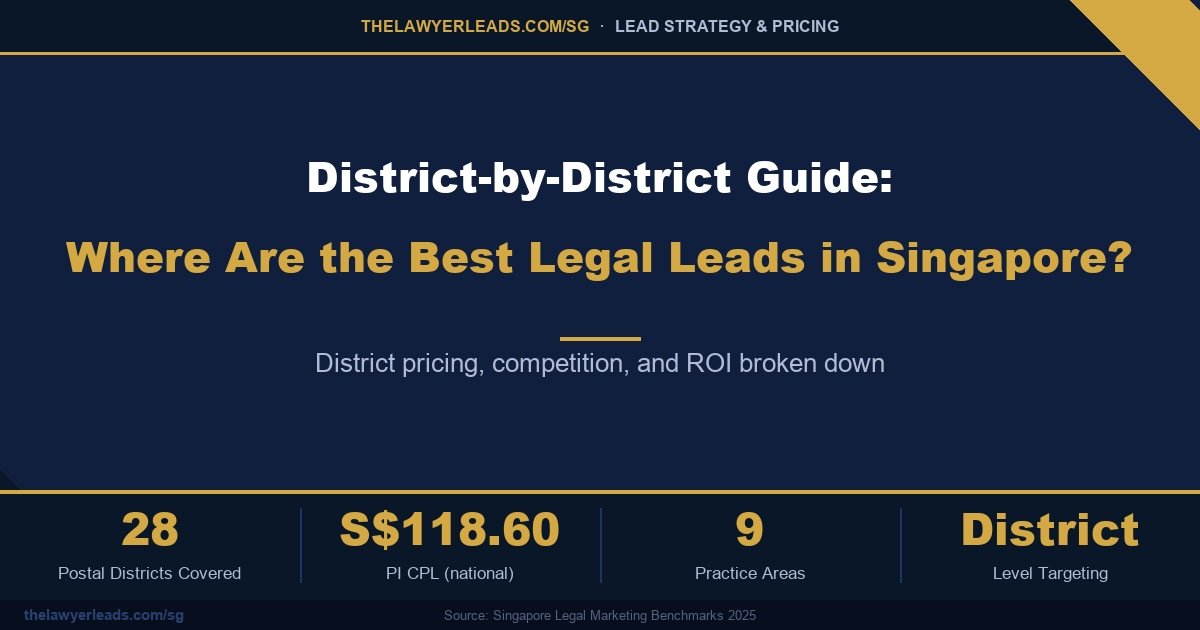
Singapore is divided into 28 postal districts, and each one behaves differently when it comes to legal demand. A conveyancing enquiry from District 9 (Orchard, River Valley) carries a very different case value than one from District 27 (Yishun, Sembawang). A personal injury lead from the industrial belt around District 22 (Jurong) looks nothing like a family law enquiry from District 15 (East Coast, Katong). If your firm buys leads without accounting for these differences, you’re almost certainly overpaying for some districts and underexposed in others. This guide breaks down where the best legal leads in Singapore actually come from — district by district — and how district-level targeting changes the maths on your lead spend.
Why District-Level Targeting Matters for Singapore Law Firms
Most legal directories and ad platforms sell leads at the national level — every enquiry costs the same, regardless of postal district. That flat pricing model ignores a basic reality of the Singapore legal market: demand, competition, and case value all shift sharply across the island’s 28 postal districts. A firm practising conveyancing near the CBD is competing with a completely different set of firms — and a completely different budget ceiling — than one serving heartland estates in the north-east.
District-level targeting means you only pay for enquiries generated in the postal districts that actually match your practice — your office location, your court appearances, or the client profile you want to serve. It is the single biggest lever for improving return on ad spend when buying legal leads in Singapore.
Firms using postal district-level targeting typically see up to 3x better conversion compared to firms buying undifferentiated, island-wide leads — because the enquiries that reach them are already geographically and practically relevant.
District-by-District: Where Legal Demand Clusters
Legal enquiries in Singapore tend to cluster around a handful of recognisable zones. Here’s a general breakdown of how demand, competition among firms, and typical practice-area fit shift across the island’s postal districts:
| District Cluster | Firm Competition | Best-Fit Practice Areas |
|---|---|---|
| Districts 1–6 (CBD, Marina, Tanjong Pagar) | High | Corporate, commercial disputes |
| Districts 9–11 (Orchard, Bukit Timah, Holland) | High | Conveyancing, private wealth, family law |
| Districts 15–16 (East Coast, Katong, Bedok) | Moderate | Family law, personal injury |
| Districts 19–20 (Serangoon, Bishan, Toa Payoh) | Moderate | Conveyancing, family law, employment |
| Districts 21–23 (Clementi, Jurong, Bukit Batok) | Low–Moderate | Personal injury, employment disputes |
| Districts 25–28 (Woodlands, Yishun, Sembawang) | Low | Family law, debt/bankruptcy, conveyancing |
The lower-competition districts on this table are often where the best value sits — not because case values are higher, but because fewer firms are actively bidding for attention there, so your cost per lead drops while enquiry quality stays consistent.
A National Benchmark, District by District
Across all 28 postal districts, the average legal cost-per-lead in Singapore sits at S$102.30, with personal injury enquiries — typically the highest-value case type — averaging S$118.60 nationally. But that national average masks real variation: a firm targeting only high-competition CBD districts will pay well above that figure, while a firm with district-level targeting across the north-east or west can bring its blended cost per lead down substantially without sacrificing volume.
▶ Key Insight
The cheapest districts aren’t always the best value, and the most expensive districts aren’t always worth the premium. The right approach is matching your firm’s practice areas and capacity to the districts where demand and competition align in your favour — not simply chasing the lowest cost-per-lead figure in isolation.
How to Choose the Right Districts for Your Firm
Before you commit lead spend to any district, run through a few basic checks:
- Map your existing client base by postal district — you may already have an untapped concentration worth doubling down on.
- Match districts to the practice areas you actually want more of — a district strong in conveyancing enquiries is wasted spend if your firm is built around litigation.
- Factor in your firm’s capacity to travel for court appearances or client meetings — proximity still matters for conversion.
- Test lower-competition districts alongside your core districts before scaling spend — this is where district-level targeting typically pays off fastest.
- Revisit your district mix quarterly — competition and demand shift as other firms adjust their own targeting.
This is exactly the targeting layer that most legal directories and generic ad platforms in Singapore don’t offer. ThelawyerLeads SG builds district-level targeting into every campaign from the start, across all 9 of our practice areas, so your firm only pays for enquiries from the postal districts that actually fit your practice.
District-by-District Guide — Summary
- Demand isn’t uniform — legal enquiries cluster differently across Singapore’s 28 postal districts, and flat, island-wide lead pricing ignores that.
- Competition drives cost — high-density districts like the CBD and Orchard carry a premium; north-east and west districts often offer better value.
- National averages hide variation — the S$102.30 average cost-per-lead (S$118.60 for personal injury) shifts meaningfully once you break it down by district.
- Match districts to practice areas — the best-value district for your firm depends on what you practise, not just where you’re located.
- District-level targeting is the lever — it’s the most direct way to improve ROI on legal lead spend in Singapore’s 9 major practice areas.
See Lead Pricing for Your District
We offer transparent, district-specific lead pricing across all major practice areas — with no contracts, no recycled contacts, and full exclusivity options.