
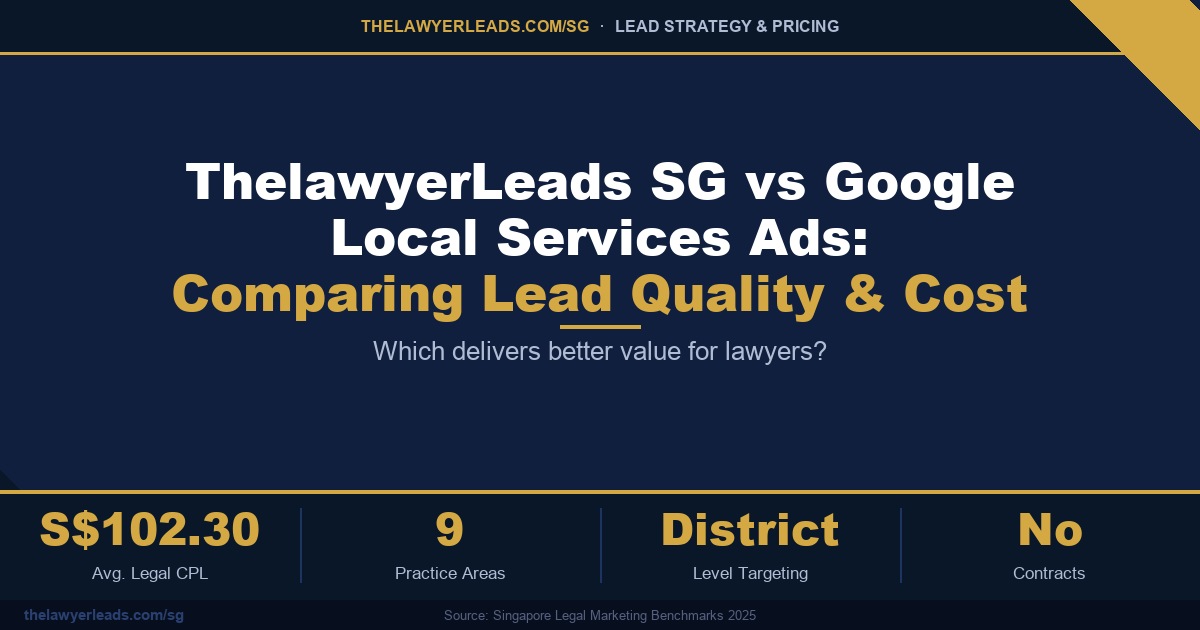
Google Local Services Ads promises “pay per lead” simplicity for lawyers — but the leads that arrive are shared, broadly targeted, and priced by an auction you don’t control. Here’s how it actually stacks up against a dedicated legal lead gen service built for Singapore firms.
Advocates & Solicitors in Singapore have two very different ways to buy ready-made leads today: Google Local Services Ads (LSA), a pay-per-lead product bolted onto Google’s ad platform, or ThelawyerLeads SG, a legal-specific lead generation service built around postal district targeting and exclusive leads. Both promise to put new client enquiries in front of your firm without the grind of cold outreach. But “pay per lead” means very different things depending on who’s selling the lead.
This comparison looks at cost per lead, lead quality, targeting precision, and contract terms — the four things that actually determine whether a lead gen channel pays for itself.
How Google Local Services Ads Works for Lawyers
Google LSA puts your firm’s listing at the very top of relevant search results, above standard Google Ads, with a “Google Screened” badge. You’re charged only when someone contacts you through the ad — in theory, a clean pay-per-lead model. In practice, firms report being charged for leads that never converted to a real enquiry: wrong-number calls, spam, enquiries entirely outside your practice area, or calls that last a few seconds.
Because LSA runs on an auction, your cost per lead fluctuates with how many other firms are bidding in your area and category at that moment. There’s no fixed, transparent price — and no postal district-level control over exactly where your leads come from within Singapore.
How ThelawyerLeads SG Is Different
ThelawyerLeads SG was built specifically for Singapore law firms, with fixed, transparent pricing per lead and postal district-level targeting across all 28 postal districts. You choose the districts and practice areas you want leads from, and you see the price before you commit — not after an auction decides it for you. Leads are matched against 9 practice areas, including Family Law, Personal Injury, Conveyancing, Criminal Law, and Employment Law, so you’re not paying for enquiries outside your focus.
The core difference: Google LSA sells ad placement and hopes it converts into a lead. ThelawyerLeads SG sells the lead itself — pre-qualified, district-matched, and priced upfront.
Head-to-Head Comparison
| Factor | Google Local Services Ads | ThelawyerLeads SG |
|---|---|---|
| Pricing model | Auction-based, fluctuates daily | Fixed, transparent per-lead pricing |
| Avg. legal CPL | Varies widely, often unpredictable | S$102.30 average |
| Geographic targeting | Broad service-area radius | Postal district-level targeting |
| Practice area matching | General categories only | 9 dedicated legal practice areas |
| Lead exclusivity | Not guaranteed | Exclusivity options available |
| Contracts | Ongoing ad spend commitment | No long-term contracts |
| Disputed/invalid leads | Credit dispute process required | Pre-qualified before delivery |
Why Postal District Targeting Matters More Than It Sounds
A conveyancing lawyer based near Districts 9–11 has little use for an enquiry from someone in Jurong or Woodlands who isn’t willing to travel. Google LSA’s service-area radius can’t make that distinction with precision — it casts a wide net and lets the auction sort out who pays. ThelawyerLeads SG lets firms select the specific postal districts they want to serve, so the leads arriving match both the practice area and the geography the firm actually works in.
▶ Key Insight
Cost per lead only tells half the story. A S$102.30 lead that’s pre-qualified for your exact practice area and postal district is worth more than a cheaper lead from a broad ad auction that half the time isn’t even a real enquiry.
Cost Per Case: The Number That Actually Matters
Cost per lead is a vanity metric if the leads don’t convert into retained clients. Because Google LSA leads aren’t filtered by practice area specifics or postal district fit, firms often see a higher volume of leads that never become cases — inflating the real cost per case well above the advertised cost per lead. ThelawyerLeads SG’s district- and practice area-matched approach is designed to narrow that gap, so the price you pay per lead sits closer to the price you actually pay per case won.
There’s also the question of exclusivity. When a lead is shared across multiple firms responding to the same enquiry — common with broad ad-platform leads — your odds of winning that client drop before you’ve even made contact. Exclusive leads remove that race entirely.
ThelawyerLeads SG vs Google Local Services Ads — Summary
- Pricing — Google LSA’s auction pricing fluctuates; ThelawyerLeads SG offers fixed, transparent per-lead pricing averaging S$102.30.
- Targeting — LSA uses a broad service-area radius; ThelawyerLeads SG targets by specific postal district across all 28 districts.
- Practice area fit — ThelawyerLeads SG matches leads against 9 dedicated legal practice areas, reducing off-target enquiries.
- Exclusivity — Exclusive lead options with ThelawyerLeads SG mean you’re not racing other firms for the same enquiry.
- Commitment — No long-term contracts required to use ThelawyerLeads SG, unlike ongoing ad spend commitments with LSA.
Google Local Services Ads can work as one channel among several, particularly for firms that want top-of-search visibility regardless of lead cost. But for firms that want predictable pricing, precise postal district control, and leads matched to specific practice areas without racing competitors for the same enquiry, a dedicated legal lead gen service built for the Singapore market is the stronger long-term fit.
See Lead Pricing for Your District
We offer transparent, district-specific lead pricing across all major practice areas — with no contracts, no recycled contacts, and full exclusivity options.