
Most Singapore law firms have no idea how much a new client is actually worth to them. Not in vague terms — but as a real number. And without that number, it is impossible to make a rational decision about how much to spend acquiring one.
This guide walks you through a simple framework for calculating the return on investment of legal lead generation — so you can approach it as a business decision, not a leap of faith.
Step 1 — Know Your Average Client Value
The first number you need is your Average Client Value (ACV) — the average fee revenue generated per client engagement, across your practice area.
To calculate it:
- Take your total fee revenue from the last 12 months
- Divide by the number of client matters you handled
- That is your ACV
For example, a family law firm that billed S$480,000 across 60 matters last year has an ACV of S$8,000.
If your clients often return for related matters — a divorce leading to a will, or an EP application followed by a PR application — factor in the lifetime value, not just the first engagement. This makes your ACV significantly higher and changes the entire ROI picture.
📊 Typical ACV Ranges — Singapore Law Firms
| Practice Area | Typical ACV (SGD) |
|---|---|
| Family Law (Divorce) | S$5,000 – S$25,000+ |
| Criminal Defence | S$3,500 – S$30,000+ |
| Immigration (EP / S Pass / PR) | S$1,500 – S$6,000 |
| Wills & LPA | S$800 – S$3,500 |
| Bankruptcy | S$2,500 – S$8,000 |
Figures are illustrative estimates based on general Singapore market rates. Your firm’s ACV will vary.
Step 2 — Know Your Lead-to-Client Conversion Rate
Not every lead becomes a client. Your conversion rate is the percentage of leads your firm actually retains as paying clients. This is the second critical variable in your ROI calculation.
If you do not currently track this, start now. A simple spreadsheet logging every inquiry and its outcome (retained, no response, lost to competitor, not qualified) will give you this number within a month or two.
Typical conversion rates vary widely:
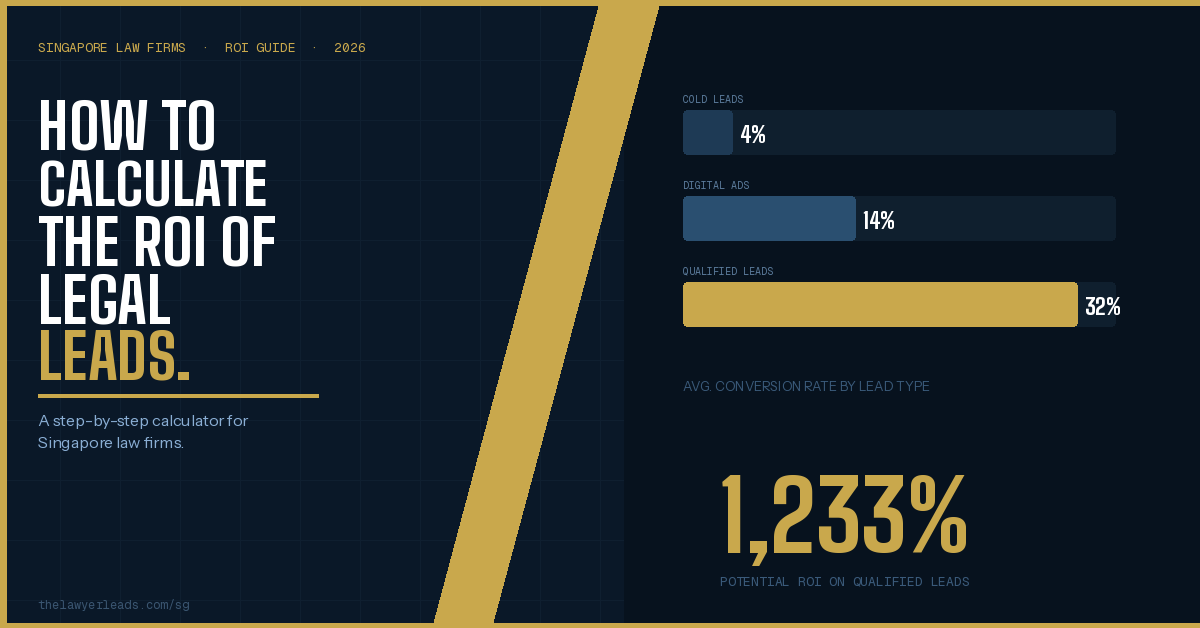
- Cold or unqualified leads: 1% – 5%
- General digital marketing leads: 8% – 15%
- Pre-screened, qualified leads (like those from The Lawyer Leads): 20% – 40%
The gap between cold and qualified is not marginal — it is transformative. A lead that has already been screened for intent, practice area fit, and urgency arrives halfway to a decision. Your job is to close, not to convince.
Step 3 — Run the ROI Calculation
Now you have everything you need. Here is the formula:
ROI Formula
Revenue per lead = ACV × Conversion Rate
Gross profit per lead = Revenue per lead − Cost per lead
ROI (%) = (Gross profit per lead ÷ Cost per lead) × 100
Worked example — Family Law firm:
- ACV: S$8,000
- Conversion rate on qualified leads: 25%
- Revenue per lead: S$8,000 × 25% = S$2,000
- Cost per qualified lead: S$150
- Gross profit per lead: S$2,000 − S$150 = S$1,850
- ROI: (S$1,850 ÷ S$150) × 100 = 1,233%
“At a 25% conversion rate and an S$8,000 average client value, every S$150 lead generates over S$1,800 in gross profit. That is not a marketing expense — that is a business investment with a 12× return.”
— The Lawyer Leads, Singapore
Step 4 — Factor In What You Are Currently Spending
Before comparing lead generation to your current marketing spend, you need to be honest about what your current efforts actually cost — including hidden costs.
Add up:
- Monthly agency or SEO retainer fees
- Google or Meta ad spend
- Directory listings (e.g. Lawyers.sg, FindALawyer)
- The hourly cost of your own time spent on networking, referral management, and chasing unqualified enquiries
That last item is the one most firms undercount. If you bill at S$400/hour and spend 10 hours a month on marketing activities, that is S$4,000 in opportunity cost — every month. Against that benchmark, a pay-per-lead model with zero time overhead looks very different.
The comparison is not just lead cost vs lead cost. It is total cost per acquired client, including your time.
Step 5 — Set a Maximum Acceptable Cost Per Lead
Now that you know your ACV and conversion rate, you can work backwards to calculate the maximum you should be willing to pay per lead while still making a healthy profit.
The formula:
Max CPL = ACV × Conversion Rate × (1 − Target Profit Margin)
Example: ACV S$8,000 × 25% conversion × 70% margin = maximum CPL of S$600
If leads are available at S$150–S$200, you have substantial headroom. This means you can profitably scale — buying more leads while maintaining healthy margins — rather than treating lead generation as a cautious experiment.
The Bottom Line
Legal lead generation is not a cost — it is an investment with a calculable return. Once you know your ACV and conversion rate, the decision to buy qualified leads becomes straightforward arithmetic.
The firms that treat client acquisition this way — as a system with measurable inputs and outputs — are the ones that scale predictably. The ones that treat it as an expense to minimise are the ones perpetually dependent on referral luck.
Run the numbers for your own firm. The ROI may surprise you.
See what qualified leads cost for your practice area.
Browse our pricing and available lead categories for Singapore law firms.
thelawyerleads.com/sg • Singapore’s Legal Lead Generation Platform • Exclusive • Pre-Qualified • Pay-Per-Lead