Why Directory Listings Aren’t Enough: How UK Solicitors Are Finding Clients in 2026

Why Directory Listings Aren’t Enough: How UK Solicitors Are Finding Clients in 2026


For decades, UK solicitors relied on a simple formula: list your firm in the Law Society directory, pay for a premium listing on Solicitors.co.uk, perhaps invest in some Google Ads, and wait for the phone to ring.

That formula is broken.

In 2026, the average UK law firm spends £3,200 per month on marketing activities that generate fewer qualified client enquiries than they did five years ago. Directory listings that once delivered a steady stream of instructions now produce little more than tyre-kickers and price shoppers.

Meanwhile, a growing segment of UK solicitors has quietly abandoned the old playbook. They’re using targeted lead generation to build £500,000+ revenue practices without touching a single directory listing or bidding on expensive Google Ads keywords.

Here’s what’s actually working in 2026—and why the firms still relying on traditional methods are getting left behind.

The Directory Listing Delusion

Pull up the Law Society’s Find a Solicitor directory and search for family law solicitors in Manchester. You’ll find 847 results.

Now put yourself in a potential client’s shoes. Are they really going to scroll through 847 listings to find you? Even if they narrow it down by specialty or location, they’re still looking at dozens of near-identical profiles.

The harsh reality: most directory listings generate zero enquiries per month. The firms that do receive calls from directories are usually competing with 4-6 other solicitors for the same client—a race to the bottom on price.

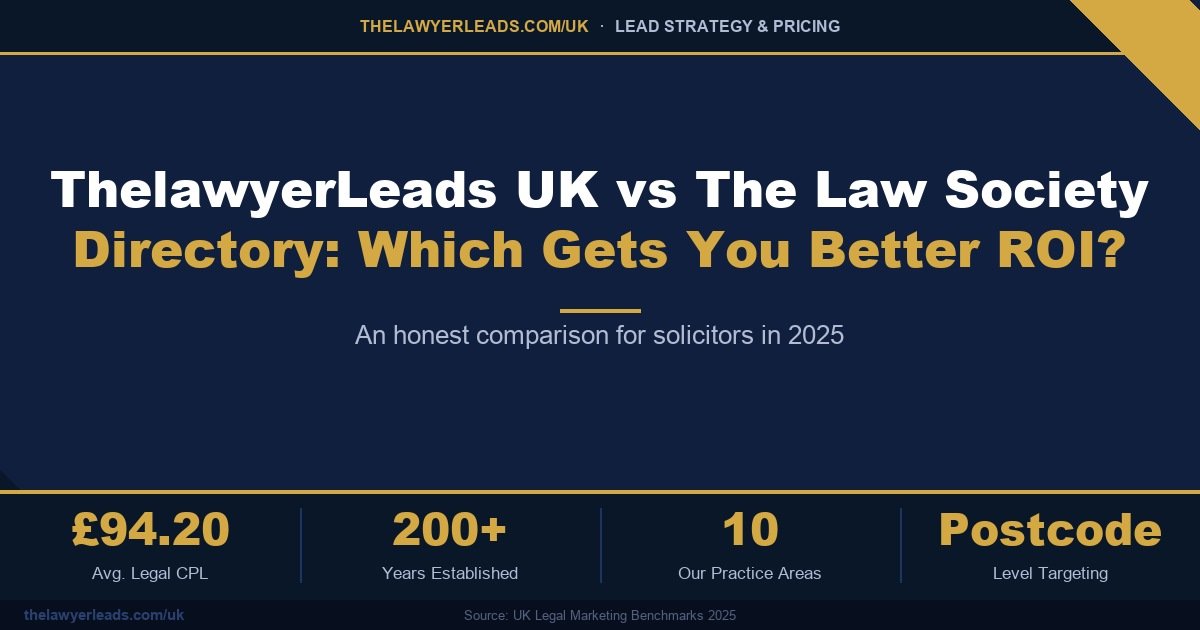
Premium listings on commercial directories like Solicitors.co.uk or Simply.Law cost £150-400 per month. For that investment, the average firm receives 2-3 enquiries monthly, with conversion rates hovering around 15-20%. That’s one new client every two months, at a customer acquisition cost exceeding £1,000.

For high-value practice areas like commercial property or employment law, those economics might work. For volume-based practices like residential conveyancing or consumer immigration, they’re unsustainable.

The Google Ads Money Pit

When directory listings stop working, most solicitors turn to Google Ads. After all, if someone searches “family solicitor near me” or “conveyancing quote”, they’re actively looking for legal help right now.

The logic is sound. The economics are brutal.

Here are the current average cost-per-click rates for common UK legal keywords in 2026:

  • “Divorce solicitor” — £18-32 per click
  • “Personal injury solicitor” — £25-48 per click
  • “Employment solicitor” — £22-38 per click
  • “Conveyancing quote” — £15-27 per click
  • “Immigration solicitor” — £20-35 per click

And those are just clicks, not clients. If your landing page converts at 8% (above industry average) and your enquiry-to-instruction rate is 25% (optimistic), you’re paying £900-2,400 per new client depending on practice area.

Small firms operating on tight margins simply can’t sustain those acquisition costs. Even mid-sized practices struggle to generate positive ROI unless they’re extremely sophisticated with campaign optimization, landing page testing, and remarketing.

The firms winning at Google Ads in 2026 are either large practices with dedicated marketing teams and six-figure monthly budgets, or they’ve found a hyper-specific niche where competition is lower. Everyone else is haemorrhaging money.

Why Traditional Marketing Is Failing UK Solicitors

The client acquisition crisis in UK legal services isn’t random. Three fundamental shifts have made traditional marketing methods obsolete:

1. Client expectations have evolved

Modern legal consumers expect immediate responses. Research from the Legal Services Board shows that 67% of UK legal clients contact multiple solicitors before making a decision—and 73% choose the firm that responds first.

Directory listings are passive. By the time you check your enquiry form submission (usually once or twice daily), that potential client has already spoken to three other firms.

2. Marketing channels are saturated

When every solicitor in your area is listed on the same directories and bidding on the same Google keywords, differentiation becomes impossible. Clients default to choosing based on price or arbitrary factors like which website loaded faster.

The Law Society directory alone has over 140,000 solicitor profiles. Simply.Law lists 25,000+ law firms. Your profile is background noise.

3. Comparison shopping drives down margins

Aggregator sites and comparison tools have trained legal consumers to shop primarily on price. When clients find you through a directory listing or comparison site, they’ve usually already received 2-3 quotes from competitors.

This creates a race to the bottom. Solicitors feel pressure to offer “discounted” conveyancing fees or no-obligation consultations just to compete. The firms that win on price are often the ones that cut corners on service quality.

What High-Growth UK Firms Are Doing Instead

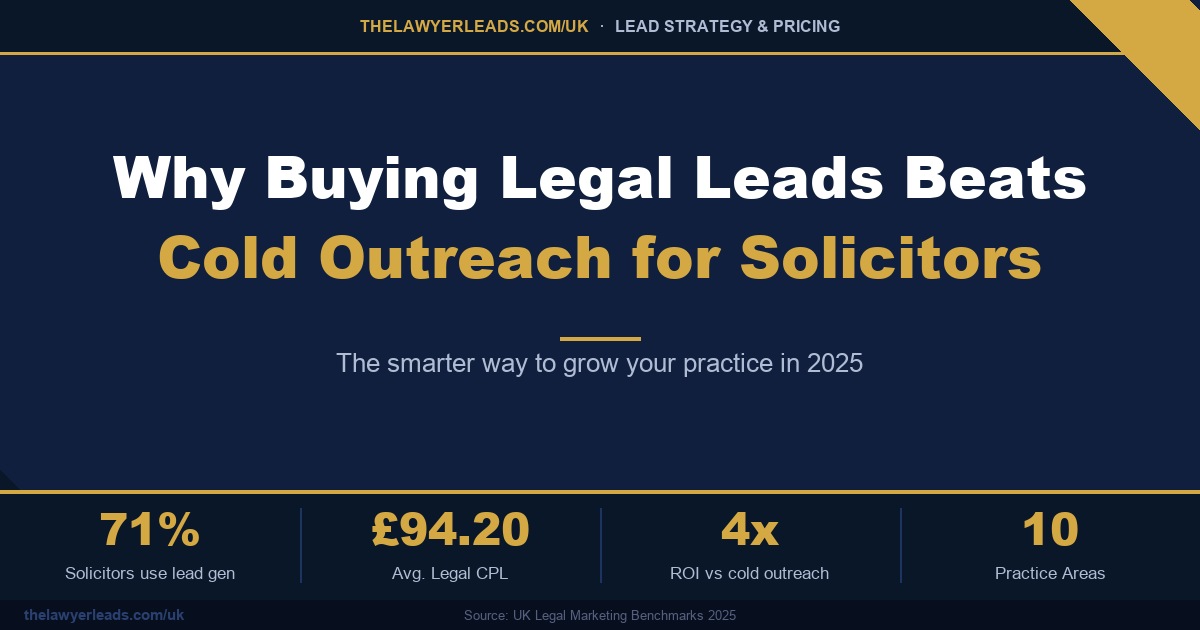
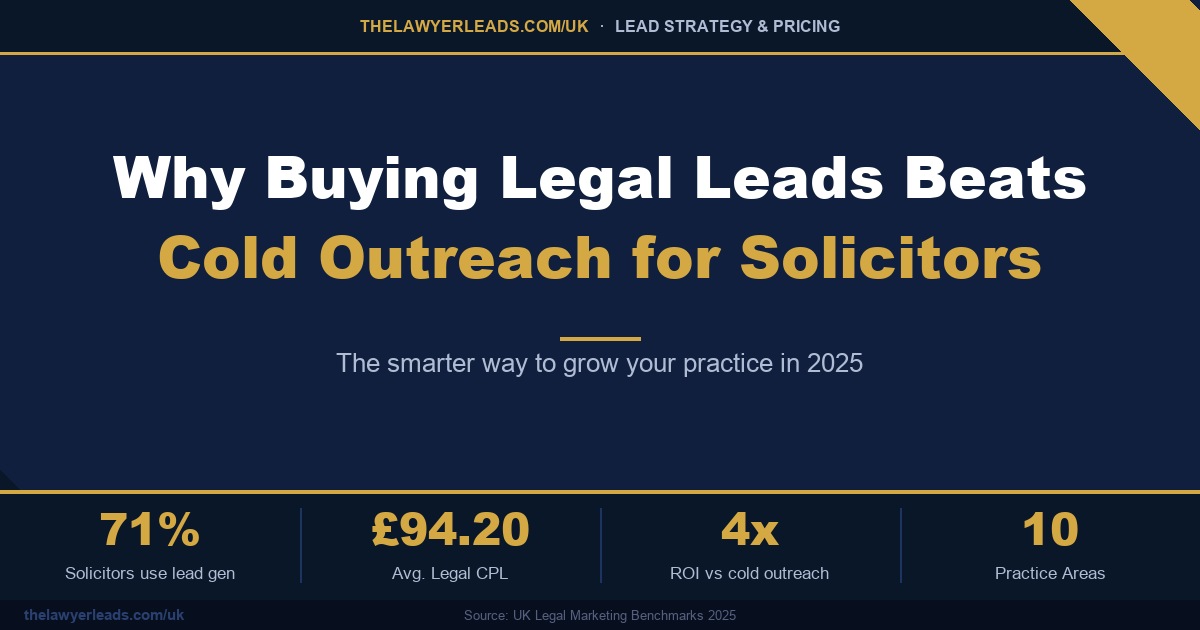
While most solicitors continue throwing money at dying marketing channels, a smaller group has quietly transitioned to a fundamentally different model: purchasing qualified leads instead of renting advertising space.

Here’s how it works:

Instead of waiting for potential clients to find you in a crowded directory or hoping they click your expensive Google Ad, you receive direct notification when someone in your practice area and location needs legal help immediately.

These aren’t cold contacts or vague website form fills. They’re individuals who have actively requested to speak with a solicitor about a specific legal matter and provided their contact details and case information.

The economics are completely different:

  • Pay £50-150 per qualified lead depending on practice area (not per click)
  • Receive exclusive leads sent only to your firm (not shared with 5 competitors)
  • Get immediate notification via SMS and email when leads arrive
  • Only pay for leads that meet your specific criteria and location
  • Scale up or down based on capacity without long-term contracts

A family law solicitor in Birmingham recently shared their numbers: “We were spending £1,800/month on directory listings and Google Ads combined. Generated maybe 6-8 enquiries per month, converted 1-2 into clients. Now we buy 12-15 qualified family law leads monthly at £85 each. Our conversion rate is 45% because we’re the only firm these clients speak to. Revenue’s up 60% and our marketing spend is actually lower.”

The key difference: you’re buying access to clients, not visibility in a crowded marketplace.

The Lead Generation Advantage: Real Numbers

Let’s compare the true cost per client across three common acquisition channels for a hypothetical family law practice in Leeds:

Directory Listings (Premium)
Monthly cost: £350
Monthly enquiries: 3
Conversion rate: 20%
Monthly new clients: 0.6
Cost per client: £583

Google Ads
Monthly budget: £2,000
Average CPC: £25
Monthly clicks: 80
Landing page conversion: 10%
Enquiries: 8
Enquiry-to-client conversion: 25%
Monthly new clients: 2
Cost per client: £1,000

Qualified Lead Purchase
Lead cost: £95 each
Monthly leads purchased: 10
Monthly spend: £950
Conversion rate: 40% (exclusive leads)
Monthly new clients: 4
Cost per client: £238

The qualified lead model delivers more clients at a lower acquisition cost—and requires significantly less time spent on marketing management, campaign optimization, and competing for enquiries.

The Response Time Advantage

Here’s another reality most solicitors don’t appreciate: lead generation providers typically notify you within minutes of a client enquiry, often via SMS.

Compare that to:

  • Directory listing contact forms (checked once or twice daily)
  • Website enquiry forms (might sit unnoticed for hours)
  • Google Ads landing pages (often go to a general inbox)

Industry research consistently shows the same pattern: the first solicitor to respond to a legal enquiry wins the instruction 78% of the time.

Speed isn’t just about client service—it’s about competitive survival. When you receive immediate notification of qualified leads and respond within 5-10 minutes, you’re having the first real conversation. Everyone else is playing catch-up.

Is Lead Generation Right for Your Practice?

Qualified lead generation isn’t a magic solution for every firm. It works best when:

  • You have capacity to take on new clients immediately
  • You can respond to enquiries within 15 minutes during business hours
  • Your practice areas have sufficient client lifetime value to justify £50-150 acquisition costs
  • You’re comfortable with volume-based growth rather than sporadic high-value cases
  • You have systems in place to track conversion rates and client ROI

If you’re still building your practice systems, lack dedicated intake staff, or only want 1-2 new clients per month, traditional directories or referral relationships might be more appropriate.

But if you’re ready to scale, tired of competing on price, and want predictable client acquisition, lead generation represents the future of legal marketing in the UK.

The Bottom Line

Directory listings and expensive Google Ads campaigns still work—just not efficiently, not predictably, and not for most firms.

The UK solicitors building £500,000+ revenue practices in 2026 have made a fundamental shift: they’ve stopped competing for visibility in crowded marketplaces and started purchasing direct access to clients who need their services now.

The firms still clinging to 2015’s marketing playbook are finding it harder each year to justify the costs and effort. The gap between early adopters and holdouts is widening.

Which side of that gap will your practice be on?

Ready to See How Qualified Lead Generation Works?

Discover transparent pricing with no monthly retainers, no long-term contracts, and no shared leads.

View Lead Pricing

Legal Lead Quality vs Quantity: What UK Law Firms Should Really Focus On

Legal Lead Quality vs Quantity: What UK Law Firms Should Really Focus On

⏱️ Estimated Reading Time: 4 minutes


Introduction

Many UK law firms ask the same question:
“Should we get more leads — or better leads?”

While high lead volume may look impressive on paper, it often results in wasted time, overloaded intake teams, and poor ROI. This article explains why lead quality consistently outperforms lead quantity — and how UK law firms can make smarter, more profitable lead decisions.


1. More Leads Doesn’t Mean More Clients


Receiving dozens of enquiries can feel productive, but if most leads are unqualified, outside your practice area, or highly price-sensitive, they quickly drain resources.

📉 Common problems with high-volume leads:

  1. Time wasted on unqualified calls
  2. Low conversion rates
  3. Overloaded intake teams
  4. Poor client experience

Volume without relevance creates noise, not growth.


2. High-Quality Leads Are Easier to Convert


High-quality legal leads typically come from clients who are:

  1. Actively seeking legal help
  2. Aligned with your practice area
  3. Located within your service region
  4. Ready to speak with a solicitor

These enquiries require less persuasion and convert faster.

💡 One strong, relevant enquiry often outperforms ten weak ones.


3. UK Clients Value Relevance — Not Speed Alone


Speed matters, but relevance closes the deal.

A client searching for an employment solicitor in Leeds does not want to speak with a general practice firm based in London. When your response aligns with their exact legal need, trust increases immediately.

🎯 Quality leads are aligned by:

  1. Practice area
  2. Geographic location
  3. Urgency level
  4. Case type

Relevance turns responses into conversations — and conversations into clients.


4. Quantity-Based Marketing Hurts ROI


High-volume lead campaigns may appear cheaper upfront, but they often cost more in the long run due to low conversion performance.

💷 The real metric is not cost per lead — it’s cost per signed client.

UK law firms focused on quality typically achieve:

  1. Higher conversion rates
  2. Lower cost per client
  3. Stronger reviews and referrals

Better leads create better outcomes across the board.


5. How UK Law Firms Can Improve Lead Quality


To prioritise quality over quantity, firms should:

  1. Filter leads by practice area
  2. Select region-specific enquiries
  3. Exclude low-intent submissions
  4. Use exclusive lead delivery
  5. Track conversion data — not just volume

Platforms like TheLawyerLeads UK are built to prioritise relevance and intent, not mass submissions.


Conclusion: Fewer Leads, Better Results


In legal marketing, quality always beats quantity.
UK law firms that focus on the right leads — instead of simply more leads — grow faster, work smarter, and build stronger client relationships.


Looking for Better Leads — Not Just More?

👉 Explore high-intent, exclusive legal leads tailored for UK law firms with TheLawyerLeads UK

How Fast Response Time Impacts Legal Lead Conversion in the UK

How Fast Response Time Impacts Legal Lead Conversion in the UK

⏱️ Estimated Reading Time: 4 minutes


Introduction

In the UK legal market, speed is no longer optional — it’s a competitive advantage. Even with high-quality or exclusive legal leads, delayed responses can cost law firms valuable clients. In this article, we break down why response time plays a critical role in legal lead conversion and how UK law firms can build a faster, more effective intake process.


1. UK Legal Clients Contact Multiple Firms


Most people searching for legal help in the UK don’t wait for one response.
They submit enquiries to multiple law firms within minutes.
⏱️ If your firm responds hours later, the client may have already spoken to another solicitor — or even instructed them.


2. The First Meaningful Response Builds Trust


It’s not just about replying fast — it’s about replying with relevance.
A quick response that acknowledges the client’s issue, location, or urgency instantly builds credibility and confidence.

💬 Example:
“Thanks for reaching out regarding an employment dispute in Birmingham. We handle cases like this regularly and can advise you today.”


3. Delayed Responses Lower Lead Value


Every minute that passes reduces a lead’s conversion potential.
What starts as a high-intent enquiry can quickly turn cold if the client feels ignored or uncertain.

📉 Slow responses lead to:

  1. Lower conversion rates
  2. Higher cost per client
  3. Wasted marketing spend


4. Exclusive Leads Still Require Speed


Even exclusive leads — where no other firm receives the enquiry — perform best when handled quickly.
Why?
Because clients expect professionalism. A fast reply signals organisation, reliability, and seriousness.

🚀 Speed enhances exclusivity — it doesn’t replace it.


5. How UK Law Firms Can Respond Faster


Here are practical ways to improve response time:

  1. Enable instant email or SMS alerts
  2. Assign a dedicated intake handler
  3. Use short response templates for first contact
  4. Schedule callbacks immediately
  5. Integrate leads with CRM or WhatsApp Business

Platforms like TheLawyerLeads UK deliver leads in real time so firms can act instantly.


Conclusion: Speed Turns Leads into Clients


In legal lead generation, the fastest professional response often wins the client.
By combining exclusive, high-intent leads with a fast intake system, UK law firms can dramatically improve conversions and ROI.


Ready to Go Exclusive?

👉 Explore real-time, exclusive legal leads for UK law firms at TheLawyerLeads UK

SIMILAR ARTICLES

Why Exclusive Legal Leads Deliver Better Results for UK Law Firms

Why Exclusive Legal Leads Deliver Better Results for UK Law Firms

⏱️ Estimated Reading Time: 4 minutes

Introduction

In today’s crowded UK legal market, sharing leads with multiple firms is a losing game. When potential clients get calls from several lawyers, your chances of converting them drop sharply. That’s why exclusive legal leads have become the gold standard for law firms looking to grow efficiently and consistently.

In this article, we explain why exclusive leads outperform shared leads — and how your firm can benefit from using a trusted provider like TheLawyerLeads UK.


1. You Eliminate Direct Competition


With shared leads, several law firms contact the same person. The client often goes with whoever replies first or quotes the lowest price — not necessarily the best fit.

🎯 With exclusive leads, you’re the only one reaching out. That gives you time to understand the case, build rapport, and present your offer without competing for attention.


2. Higher Conversion Rates, Lower Marketing Waste


Exclusive leads are pre-screened and directly matched to your selected practice area and region. That means less chasing unqualified prospects and more signed retainers.

📈 Result: Higher close rates and lower acquisition cost per client.


3. Better Client Experience = Stronger Reputation


When only one firm contacts the client, the experience feels more professional and less “salesy.”

Clients feel valued and respected — a crucial factor in the UK’s reputation-driven legal sector.

💬 This also increases referrals, repeat business, and online reviews.


4. You Control the Intake Speed and Tone


Because you’re not competing with other firms, you can structure your intake process for quality instead of urgency. Respond promptly but with care, and tailor your communication style to the client’s tone and case type.

🕒 This balance builds trust right from the first interaction.


5. Exclusive Leads Integrate Better with Advanced Filters


When you combine exclusivity with advanced lead filters — like case type, region, or urgency — you get the perfect match for your firm’s expertise and workload.

🧠 TheLawyerLeads UK platform lets you refine leads by:

  1. Legal practice area
  2. UK city or county
  3. Urgency level
  4. Case value or type


Conclusion: Quality Beats Quantity


In lead generation, more isn’t always better — better is better.

Exclusive leads ensure every inquiry you receive is truly yours to convert, nurture, and retain.

With TheLawyerLeads UK, you’ll gain access to verified, exclusive, and practice-specific leads — helping you grow your firm without wasting time competing for the same prospects.


Ready to Go Exclusive?

👉 Explore Exclusive Legal Leads for UK Lawyers at TheLawyerLeads.com/UK

Top 5 Lead Generation Mistakes UK Law Firms Should Avoid

Top 5 Lead Generation Mistakes UK Law Firms Should Avoid

⏱️ Estimated Reading Time: 5 minutes

Introduction


Generating legal leads is essential for growing your UK law firm — but if your strategy has gaps, you could be wasting money and missing valuable clients.

From targeting the wrong audience to slow follow-ups, small missteps in your lead management process can have a major impact on your conversion rate. In this article, we’ll explore the top 5 mistakes UK law firms make in lead generation and how to avoid them.

1. Not Defining Your Ideal Client Clearly


Before running ads or buying leads, you must know exactly who you want to reach. Many firms target too broadly, attracting unqualified prospects.

🎯 Fix: Identify your ideal client’s location, legal issue, income range, and urgency. TheLawyerLeads UK allows you to filter leads based on these exact parameters — ensuring every enquiry fits your firm.


2. Relying Only on Referrals


Referrals are great, but they’re unpredictable. In the modern UK legal market, firms that rely solely on word-of-mouth risk stagnation.

📈 Fix: Combine your referral flow with paid lead generation. With exclusive, pre-screened leads, you can maintain a steady stream of new cases year-round.


3. Responding Too Slowly


The biggest conversion killer? Delayed response times. UK consumers often contact multiple firms simultaneously — the first to respond usually wins the client.

⏱️ Fix: Use instant lead notifications and assign a dedicated intake person or system to respond within 5 minutes.


4. Treating All Leads the Same


Not every lead has the same urgency or budget. Sending the same pitch to all prospects can turn qualified leads away.

💡 Fix: Segment leads by case type, urgency, and region. For example, treat an urgent employment dispute differently from a routine will inquiry.


5. Not Tracking Lead Performance


If you’re not analysing what works, you’re guessing. Many firms don’t track lead-to-client conversions, cost per client, or region-based performance.

📊 Fix: Track every lead source and conversion rate. Reinvest in what performs best — for example, leads from Greater London or immigration law may yield higher ROI than others.


Conclusion: Generate Smarter, Not Harder


The UK legal industry is evolving fast. To stay ahead, law firms must combine smart targeting, speed, and analytics to turn leads into loyal clients.

With TheLawyerLeads UK, you get advanced filters, exclusive leads, and real-time delivery — helping your firm focus on what matters most: winning new clients efficiently.


Ready to Grow?


👉 Explore TheLawyerLeads UK and start receiving qualified, exclusive legal leads tailored to your firm’s goals.

How to Maximize Your ROI from Legal Leads in the UK

How to Maximize Your ROI from Legal Leads in the UK

⏱️ Estimated Reading Time: 5 minutes


Introduction


Legal leads can be a game-changer for UK law firms — but only if you’re using the right strategy to handle and convert them. Many firms waste time or money chasing cold leads, missing out on the real ROI potential that quality lead generation platforms like TheLawyerLeads UK can offer.

In this blog, we’ll show you how to make every lead count and significantly boost your return on investment from paid legal leads in the UK market.


1. Know Your Practice Area Inside Out


Don’t buy every lead. Focus on your strongest legal verticals — whether it’s immigration, conveyancing, personal injury, or business law. Choose leads that match your specialty and capacity so you can deliver results fast.

🛠️ Tip: On TheLawyerLeads UK, you can filter leads by legal category and even choose only those from specific UK cities or regions.


2. Respond Within Minutes, Not Hours


Speed = conversions. Leads go cold quickly, and UK consumers tend to compare multiple firms. If you call or email within 5 minutes of receiving a lead, your chances of converting skyrocket.

📲 Pro tip: Use an auto-responder or integrate leads into your CRM for real-time notifications.


3. Personalise Your Initial Contact


Avoid sounding robotic. Use the information provided in the lead — like location, legal issue, or urgency — to start a more relevant conversation.

🗣️ Example: “Hi Sarah, I see you’re looking for help with a lease dispute in Manchester. Let’s talk about how we can support you.”


4. Use a Clear Follow-Up System


Most leads don’t convert on the first try. Have a 3-5 step follow-up plan via calls, emails, or SMS reminders.

🕒 Suggested sequence:

Day 0: First call & email

Day 1: SMS follow-up

Day 3: Reminder email with FAQs

Day 5: Final follow-up offer (free consultation or flat fee)


5. Track Your ROI by Lead Type & Region


Not all leads perform the same. Monitor which regions or practice areas give you better clients or faster closes. This helps you reinvest your budget more intelligently.

📊 Use internal CRM reports or integrate with Google Sheets to track lead outcomes.


Conclusion: Build a Lean, Profitable Intake Funnel


Buying leads is just step one. To truly win, UK firms must focus on responsiveness, follow-ups, and regional targeting. With TheLawyerLeads UK, you’re not just buying data — you’re investing in exclusive, high-intent legal opportunities.

Need Help Getting Started?

📩 Reach out to us to learn how our UK-specific legal leads can help your firm grow smarter, not harder.