Not every county in the UK produces legal leads the same way. A firm in Greater Manchester competes for very different volume, price, and case mix than one in Powys or Norfolk — and pricing your lead spend without accounting for that is how solicitors end up overpaying for underperforming enquiries.
Legal lead generation isn’t a single national market — it’s 48 overlapping regional ones, each with its own competition density, average cost per lead, and mix of practice areas in demand. A conveyancing firm in a commuter-belt county sees completely different demand patterns to a personal injury practice in an industrial region. Understanding county-level legal leads data is the difference between a lead strategy that scales profitably and one that just burns budget.
Why County Matters More Than National Averages
Most legal marketing benchmarks quote a single national average cost-per-lead (CPL) figure, but that number hides enormous regional variation. Competition for personal injury and conveyancing leads is far higher in London, the South East, and major metro counties like Greater Manchester and the West Midlands, pushing CPLs above the national average. Meanwhile, less densely populated counties often carry lower CPLs but also lower search volume — meaning the right strategy depends entirely on where your practice actually operates.
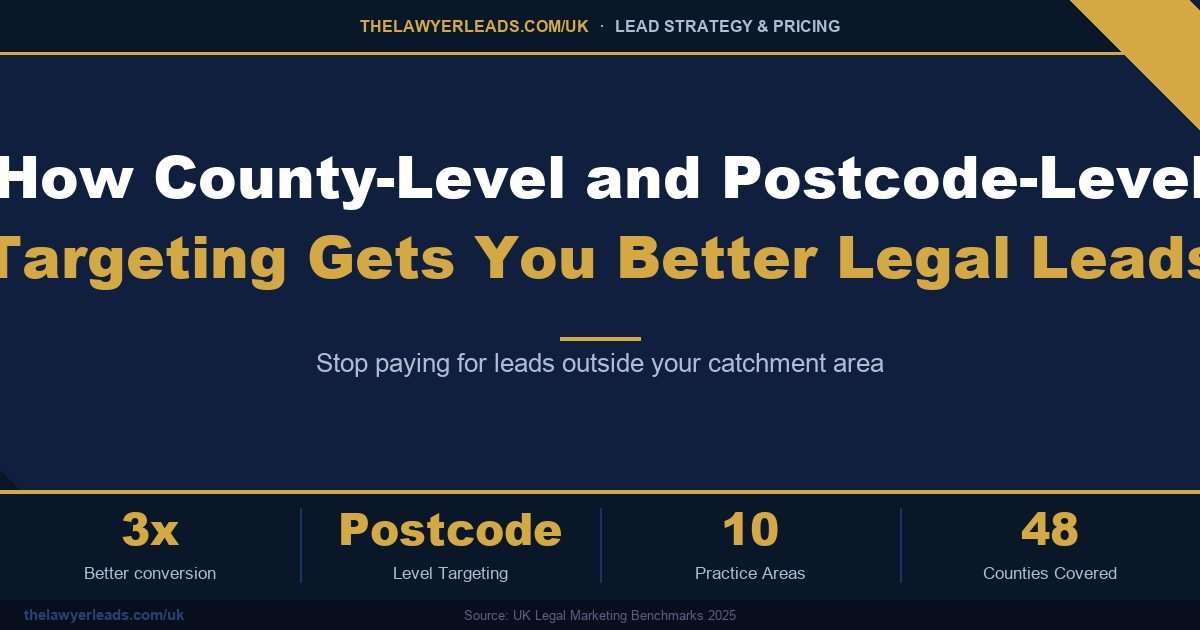
At ThelawyerLeads UK, we built our platform around postcode and county-level targeting specifically because national averages are close to useless for a firm deciding where to spend its acquisition budget. Every lead is filtered and priced according to the county — and often the postcode district — it originates from, so you’re never paying metro-level prices for a lead that’s genuinely local to a lower-competition area, and never underpaying in a way that leaves your pipeline thin.
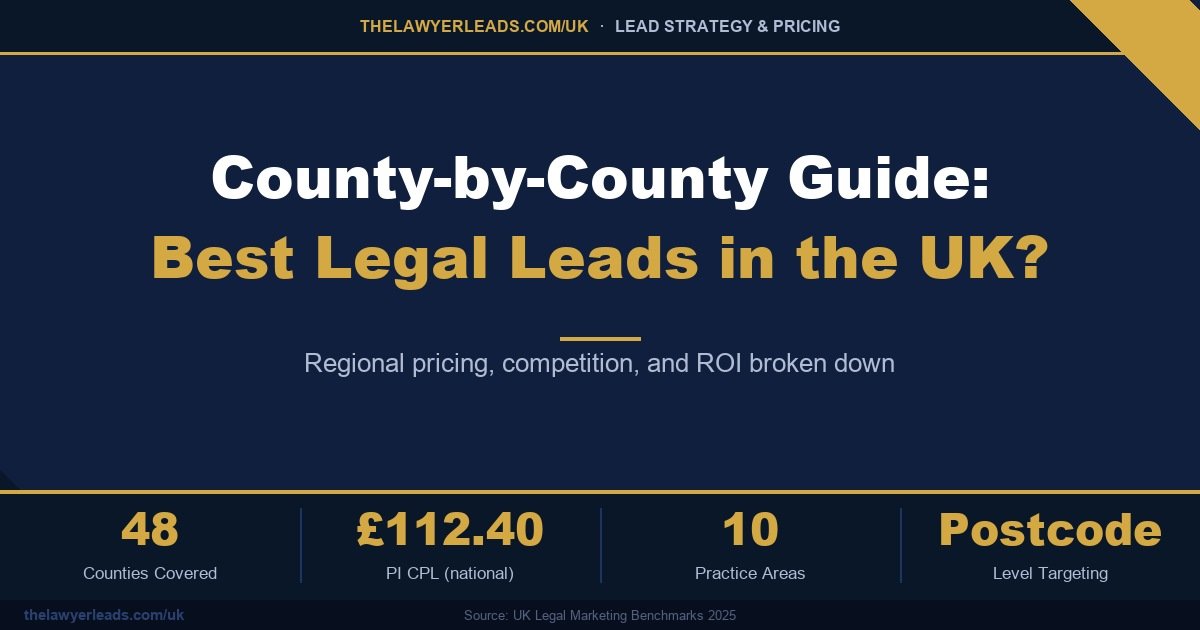
We cover 48 counties across England, Wales, Scotland, and Northern Ireland with dedicated pricing tiers — so your lead spend reflects your actual catchment area, not a blended national estimate.
Regional Pricing and Competition Snapshot
The table below illustrates how competition and pricing shift across a sample of county types. Figures are illustrative averages based on UK Legal Marketing Benchmarks 2025 and reflect the kind of variation solicitors should expect to see across our full 48-county coverage.
| County Type | Competition Level | Relative CPL | Strongest Practice Areas |
|---|---|---|---|
| Major metro (e.g. Greater London, Greater Manchester) | High | Above average | Personal Injury, Employment Law |
| Commuter-belt counties (e.g. Surrey, Hertfordshire) | Medium-High | Above average | Conveyancing, Family Law |
| Industrial / former industrial counties | Medium | Near national average | Personal Injury, Employment Law |
| Rural / lower-density counties | Low | Below average | Conveyancing, Wills & Probate |
How to Use County Data to Plan Your Lead Spend
1. Map your actual catchment, not your postal address
Many firms buy leads based on where their office sits rather than where clients genuinely come from. If your caseload draws from three or four neighbouring counties, your lead sourcing should reflect that spread rather than being anchored to a single postcode.
2. Match practice area to regional demand
Personal injury and employment law leads tend to concentrate around dense working populations, while conveyancing and wills & probate skew toward commuter-belt and rural counties with higher home-ownership turnover. Aligning your lead mix with what a county actually generates avoids paying for enquiries that never convert.
3. Use postcode-level filters to control quality, not just volume
County is a useful planning unit, but postcode-level filtering lets you exclude specific districts that historically convert poorly, without cutting off an entire county’s worth of otherwise strong leads.
▶ Key Insight
Firms that plan lead spend at county and postcode level consistently see stronger conversion than those buying against a single blended national CPL — because they’re only paying for demand that actually exists in their catchment.
Why This Matters for Your Bottom Line
A national average CPL of £112.40 for personal injury leads is a useful benchmark — but it can mask a 30-40% swing between high-competition metro counties and quieter regions. Firms that ignore this variation either overpay in competitive counties without adjusting expectations, or underinvest in quieter counties where leads are cheaper and conversion can be just as strong. Getting the regional picture right is one of the simplest ways to improve ROI without changing anything else about how you handle a case.
County-by-County Guide — Summary
- National averages hide real variation — CPL and competition differ significantly by county.
- Metro and commuter-belt counties carry higher competition and CPL, but stronger volume for PI and family law.
- Rural and lower-density counties offer lower CPL with steady demand for conveyancing and wills & probate.
- Postcode-level filtering refines county-level targeting further, cutting spend on historically weak districts.
- ThelawyerLeads UK covers all 48 counties with dedicated, transparent pricing — no blended national guesswork.
If you’re still buying leads against a single national price point, you’re almost certainly overpaying somewhere in your catchment and underinvesting somewhere else. County and postcode-level data fixes both problems at once.
See Lead Pricing for Your County
We offer transparent, county-specific lead pricing across all major practice areas — with no contracts, no recycled contacts, and full exclusivity options.