
A three-attorney estate planning firm in suburban Ohio was booking four consultations a week from referrals alone — until two of their top referring CPAs retired the same year. Within six months, revenue was down 30% and the partners had no idea how to replace that pipeline without spending six figures on advertising they didn’t understand.
Estate planning is one of the hardest practice areas to market. Clients don’t search the way personal injury or criminal defense clients do — they procrastinate, they research quietly for months, and they buy on trust more than urgency. That makes estate planning client acquisition a different discipline from most legal marketing playbooks, and firms that treat it like a PI campaign usually burn budget with little to show for it.
This post breaks down what actually works for building a predictable client pipeline in wills, trusts, and probate — and where firms consistently waste money.
Why Estate Planning Client Acquisition Behaves Differently
Most estate planning clients are not in crisis. There’s no injury, no arrest, no eviction notice forcing a same-day decision. Instead, the trigger is usually a life event — a new grandchild, a health scare, a friend’s messy probate, or simply turning 60 — that starts a slow-burning search. The buying window can stretch from a few weeks to over a year, and trust signals matter more than speed.
This changes the math on client acquisition. A firm that only measures cost-per-lead against personal injury benchmarks will conclude estate planning marketing “doesn’t work,” when in reality the pipeline just needs a longer nurture cycle and a different qualification standard.
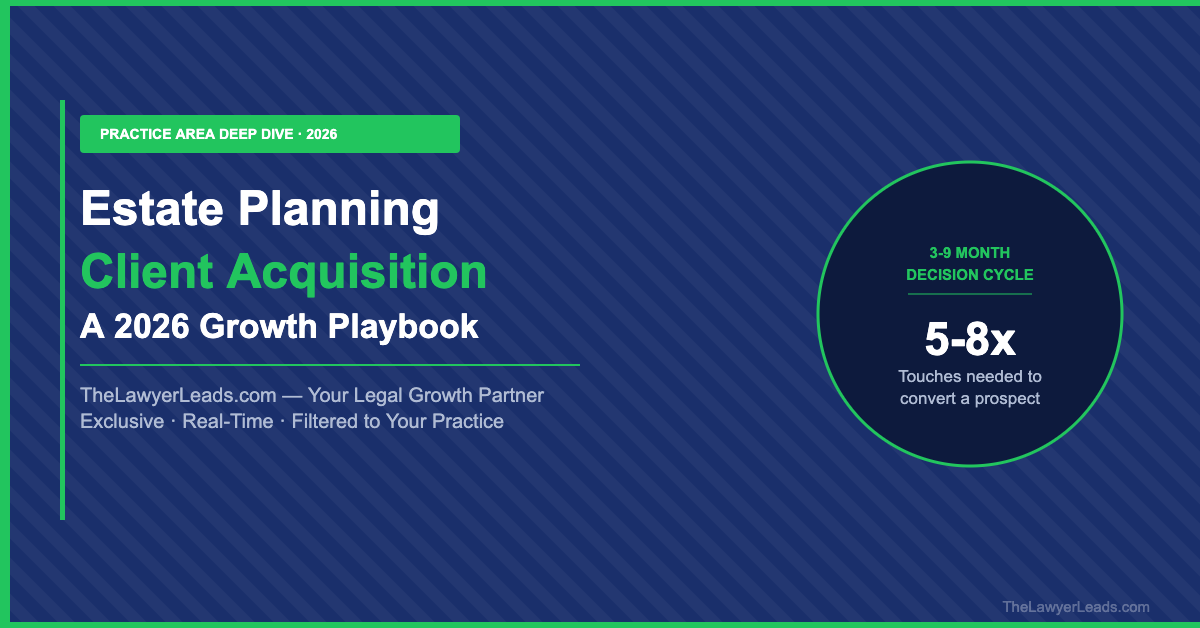
Estate planning prospects typically research for 3–9 months before booking a consultation — nearly triple the average timeline for personal injury or family law inquiries.
Where Firms Waste Budget on Estate Planning Marketing
Broad-match search terms
“Estate planning lawyer” and “wills and trusts attorney” are expensive, crowded, and attract a lot of price-shoppers and DIY-curious browsers who never convert. Firms that instead target intent-specific long-tail terms — “trust for blended family,” “probate avoidance for rental property,” “special needs trust attorney near me” — see meaningfully lower cost per qualified consultation.
One-touch nurture
Because the decision cycle is long, a single follow-up call or one email after a form submission loses the majority of prospects. Firms with strong estate planning pipelines typically run 5–8 touches across call, text, and email over 30–60 days before a prospect is considered dead.
Ignoring referral-adjacent channels
CPAs, financial advisors, and elder-care professionals remain the highest-converting referral source for estate planning — but relying on them exclusively, as the Ohio firm in our opening example did, leaves a firm’s entire pipeline exposed to a handful of relationships. The strongest firms treat referrals as one input into a client acquisition system, not the whole system.
| Metric | Referral-Only Approach | Diversified Growth Pipeline |
|---|---|---|
| Monthly consultations | 3–6, unpredictable | 12–20, consistent |
| Exposure to one channel failing | High | Low |
| Average client acquisition cost | Low but unscalable | Predictable, scalable |
| Ability to forecast revenue | Difficult | Quarter-over-quarter planning |
Building a Predictable Estate Planning Pipeline
A durable client pipeline for estate planning rests on three legs: educational content that captures long-window searchers early, a nurture sequence built for a multi-month decision cycle, and exclusive, filtered leads that let the firm control volume without diluting quality. The firms that grow fastest in this practice area treat all three as one connected system rather than separate initiatives run by different vendors.
Filtering matters more here than almost any other practice area. A lead generated from a generic “free will template” download is a different prospect than someone actively comparing local attorneys for a revocable living trust — and pricing, follow-up cadence, and even the intake script should reflect that distinction.
Key Insight
Estate planning firms that pair exclusive, intent-filtered leads with a structured multi-touch nurture sequence consistently report higher consultation-to-retention rates than firms relying on shared or broad-audience leads — because the prospect has already been qualified on both intent and readiness.
Practical Filters to Apply Before You Spend
Before committing budget to any channel, ask whether it can answer three questions: Can it identify prospects with a specific triggering life event, not just generic estate planning interest? Can it support a follow-up cadence measured in months, not days? And does it give the firm control over volume and geography, rather than competing for the same shared prospect against other firms in the same ZIP code?
Summary: Estate Planning Client Acquisition
- Expect a longer decision cycle — measure success over months, not days, and build nurture sequences accordingly.
- Target intent-specific searches instead of broad, expensive keywords that attract browsers over buyers.
- Diversify beyond referrals so the pipeline survives the loss of any single relationship.
- Filter for readiness, not just interest, using exclusive leads tied to real triggering events.
- Treat acquisition as a system, combining content, nurture, and lead quality rather than isolated tactics.
Build a Predictable Estate Planning Pipeline
TheLawyerLeads.com connects estate planning firms with exclusive, filtered prospects — matched to your practice, your geography, and your capacity.