
A managing partner at a four-attorney firm reviews her monthly report and finds that nearly one in five inquiries she paid for were disconnected numbers, duplicates, or people outside her county. Her provider agreement says nothing about what happens next. The legal lead return policy she never read is now the most expensive clause in her marketing budget.
Most attorneys evaluate a client acquisition partner on price per inquiry, geography, and practice area. Very few negotiate the legal lead return policy before the first invoice, even though it determines how much of your spend is protected when an inquiry turns out to be unusable. This guide explains what a sound policy looks like, which terms to push on, and how to tell a real guarantee from marketing language.
Why a Legal Lead Return Policy Matters More Than Price
A low per-inquiry price means little if there is no mechanism to recover cost on bad records. Industry operators commonly see 8% to 20% of raw inquiries fail basic usability checks: wrong numbers, duplicate submissions, out-of-area residents, or people seeking a different practice area entirely. Without a clear return or credit process, that waste comes straight out of your cost per signed case.
A well-written policy also changes provider behaviour. When a partner knows invalid records will be credited, it has a financial incentive to filter, verify, and de-duplicate before delivery rather than after you complain.
Rule of thumb: if you cannot summarise your provider’s return terms in two sentences, they are probably written to be difficult to use.
What a Strong Legal Lead Return Policy Should Cover
Review the agreement for five specific terms. Each one closes a gap that vague policies leave open.
1. A defined claim window
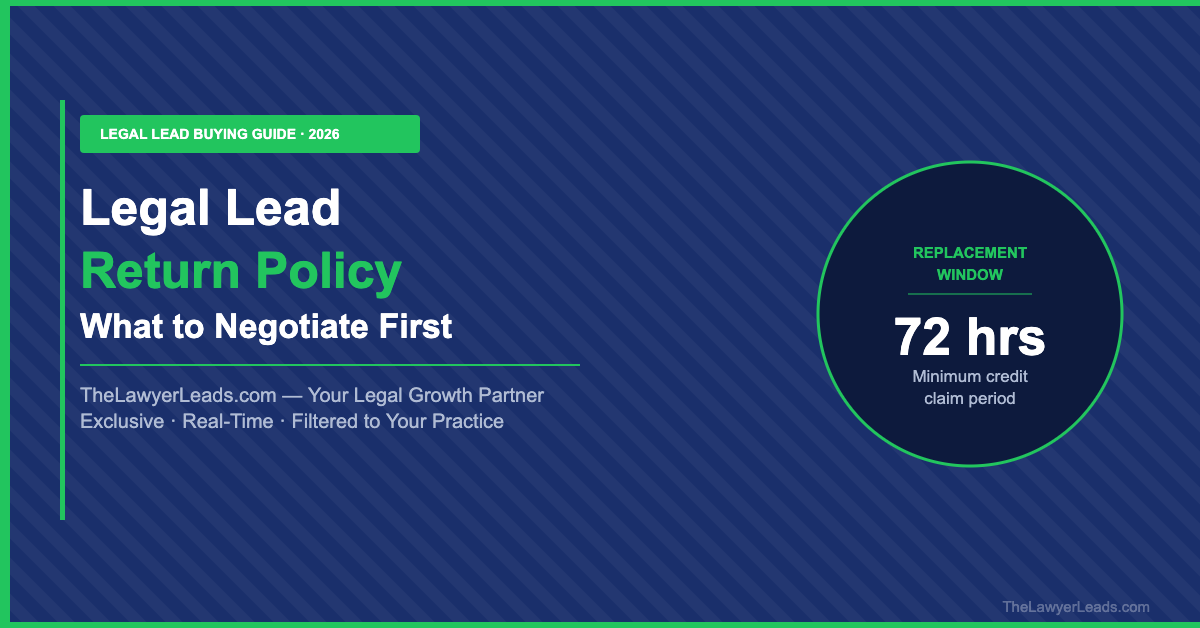
You need enough time to attempt contact and document it. Anything under 48 hours is a warning sign for firms without 24-hour intake; 72 hours to 7 days is a workable range.
2. Objective qualifying reasons
The policy should list the grounds for a credit: invalid or disconnected contact details, duplicates of an inquiry already delivered to you, outside your stated geography, and wrong practice area. Subjective grounds such as “the prospect was not serious” are rarely creditable, and you should not expect them to be.
3. Evidence standards you can actually meet
Ask what documentation is required. A reasonable standard is a call log showing a minimum number of attempts across different times of day. If the provider demands proof you cannot realistically produce, the guarantee is cosmetic.
4. Credit or refund, in writing
Clarify whether approved returns come back as account credit, replacement inquiries, or cash. Credit is common and acceptable, but confirm that unused credit does not expire in 30 days.
5. A response-time commitment
Disputes that sit for three weeks are effectively denied. Look for a stated turnaround, ideally within two business days.
Comparing Return Policies: Weak Versus Strong Terms
| Policy Element | Weak Policy | Strong Policy |
|---|---|---|
| Claim window | 24 hours or unspecified | 72 hours to 7 days |
| Qualifying reasons | “At our discretion” | Listed: invalid, duplicate, out of area, wrong practice |
| Evidence | Recorded calls you cannot produce | Call log with dated attempts |
| Resolution | Store credit that expires | Credit or replacement, no expiry |
| Dispute speed | No stated timeline | Decision within two business days |
Reading Beyond the Return Policy
A return policy is a safety net, not a strategy. The better question is how often you will need it. Ask any prospective partner for its return rate over the last 90 days, how records are verified before delivery, and whether inquiries are exclusive to your firm. Exclusivity matters here because a shared inquiry that three firms call within five minutes is technically valid and practically worthless.
Key Insight
A partner confident in its verification process will talk openly about its return rate. Evasiveness on this number tells you more than any brochure.
Track returns internally too. Log every credit request with a reason code for the first 60 days. If one category, such as out-of-area submissions, dominates, you have found a filtering problem that can be fixed through tighter geographic targeting rather than more claims.
Common Mistakes When Reviewing a Legal Lead Return Policy
Three errors recur across firms. First, never testing the process: submit one legitimate claim in the first month so you know how it works before volume scales. Second, missing the window because intake staff do not flag bad records the same day. Third, accepting verbal assurances from a sales representative that do not appear in the contract. If it is not written down, it is not a policy.
Return Policy Checklist
- Claim window — at least 72 hours, in writing.
- Objective grounds — invalid, duplicate, out of area, wrong practice.
- Achievable evidence — call logs, not impossible proof.
- Credit that holds value — no short expiry on approved credits.
- Fast decisions — two business days or better.
- Ask for the return rate — and test the process in month one.
Build a Client Pipeline With Clear Terms
TheLawyerLeads.com delivers exclusive, filtered inquiries by practice area and geography, with transparent terms from day one.