
Most solicitors know roughly what they spend on marketing each month. Far fewer can say, with any confidence, what that spend actually returns in signed cases. If you’re buying legal leads without tracking ROI, you’re flying blind on the one number that matters most.
Legal lead generation has become the default growth channel for UK firms that want predictable new-client flow without the long lag of SEO or the guesswork of referrals. But “predictable” only holds if you’re measuring the right things. A lead costing £94.20 sounds expensive until you work out what it’s worth once it converts — and worthless if you never do the sum at all.
This guide walks through how to calculate legal lead ROI properly, what a healthy benchmark looks like across practice areas, and how the mechanics of a lead service — targeting, exclusivity, contract terms — quietly move that number in your favour or against it.
The ROI Formula Solicitors Actually Need
Return on investment for legal lead generation isn’t complicated, but it’s rarely calculated with real numbers. The formula is:
ROI = (Revenue from converted leads − Total lead spend) ÷ Total lead spend
The two variables firms most often get wrong are conversion rate and average case value. Conversion rate depends heavily on lead quality — a shared lead sold to five other firms converts at a fraction of the rate of an exclusive one, because the prospect has already spoken to a competitor by the time you call. Case value depends on practice area: a conveyancing instruction and a catastrophic personal injury claim sit at opposite ends of the value scale, and blending them into one average number will mislead you.
What a Healthy Legal Lead Gen ROI Looks Like
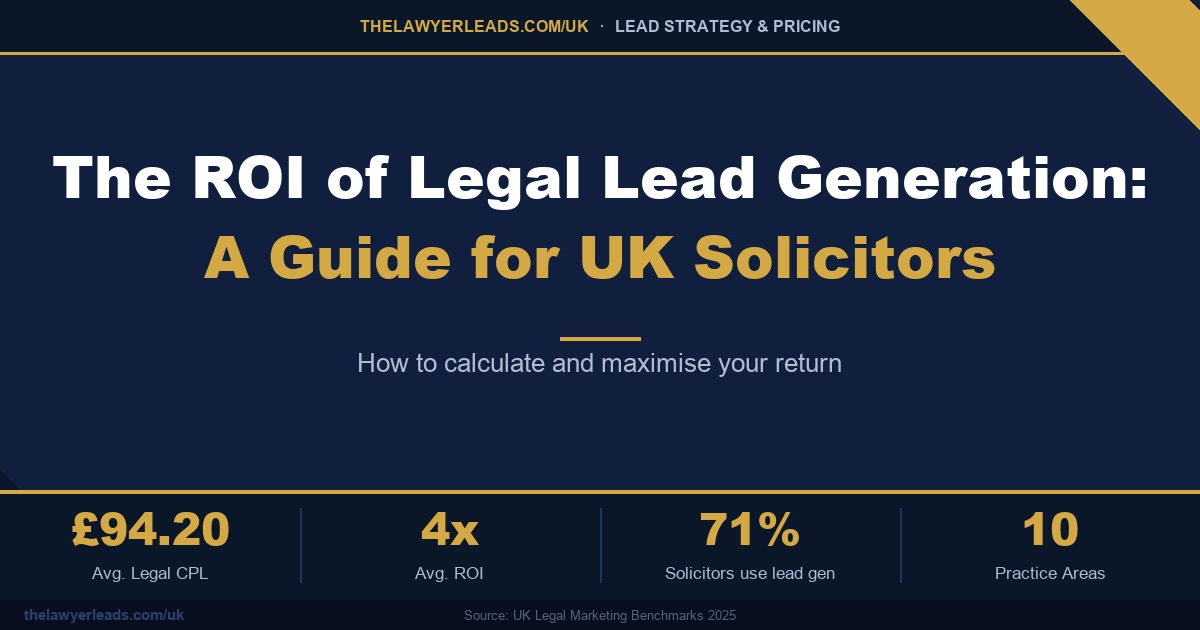
| Metric | UK Benchmark |
|---|---|
| Average legal cost-per-lead | £94.20 |
| Average ROI on lead spend | 4x |
| Solicitors using lead generation | 71% |
| Practice areas commonly served | 10 |
A 4x return means every £1 spent on leads returns roughly £4 in fee income once conversion and case value are accounted for. That’s the number to hold your own campaigns against — if you’re below it, the issue is almost always lead quality or targeting, not the concept of buying leads itself.
The Three Levers That Move Your ROI
1. Exclusivity
A lead sold to one firm converts differently to a lead sold to several. Exclusive leads mean you’re the only solicitor the prospect hears from, which removes the race-to-respond dynamic that kills conversion on shared or recycled contacts. If your current provider won’t confirm exclusivity in writing, assume you’re competing for every enquiry.
2. Geographic Targeting
Postcode and county-level targeting keeps leads inside your actual catchment area, which matters for anything requiring in-person meetings, court attendance, or local knowledge — conveyancing and family law especially. Leads generated at a national level and distributed regardless of location waste spend on enquiries you were never realistically going to convert.
3. Contract Flexibility
Long-term contracts lock in a cost-per-lead regardless of how your ROI trends. A pay-per-lead model without a minimum term lets you scale spend up in practice areas that are working and pull back from ones that aren’t — which, over a quarter, does more for your blended ROI than any single tactic.
▶ Key Insight
Firms that track ROI by practice area — rather than one blended figure across the whole firm — consistently spot underperforming categories faster and reallocate budget before the quarter is wasted.
Tracking ROI Without a Data Team
You don’t need expensive attribution software to track this properly. A simple spreadsheet with lead source, practice area, conversion outcome, and final fee income — reconciled monthly against your lead spend — gives you everything the formula above needs. The discipline matters more than the tooling: firms that review this monthly catch declining conversion trends within weeks; firms that review it annually catch them a year too late.
- Tag every enquiry with its source and practice area at intake
- Record the outcome — converted, declined, or dropped — within 30 days
- Log final fee income against the original lead cost once the matter closes
- Review blended and per-practice-area ROI monthly, not annually
The ROI of Legal Lead Generation — Summary
- Calculate ROI properly — (revenue from converted leads minus spend) divided by spend, split by practice area, not blended.
- 4x is the UK benchmark — firms below that should look first at exclusivity and targeting, not abandon lead gen entirely.
- Exclusivity, postcode-level targeting, and no long-term contracts are the three levers that most reliably improve conversion and cost-efficiency.
- Track monthly, not annually — a simple spreadsheet tagging source, practice area, and outcome is enough to catch problems early.
Buying legal leads isn’t inherently more or less profitable than any other growth channel — it’s only as good as the measurement discipline behind it. Get the tracking right, and the ROI conversation with your practice manager becomes a lot easier to have.
See Lead Pricing for Your County
We offer transparent, county-specific lead pricing across all major practice areas — with no contracts, no recycled contacts, and full exclusivity options.