
A mid-sized personal injury firm spends $18,000 a month on ads, phones ring constantly, and yet the partner cannot say with confidence how many of those calls became signed clients. The marketing budget looks busy. The intake conversion rate the number that actually matters has never been measured.
Most firms know their cost per lead. Far fewer know their intake conversion rate the percentage of inquiries, calls, and form fills that turn into signed clients. That single number determines whether a marketing dollar is well spent or wasted, and it is the lever most attorneys never pull. Improving law firm intake conversion rates is usually cheaper and faster than buying more traffic, because the leads are already arriving. The problem is what happens to them after the phone rings.
Why Intake Conversion Rate Is the Metric That Matters Most
Ad spend, SEO rankings, and even lead volume are vanity metrics if the intake process leaks prospects. A firm that converts 45% of qualified inquiries into signed clients is getting roughly twice the return on every marketing dollar as a firm converting 22%, without spending a cent more on acquisition. Yet in our conversations with firm owners, the vast majority track cost-per-lead religiously and have never calculated their own intake-to-signed-client percentage.
The math is simple: if you generate 100 inquiries a month at $150 each ($15,000 spend) and convert 25 into clients, your true cost per client is $600. Raise conversion to 35% with zero additional spend, and cost per client drops to $429 a 29% efficiency gain that shows up directly on the bottom line.
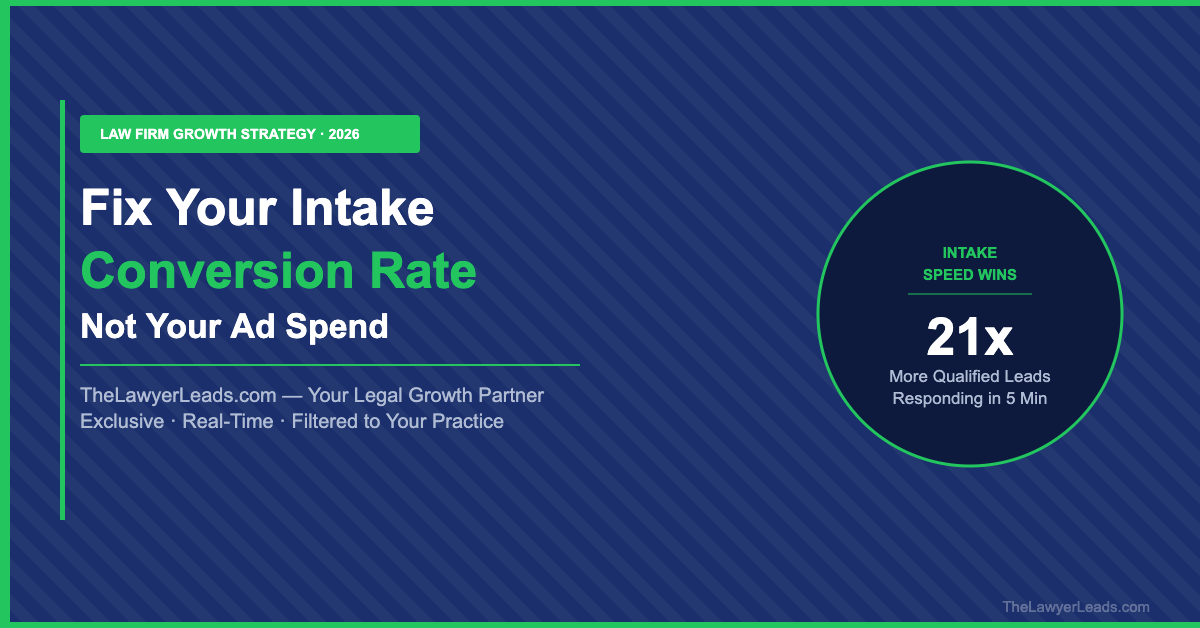
Firms that respond to a new inquiry within 5 minutes are roughly 21 times more likely to qualify that lead than firms that wait 30 minutes, according to widely cited speed-to-lead research across service industries. In legal intake, where consumers routinely call three or four firms back to back, that window is often the entire game.
Where Law Firms Lose Clients in the Intake Funnel
Speed to Contact
Every hour a lead sits unanswered, the probability of ever reaching that person drops sharply. Prospective clients who called an injury or family law firm rarely wait quietly; they move to the next result. A firm serious about improving intake conversion needs a same-hour, ideally same-minute, response standard even if that first contact is just a scheduling text.
Script Quality and Staff Training
Front-desk staff or paralegals answering intake calls without a structured script tend to sound transactional, which undermines trust at the exact moment a prospective client is deciding whether to hire the firm. A consistent, empathetic intake script that qualifies the case while building rapport consistently outperforms ad-hoc conversations.
Follow-Up Cadence
Most firms give up after one or two follow-up attempts. Data across service-based industries shows meaningful conversion lift when follow-up extends to five or more touches across call, text, and email over the first 72 hours. Prospects who do not answer the first call are not lost they are simply busy.
| Intake Practice | Typical Firm | Growth-Focused Firm |
|---|---|---|
| Response Time | 30-60+ minutes | Under 5 minutes |
| Follow-Up Attempts | 1-2 calls | 5+ touches over 72 hours |
| Intake Script | Informal, staff-dependent | Standardized, tested, and tracked |
| Lead Source Tracking | Not measured by channel | Conversion tracked by source and staffer |
Building an Intake System That Scales With Your Pipeline
Improving conversion is not a one-time fix; it is an operating system. Firms that sustain high intake conversion rates typically build three things: a documented response-time SLA (with accountability if it slips), a CRM or intake tool that timestamps every touch so nothing falls through, and monthly review of conversion by lead source and by staff member so coaching is based on data, not guesswork.
This is also where the quality of the client pipeline itself matters. A firm feeding its intake team a mix of exclusive, pre-qualified inquiries converts more efficiently than one drowning in shared or unfiltered leads, because staff spend their limited time on prospects who actually match the firm practice areas and case criteria.
Key Insight
Conversion rate optimization compounds. A firm that improves intake conversion from 25% to 35% does not just sign more clients this month it permanently lowers its cost per client for every future dollar of marketing spend, freeing budget to reinvest in growth rather than replace leakage.
Measuring ROI: What to Track Monthly
A firm serious about client acquisition ROI should track four numbers every month: cost per lead by source, intake conversion rate by source, cost per signed client by source, and average case value by source. Together, these reveal which channels and which intake habits are actually building the pipeline versus which are just generating noise. Firms that review this dashboard monthly consistently outperform those that review marketing spend only at renewal time.
Quick-Reference Summary
- Measure intake conversion, not just lead volume it is the number that actually drives ROI.
- Respond within 5 minutes speed to contact is the single highest-leverage fix most firms can make this week.
- Standardize the intake script consistency across staff protects conversion regardless of who answers.
- Extend follow-up to 5+ touches most lost clients simply were not reached enough times.
- Feed the funnel with quality exclusive, well-filtered inquiries convert at a materially higher rate than shared leads.
Build a Pipeline Your Intake Team Can Actually Convert
TheLawyerLeads.com connects your firm with exclusive, real-time client inquiries filtered to your practice area so your team spends its time converting, not sorting.