
A personal injury firm in Tampa spends $4,200 a month on paid search and gets a trickle of clicks. Three blocks away, a two-partner firm with a fraction of that budget shows up in the Map Pack for “personal injury lawyer near me” every single time someone searches it — and their phone rings before the ad ever loads.
That gap isn’t luck. It’s a local SEO checklist for law firms that most practices never fully execute. Local search — the Google Business Profile listing, the Map Pack, the “near me” results — drives a disproportionate share of legal client inquiries, and it costs nothing per click. Yet most firm websites are set up to chase organic blog traffic or national keywords while leaving the three-pack, the highest-intent real estate on the entire search results page, half-optimized or outright neglected.
Ranking there in 2026 requires more precision than it did even two years ago. Google’s local algorithm now weighs review velocity, citation consistency, and on-page proximity signals more heavily than raw backlink counts. Here is the full local SEO checklist for law firms that actually moves the needle — and where most firms are quietly losing ground.
What Local SEO Actually Means for a Law Firm in 2026
Local SEO is the set of signals Google uses to decide which three firms appear in the Map Pack when someone searches “divorce attorney [city]” or “car accident lawyer near me.” It is governed by three factors: relevance (does your profile and website match the search), distance (how close is your office to the searcher), and prominence (how established and trusted does Google consider your firm, based on reviews, citations, and links).
Firm owners often confuse local SEO with general SEO — blog posts, backlinks, domain authority. Those still matter for organic rankings further down the page, but the Map Pack runs on a separate set of rules, and a firm can rank #1 organically while being invisible in the three-pack because its Google Business Profile is thin or its citations are inconsistent.
Why This Matters More for Attorneys Than Most Industries
Legal searches are almost entirely local and high-intent. Nobody searches “bankruptcy attorney” out of curiosity — they search it because they are days from a filing deadline or a wage garnishment. That urgency is why the Map Pack converts better than a display ad: the searcher is choosing from three visible, verified options, not scrolling past ten blue links.
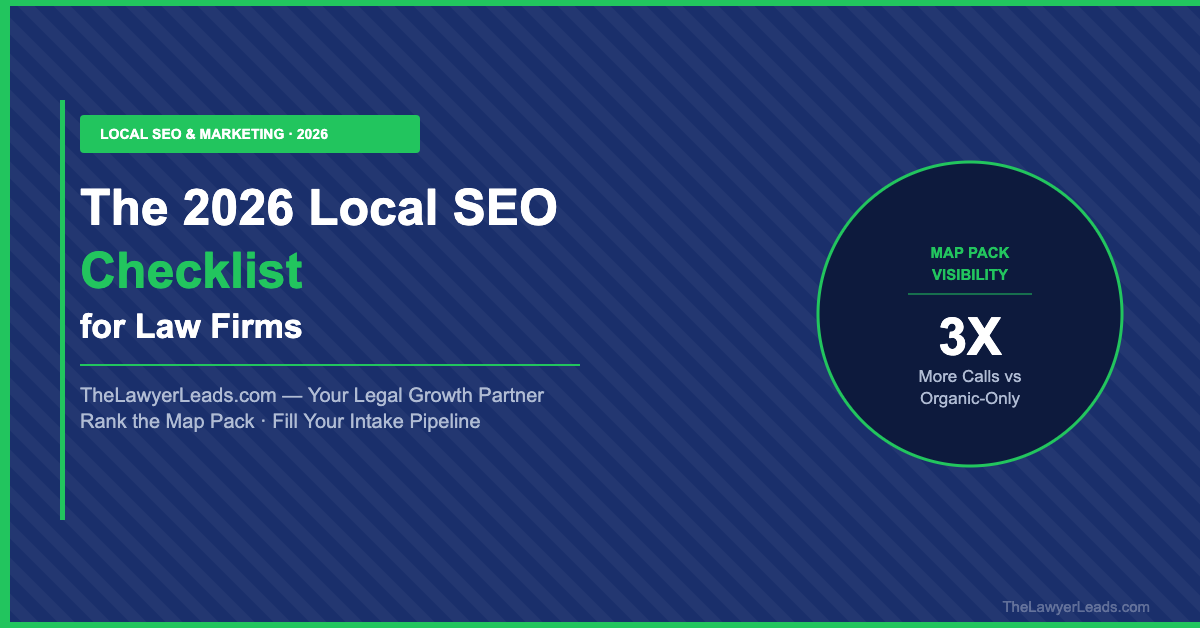
Firms that appear in the Map Pack for their core practice-area keyword typically see 2–3x the call volume of firms ranking only in the organic results below it, at zero marginal cost per lead.
The Google Business Profile Checklist
Your Google Business Profile (GBP) is the single highest-leverage asset in local SEO for law firms. Most firms claim it once, fill in the basics, and never touch it again — which is precisely why an actively maintained profile outperforms a dormant one, even when the dormant firm has more years in practice.
| GBP Element | Typical Firm Setup | Optimized Setup |
|---|---|---|
| Categories | “Lawyer” only | Primary + 3–5 specific categories (e.g. “Personal Injury Attorney”) |
| Review Cadence | A handful from years ago | 4–8 new reviews per month, ongoing |
| Photos | Logo only | Office, team, and case-result photos updated quarterly |
| Q&A Section | Empty | Firm pre-seeds 5–10 common client questions |
| Posts | Never used | Weekly update or case-type spotlight |
Review velocity deserves special attention: Google weighs the rate of new reviews, not just total count. A firm with 40 reviews trickling in over six years signals less current activity than a firm with 25 reviews added steadily over the last twelve months — even though the second firm has a smaller total.
On-Site and Citation Signals That Move the Needle
A strong GBP only works alongside a website that reinforces the same signals. Google cross-references your listing against your site and third-party directories — when they disagree, rankings suffer.
NAP Consistency
Your firm’s Name, Address, and Phone number (NAP) must be identical, character-for-character, across your website, GBP, and every legal directory listing — Avvo, FindLaw, Justia, the state bar directory, and local chamber sites. “Suite 200” versus “Ste. 200” is enough of a mismatch to dilute prominence signals.
Location-Specific Landing Pages
Firms serving multiple cities or counties need a dedicated page per location — not a single “areas we serve” list. Each page should include unique content about that location, embedded map, local testimonials where available, and the practice-area keyword paired with the city name in the title tag and H1.
Key Insight
A firm with five well-built location pages consistently outranks a firm with one generic “service area” page listing the same five cities in a sentence. Depth beats breadth in local SEO.
Schema Markup
LegalService and Attorney schema markup tells Google explicitly what your firm does, where it operates, and what it charges (or that consultations are free) — removing ambiguity that would otherwise be inferred, often incorrectly, from unstructured text.
Common Mistakes That Keep Firms Out of the Map Pack
The most common failure isn’t a missing tactic — it’s inconsistency. A firm runs a review campaign for one month, stops, and wonders why rankings plateaued. Local SEO rewards sustained activity more than any single optimization.
Other frequent errors: using a call-tracking number on the GBP that doesn’t match the website (a major NAP violation), stuffing the business name field with keywords like “Smith Law — Personal Injury & Car Accident Attorneys” (a violation of Google’s guidelines that risks suspension), and ignoring negative reviews instead of responding professionally, which signals inactivity to both Google and prospective clients.
Google Business Profile suspensions for keyword-stuffed business names are among the most common — and most preventable — ranking losses firms report each year.
Local SEO Checklist Summary
- Claim and fully complete your GBP — categories, hours, services, and attributes, not just name and address.
- Build a steady review cadence — 4–8 new reviews per month beats a one-time push to 50.
- Lock down NAP consistency across your site, GBP, and every legal directory.
- Build dedicated location pages for every city or county you actively serve.
- Add LegalService schema markup to remove ambiguity for search engines.
- Respond to every review, positive and negative, within a few days.
Local SEO compounds. A firm that executes this checklist consistently for two quarters typically sees Map Pack visibility firm up before organic rankings catch up — and unlike paid search, that visibility doesn’t disappear when the budget pauses. Even a firm doing everything right locally still needs a way to fill gaps in slow months or new practice areas.
Build Your Pipeline While Your SEO Compounds
TheLawyerLeads.com pairs exclusive, filtered client opportunities with your organic growth strategy — so your intake stays full while your Map Pack rankings climb.