
A personal injury firm in Phoenix books 40 consultations a week. On paper, the pipeline looks healthy. In reality, only 24 people show up — the other 16 slots, and the marketing dollars behind them, simply evaporate.
Every firm obsesses over lead volume and cost per lead. Far fewer track what happens between “consultation booked” and “consultation held.” That gap — the consultation no-show rate — is one of the most expensive and most fixable leaks in law firm client acquisition. Firms that treat it as a growth metric, not an administrative afterthought, routinely convert 20–35% more of the leads they’re already paying for.
Why Consultation No-Shows Are a Growth Problem, Not a Scheduling Problem
Most firms respond to no-shows with more reminders — a text here, an email there. Reminders help, but they treat a symptom. The real driver of no-shows is time-to-consultation: the gap between when a prospective client requests help and when they actually sit down with an attorney or intake specialist.
Someone who fills out a form after a car accident or an arrest is in an urgent, emotional state. If the earliest available slot is three or four days out, they keep calling around — and by the time your reminder fires, they’ve already retained someone else or decided the problem has passed. The no-show isn’t a courtesy failure; it’s a symptom of a slow client acquisition funnel.
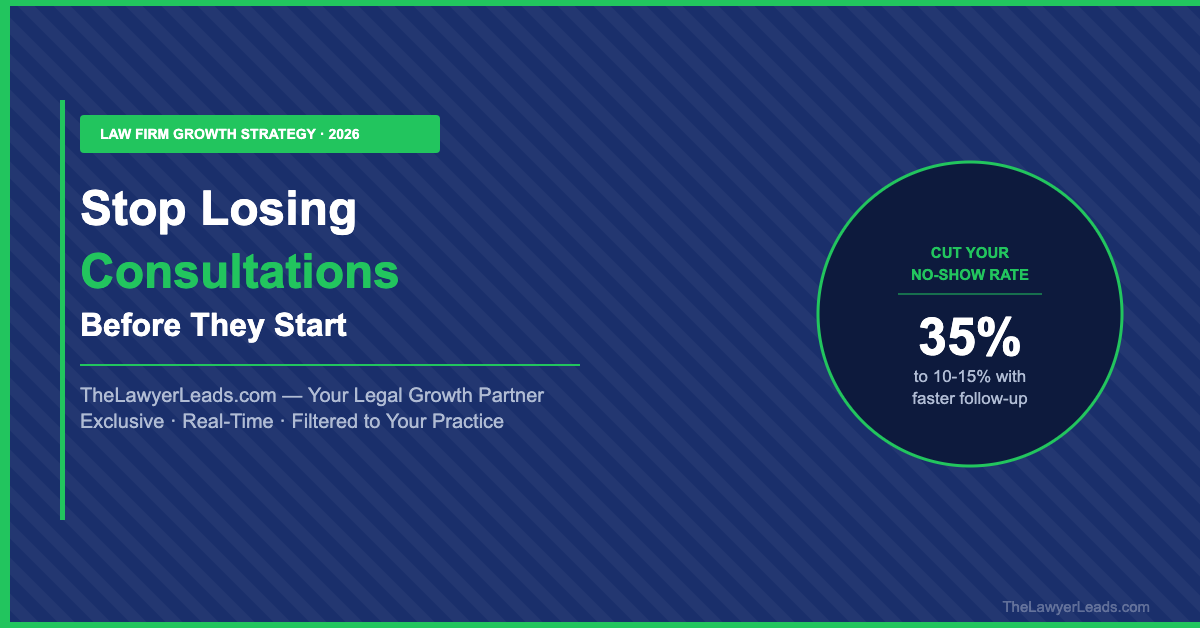
Firms that hold consultations within 24 hours of the initial inquiry report no-show rates of roughly 10–15%. Firms with a 3+ day booking gap regularly see no-show rates above 35%.
The Four Levers That Actually Move the Number
1. Compress the booking window
Same-day or next-day slots should exist for every practice area with urgent intake — personal injury, criminal defense, immigration detention matters. If your calendar is genuinely full, that’s a capacity conversation, not a scheduling one.
2. Confirm with a human touch, not just a bot
Automated reminders are necessary but not sufficient. A short call or personalized text from the intake team 24 hours out — one that references the specifics of the case — outperforms generic automation because it re-establishes that a real person is waiting for them.
3. Give the prospect a reason to prepare
Sending a short checklist (“bring your police report, insurance card, and any photos”) converts a passive appointment into an active commitment. People who take a preparation step before the meeting show up at meaningfully higher rates.
4. Track it like you track cost per lead
Most CRMs can report show rate by source, by day of week, and by intake staffer. If you’re not pulling that report monthly, you’re flying blind on half your funnel.
Traditional Intake vs. a Growth-Oriented Pipeline
| Metric | Traditional Approach | With TheLawyerLeads.com |
|---|---|---|
| Time to first contact | Hours to days (shared leads, queue delays) | Real-time, exclusive delivery |
| Lead intent quality | Mixed — shared with 3-5 other firms | Filtered to your practice area & geography |
| Typical no-show rate | 30–40% | Materially lower with fast, exclusive follow-up |
| Marketing spend efficiency | Diluted across no-shows and dead leads | Concentrated on leads that convert to booked, held consultations |
Key Insight
Reducing your no-show rate by 10 percentage points has the same bottom-line effect as increasing lead volume by 10% — without spending another dollar on ads. It’s the cheapest growth lever most firms haven’t pulled.
Building This Into Your Growth Strategy
A lower no-show rate compounds. Every prospect who actually sits down with your team is a chance to demonstrate expertise, build trust, and close a signed engagement letter. Every no-show is wasted ad spend, wasted staff time, and a competitor’s opportunity. Firms that treat show rate as a core KPI — alongside cost per lead and case value — build a more predictable, more profitable client pipeline over time.
Quick-Reference Summary
- Compress your booking window — same-day or next-day slots for urgent practice areas cut no-shows dramatically.
- Confirm with a human touch — a personalized call or text outperforms generic automated reminders.
- Give prospects a prep step — a short document checklist converts a passive booking into an active commitment.
- Track show rate monthly — by lead source, day, and staffer, so you know exactly where the leak is.
- Start with exclusive, real-time leads — faster, higher-intent leads are inherently less prone to no-shows than shared, delayed ones.
Stop Losing Consultations Before They Start
Build a client pipeline with exclusive, real-time leads filtered to your practice area — so the prospects you book are the prospects who show up.