
It’s 9:47 PM on a Tuesday. A prospective client fills out a contact form on a mid-sized personal injury firm’s website after being rear-ended on the highway. Two other firms already have her information. The partner who eventually calls back at 10 AM the next morning never finds out she signed with a competitor eleven hours earlier — he just sees the lead marked “no response” in the CRM and assumes she wasn’t serious.
She was serious. She just wasn’t waiting. This is the reality behind one of the most overlooked growth levers in the legal industry: law firm intake response time. Firms obsess over ad spend, SEO rankings, and referral networks, but the data consistently shows that how fast you respond to an inquiry predicts conversion better than almost any other variable in your funnel.
Why Intake Response Time Benchmarks Matter More Than Marketing Spend
Most firms measure growth by cost per lead or cost per click. Those numbers matter, but they miss the point where the real damage — or real gain — happens: the window between an inquiry landing and a human responding to it. A prospective client rarely contacts only one firm. In competitive practice areas like personal injury, immigration, and family law, the same person is frequently filling out three or four intake forms within the same hour, comparing whoever picks up the phone first.
Every dollar spent generating a lead is wasted if intake speed lets that lead sign with a competitor before your firm ever makes contact. This is why intake response time functions as a growth multiplier: it doesn’t just affect one case, it determines the return on every marketing dollar behind it.
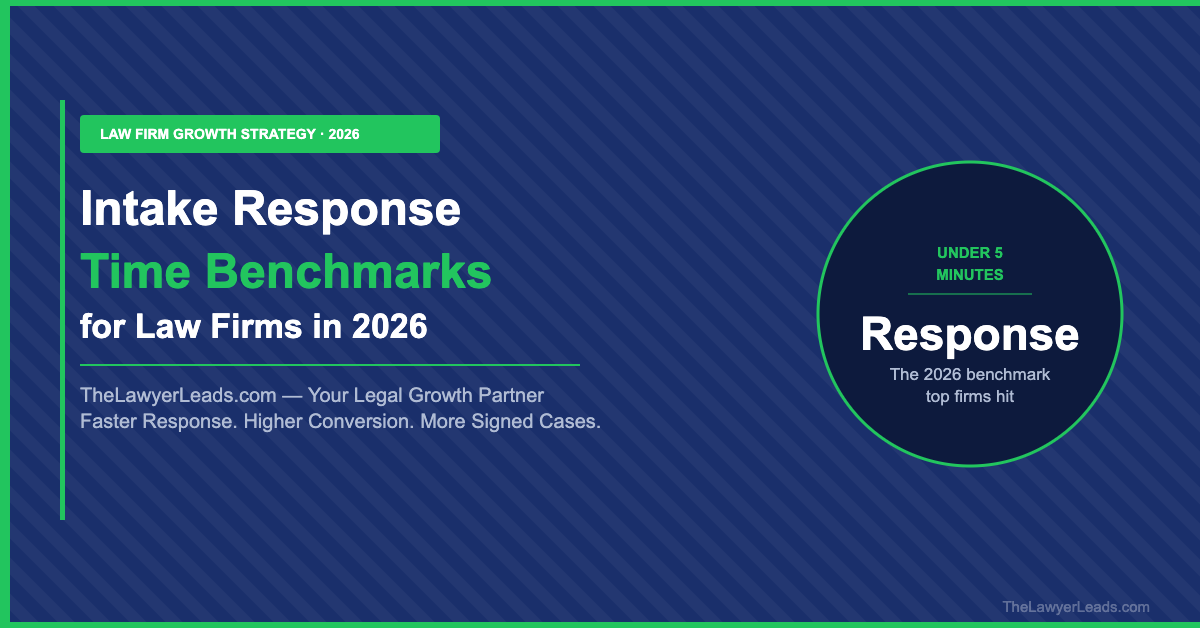
Industry conversion studies across legal intake consistently show that contact attempts made within the first five minutes convert at dramatically higher rates than those made even one hour later — and the drop-off accelerates sharply after that.
The 2026 Response Time Benchmarks Top-Performing Firms Hit
What “fast enough” actually looks like
Firms that consistently convert a high share of inquiries into signed clients tend to cluster around the same operating targets, regardless of practice area:
| Response Window | Typical Outcome | Firm Tier |
|---|---|---|
| Under 5 minutes | Highest signed-case rate; prospect rarely reaches a competitor first | Top-performing growth firms |
| 5–30 minutes | Still competitive, but conversion drops meaningfully | Solid mid-market firms |
| 1–4 hours | Prospect has likely engaged another firm already | Reactive intake process |
| Next business day | Marketing spend largely wasted on this inquiry | No dedicated intake workflow |
The gap between the top row and the bottom row is not a marginal difference — it’s the difference between a marketing budget that compounds and one that leaks. Firms that treat intake speed as a KPI, tracked and reviewed the same way they track cost per case, consistently outgrow firms that treat it as an afterthought handled “whenever someone gets to it.”
Building an Intake System That Actually Hits the Benchmark
Staffing coverage, not just speed
Hitting a five-minute response window is a staffing and process problem before it’s a technology problem. Firms that consistently perform well tend to do three things: they route new inquiries to a live person or answering service around the clock rather than a general inbox, they set a hard internal SLA (five minutes during business hours, fifteen after hours) that’s tracked weekly, and they build a follow-up cadence — call, text, email — that doesn’t rely on a single contact attempt succeeding.
Matching intake capacity to lead quality
Speed only pays off if what you’re responding to is worth responding to quickly. A firm fielding a flood of unfiltered, shared inquiries will burn out its intake team chasing prospects who never intended to retain anyone. This is where the source of your pipeline matters as much as your internal process — exclusive, pre-qualified inquiries let a smaller intake team hit aggressive response benchmarks because they aren’t wasting cycles on duplicate or low-intent contacts.
Key Insight
Intake speed and lead exclusivity reinforce each other. A firm receiving shared inquiries is racing competitors on every single contact; a firm receiving exclusive inquiries only has to beat its own internal clock. That structural advantage is often worth more than any single marketing channel.
Traditional Intake vs. an Optimized Growth Pipeline
| Metric | Traditional Approach | With TheLawyerLeads.com |
|---|---|---|
| Inquiry source | Shared across 3–5 competing firms | 100% exclusive to your firm |
| Intake team pressure | Racing competitors on every contact | Racing only your own SLA clock |
| Filtering | Manual, inconsistent, time-consuming | Pre-filtered to your practice area and criteria |
| Marketing ROI | Diluted by duplicate contacts | Concentrated on inquiries you can actually win |
What to Take Away
- Track response time as a growth KPI — review it weekly alongside cost per case, not as an afterthought.
- Aim for under five minutes during business hours and under fifteen after hours, with a multi-touch follow-up cadence built in.
- Staff intake coverage around the clock, not just business hours — inquiries don’t wait for office doors to open.
- Match intake capacity to lead quality — exclusive, pre-qualified inquiries let smaller teams hit faster benchmarks.
- Treat pipeline source as a growth lever, not just a cost line — where inquiries come from shapes how fast and how well you can respond.
Stop Racing Competitors on Every Inquiry
TheLawyerLeads.com connects your firm with exclusive, pre-qualified inquiries — so your intake team is only racing the clock, not three other law firms.