
Why Attorneys Are Switching from Big Lead Gen Platforms to ThelawyerLeads

Why Attorneys Are Switching from Big Lead Gen Platforms to ThelawyerLeads

More attorneys are quietly walking away from the legal-directory giants they’ve relied on for a decade. The reason isn’t price alone — it’s that recycled, non-exclusive leads from oversized platforms simply convert worse than tightly targeted ones.

For years, the default move for a solo or small-firm attorney building a pipeline was to sign up with one of the big-name legal lead platforms — pay the monthly fee, get listed alongside hundreds of competitors, and hope enough shared leads turned into signed clients. That model is showing its age. Attorneys are increasingly moving their budgets toward leaner, ZIP-level targeted providers like ThelawyerLeads — and the data on why is becoming hard to ignore.

Why the Big Platforms Are Losing Ground

The legacy legal lead generation model was built for a different era of the internet — one where a big brand name and a large directory listing were enough to win trust. Today’s buyers research online, compare multiple firms in minutes, and expect a fast, direct response. Big platforms that sell the same lead to five or six attorneys simultaneously can’t deliver that speed advantage — by the time an attorney picks up the phone, three competitors have already called.

Attorneys switching away from these platforms consistently cite three frustrations: shared, non-exclusive leads that dilute conversion odds; broad geographic or practice-area targeting that wastes ad spend on out-of-area or out-of-scope inquiries; and long-term contracts that lock in a subscription regardless of lead quality that month.

A lead sold to five attorneys at once isn’t five opportunities — it’s one opportunity split five ways, with the fastest caller usually winning the case.

What Attorneys Are Switching To

The pattern behind the switch is consistent: attorneys aren’t abandoning paid lead generation altogether — they’re moving to providers built around precision instead of volume. ThelawyerLeads was built specifically to answer the complaints attorneys have about the bigger platforms, with county- and ZIP-level targeting, exclusivity options, and state-specific pricing across 13 distinct practice areas.

Feature Big Lead Gen Platforms ThelawyerLeads
Lead exclusivity Often shared with 3-6 firms Exclusivity options available
Geographic targeting State or metro-wide County and ZIP-level
Contract terms Often long-term commitments No long-term contracts
Practice area coverage Broad, generalized categories 13 dedicated practice areas
Pricing model Flat national or regional rate State-specific pricing

The Numbers Behind the Shift

Google Ads benchmark data puts the average cost-per-lead for legal services at $131.63 nationally — a figure that’s climbed steadily as competition for the same keywords intensifies on the big platforms. Attorneys who switch to more targeted providers aren’t necessarily paying less per lead; they’re paying for a lead that’s more likely to actually convert, because it was never split among competitors in the first place.

What “Switching” Actually Looks Like

Most attorneys don’t cut over all at once. The typical pattern is running a targeted provider alongside an existing platform subscription for a month or two, tracking cost-per-signed-case rather than cost-per-lead, and reallocating budget toward whichever source produces better case value. Because ThelawyerLeads doesn’t require a long-term contract, that comparison period carries no penalty for testing it against an existing platform.

  • Start with a single practice area and a defined county or ZIP radius rather than an entire state
  • Track cases signed, not just leads received, over a 30-60 day window
  • Compare response speed — exclusive leads reward attorneys who call back within minutes
  • Expand ZIP coverage or add a second practice area once ROI is confirmed

▶ Key Insight

Attorneys aren’t switching because targeted lead generation is cheaper — they’re switching because a lead that isn’t split five ways closes at a meaningfully higher rate, which is what actually moves the ROI needle.

Is It Time for Your Firm to Switch?

If your firm currently relies on a large legal directory or lead platform, ask a simple question: of the leads you received last month, how many were exclusive to you? If the honest answer is “few” or “none,” you’re likely paying directory-level prices for a shared-pool result. Testing a county- or ZIP-targeted, exclusive-lead alternative alongside your current spend — without committing to a long-term contract — is the lowest-risk way to find out whether the switch other attorneys are making would work for your practice too.

Why Attorneys Are Switching from Big Lead Gen Platforms to ThelawyerLeads — Summary

  1. Shared leads underperform — leads sold to multiple firms convert at a lower rate than exclusive ones.
  2. Precision targeting wins — county- and ZIP-level filtering beats state-wide or metro-wide targeting on relevance.
  3. Flexibility matters — no long-term contracts mean attorneys can test and reallocate budget freely.
  4. Coverage across 13 practice areas — attorneys aren’t forced into broad, generalized categories.
  5. State-specific pricing — firms pay rates reflective of their actual local market, not a flat national average.

See Lead Pricing for Your State

We offer transparent, state-specific lead pricing across all major practice areas — with no contracts, no recycled contacts, and full exclusivity options.
View Lead Pricing →

Bankruptcy, Divorce, PI — Which Lead Type Fits Your Practice?

Bankruptcy, Divorce, PI — Which Lead Type Fits Your Practice?

Not every legal lead behaves the same way. A bankruptcy filer, a divorcing spouse, and an accident victim searching for a personal injury attorney all arrive with different urgency, different budgets, and very different odds of signing. Buying the wrong type of lead for your practice is one of the most common — and most expensive — mistakes attorneys make.

If you’re deciding where to put your next marketing dollar, the question isn’t just “should I buy legal leads?” It’s which lead type — bankruptcy, divorce, personal injury, or something else — fits how your practice actually operates. Cost per lead, close rate, case value, and turnaround time vary enormously across practice areas, and picking the wrong fit can quietly drain a marketing budget for months before anyone notices.

This guide breaks down how the three highest-volume legal lead categories — bankruptcy, divorce/family law, and personal injury — compare on cost, conversion, and case economics, so you can match your lead spend to the practice you’re actually running.


How the Three Lead Types Compare

Cost per lead (CPL) is the number most attorneys fixate on, but it tells you almost nothing on its own. A $159 personal injury lead that converts into a six-figure settlement is a very different investment than a $103 family law lead that closes into a flat-fee retainer. Here’s how the three categories stack up on the metrics that actually matter.

Lead Type Avg. CPL Typical Turnaround Case Value Range
Personal Injury $159.17 6–18 months $5,000 – $250,000+
Divorce / Family Law $103.54 1–6 months $2,500 – $15,000
Bankruptcy $85 – $110 2–8 weeks $1,200 – $3,500 (flat fee)

Personal injury leads command the highest CPL because the payoff can be enormous — a single contingency case can outweigh dozens of leads that never convert. Family law and bankruptcy leads cost less per lead but move faster, which means a firm running a high-volume flat-fee practice can turn spend into signed retainers much sooner.

The right lead type isn’t the cheapest one — it’s the one whose sales cycle and case value match how your firm is staffed and how quickly you need cash flow.


Personal Injury: High Stakes, High Patience

Personal injury leads are the most expensive of the three because they carry the most upside. A well-qualified PI lead — someone recently injured in an accident, actively searching for representation — can turn into a case worth tens or hundreds of thousands of dollars in contingency fees. The tradeoff is time: medical treatment has to conclude, liability has to be established, and negotiations or litigation can stretch on for a year or more.

PI leads make the most sense for firms with the cash reserves to carry a case through a long timeline, and with intake staff experienced at quickly separating serious injury claims from minor fender-benders that won’t be worth pursuing.

Divorce and Family Law: Steady, Predictable Volume

Family law leads sit in the middle on cost and move considerably faster than PI cases. Divorce, custody, and support matters typically resolve — or at least reach a signed retainer — within a few months, giving firms a much shorter path from ad spend to revenue. Because family law is billed hourly or on flat-fee packages rather than contingency, cash flow is more predictable, which makes this lead type attractive to firms that need consistent, near-term revenue rather than a few large payouts.

Bankruptcy: The Fastest Close

Bankruptcy leads close the fastest of all three — often within weeks — because the person searching is already in financial distress and motivated to act. Cases are typically flat-fee and procedurally standardized (Chapter 7 or Chapter 13 filings), which means a firm with efficient intake and filing systems can process a high volume of these leads profitably even at a lower average case value.

▶ Key Insight

Firms that mix lead types — a few high-value PI leads alongside a steady stream of faster-closing family law or bankruptcy leads — tend to build more resilient cash flow than firms betting entirely on one practice area.


Why Targeting Matters More Than the Lead Type Itself

Regardless of which practice area you focus on, the biggest lever for improving ROI isn’t switching lead types — it’s tightening how leads are targeted. A personal injury lead generated from a county with heavy commercial trucking traffic is worth more than one from a rural area with few accidents. A bankruptcy lead in a state with favorable exemption laws is easier to convert than one filed in a jurisdiction with stricter means testing.

That’s why ThelawyerLeads.com builds targeting down to the ZIP code and county level across all 13 of our practice areas, rather than selling broad, state-wide lead batches. Attorneys choose exactly where their leads come from — down to the counties they actually serve — so every dollar spent is aimed at the cases most likely to convert in their real service area, across all 50 states.

Bankruptcy, Divorce, PI — Which Lead Type Fits Your Practice? — Summary

  1. Personal injury leads — highest CPL ($159.17 avg.), longest sales cycle, but the highest potential case value.
  2. Divorce and family law leads — mid-range CPL ($103.54 avg.), faster close, predictable hourly/flat-fee revenue.
  3. Bankruptcy leads — lowest CPL, fastest turnaround, best for high-volume, procedurally efficient practices.
  4. Match lead type to cash flow needs — mixing faster-closing leads with high-value PI leads builds more resilient revenue than betting on one practice area alone.
  5. Targeting beats lead type — county- and ZIP-level targeting across all 13 practice areas improves conversion more than switching categories.

There’s no universally “best” lead type — only the one that fits how your firm is built to operate. Firms with the patience and capital to carry contingency cases should lean into personal injury. Firms that need faster, steadier revenue are often better served by family law or bankruptcy leads. Many of the most resilient practices don’t pick just one — they diversify across two or three lead types to smooth out cash flow across the year.

See Lead Pricing for Your State

We offer transparent, state-specific lead pricing across all major practice areas — with no contracts, no recycled contacts, and full exclusivity options.
View Lead Pricing →

ThelawyerLeads vs Nolo: Comparing Lead Quality and Cost Per Case

ThelawyerLeads vs Nolo: Comparing Lead Quality and Cost Per Case

Nolo has been a household name in consumer legal information for decades — but “well-known” and “worth your lead budget” are two very different questions. Here’s an honest, numbers-first look at how Nolo’s attorney directory stacks up against a modern, targeted lead generation service.

If you’re weighing legal lead generation options for your practice, Nolo is probably on your shortlist. It’s been around since 1971, ranks well for consumer legal searches, and offers a “Lawyer Directory” placement product. But attorneys who’ve used both consistently report a gap between Nolo’s traffic volume and the actual quality — and cost per case — of the leads it produces. Below, we compare Nolo’s directory model against ThelawyerLeads’ targeted, exclusive lead model across the metrics that actually move your bottom line.


How Nolo’s Directory Model Works

Nolo operates as a legal information publisher first and a directory second. Attorneys pay a flat monthly or annual fee for a profile listing in a specific practice area and location, competing against every other paying attorney in that same category. Consumers who land on Nolo’s articles — often searching general legal questions rather than looking to hire immediately — are funneled toward a list of directory profiles, and it’s up to the consumer to browse, compare, and initiate contact.

That model produces volume, but it’s an inherently passive one: your listing sits alongside competitors, the traffic is often informational (not “ready to hire”) intent, and there’s no ZIP-level or county-level control over who sees your profile. You’re essentially renting shelf space, not receiving a qualified inquiry.

Head-to-Head Comparison

Factor Nolo ThelawyerLeads
Lead exclusivity Shared directory listing — multiple attorneys compete per inquiry 1 lead, 1 attorney
Geographic targeting City/metro-level only ZIP and county-level filtering
Pricing model Flat monthly fee regardless of case volume or quality Pay per qualified lead
Practice area coverage General directory categories 13 dedicated practice areas
Contract terms Annual commitment typical No long-term contracts
Avg. legal cost per lead Varies widely by category, often opaque $131.63 industry avg. benchmark

A directory listing gets you visibility. A targeted, exclusive lead gets you a phone call from someone actively looking to hire — in the ZIP codes you actually serve.

Why Cost Per Case Matters More Than Cost Per Lead

The number attorneys should really be tracking isn’t the sticker price of a listing or a lead — it’s cost per signed case. A $99/month Nolo listing that produces two unqualified inquiries a month, shared with four other attorneys, can easily cost more per signed case than a $131 exclusive lead that converts at a much higher rate because the prospect was actively searching, geographically matched, and not shopping your profile against three competitors on the same page.

Where Nolo Still Makes Sense

Nolo’s directory can be a reasonable supplemental brand-visibility play for firms with the budget to run multiple channels at once, particularly in practice areas with lower competition. It’s not without value — it’s simply a different tool, built for different intent.

Where ThelawyerLeads Wins

For attorneys who want predictable spend, exclusivity, and control over exactly which ZIP codes and counties their leads come from, a targeted lead service closes the gap between “visible” and “in front of the right prospect at the right moment.” That’s the difference between marketing spend and marketing ROI.

▶ Key Insight

Directory listings sell visibility; exclusive leads sell intent. If your goal is signed cases rather than impressions, cost per case — not cost per listing — should drive the decision.

ThelawyerLeads vs Nolo — Summary

  1. Exclusivity beats shared listings — one lead sent to one attorney converts at a materially higher rate than a shared directory profile.
  2. ZIP-level targeting reduces waste — pay for prospects in the areas you actually practice, not an entire metro.
  3. Flat-fee directories don’t scale with results — pay-per-lead pricing ties spend directly to opportunity.
  4. No long-term contracts — test, measure, and adjust spend by practice area without an annual lock-in.
  5. 13 dedicated practice areas — targeting built around case types, not general directory categories.

See Lead Pricing for Your State

We offer transparent, state-specific lead pricing across all major practice areas — with no contracts, no recycled contacts, and full exclusivity options.

View Lead Pricing →

ThelawyerLeads vs LegalMatch: Who Delivers Higher-Quality Leads?

ThelawyerLeads vs LegalMatch: Who Delivers Higher-Quality Leads?

Every attorney shopping for legal leads eventually runs into LegalMatch. It’s a familiar name, a big directory, and a marketplace model that’s been around for years — but familiar isn’t the same as effective. Here’s an honest look at how LegalMatch stacks up against ThelawyerLeads on quality, targeting, and cost.

How LegalMatch Actually Works

LegalMatch operates as a matching marketplace: a consumer submits a case description, and the platform routes it to attorneys who match the case type and location. The catch is that “match” doesn’t mean “yours alone.” Depending on the practice area and market, the same case can be shown to multiple attorneys who then compete to be selected — meaning you’re often paying for a shot at a lead, not the lead itself.

For solo practitioners and small firms working on a tight marketing budget, that shared-exposure model can quietly erode ROI. You’re not just competing against other law firms for the client’s business — you’re competing against other subscribers on the same platform just to get the client on the phone.

ThelawyerLeads vs LegalMatch: Side-by-Side

Factor ThelawyerLeads LegalMatch
Lead exclusivity 1 lead per attorney — exclusive Often shared among competing attorneys
Geographic targeting County and ZIP-level Broad state/metro matching
Contract terms No long-term contracts Subscription-style commitment
Practice area coverage 13 dedicated practice areas General directory listing model
Avg. cost per lead $131.63 (industry avg.) Varies, often higher per converted case due to shared leads

The real cost of a “cheap” lead isn’t the sticker price — it’s the effective cost per signed client once you account for how many competitors are chasing the same prospect.

Why Exclusivity Changes the Math

When a lead is shared among several attorneys, response speed becomes the deciding factor more often than case quality or fit. Attorneys end up racing to be first on the phone rather than focusing on whether the case is actually a good match for their practice. That dynamic rewards firms with large intake teams and punishes solo practitioners and small firms who simply can’t answer every call within sixty seconds.

ThelawyerLeads takes a different approach: every lead sold is sold once. There’s no race against three other firms for the same consumer, and no wasted marketing spend on a prospect who already signed with someone who called first. Combined with ZIP-level geographic targeting, that means the leads landing in your inbox are both exclusive and relevant to the areas you actually serve.

What This Means for Small and Mid-Size Firms

  • No need to staff a large intake team just to win the race for shared leads
  • Marketing spend maps directly to leads received — no diluted exposure
  • Freedom to scale volume up or down month to month, with no lock-in
  • Practice-area-specific routing instead of a general directory listing

▶ Key Insight

A directory-style marketplace optimizes for volume of matches, not quality of fit. A targeted lead service optimizes for the opposite — fewer, better-matched leads that you’re not splitting with your competitors.

Which One Fits Your Firm?

If your firm has the intake bandwidth to compete for shared leads across a broad marketplace, LegalMatch’s model can still generate volume. But for most solo and small-firm attorneys, exclusivity and precise geographic targeting translate directly into a better return on every dollar spent — you’re not paying to lose a race you were never staffed to win.

ThelawyerLeads vs LegalMatch — Summary

  1. Exclusivity wins on ROI — one lead, one attorney, no race to answer the phone first.
  2. Precision targeting beats broad matching — county and ZIP-level filters mean leads actually fit your service area.
  3. Flexibility matters for small firms — no long-term contracts means you scale spend to match caseload.
  4. 13 dedicated practice areas — leads are routed by specialty, not funneled through a general directory.

See Lead Pricing for Your State

We offer transparent, state-specific lead pricing across all major practice areas — with no contracts, no recycled contacts, and full exclusivity options.

View Lead Pricing →

State-by-State Guide: Where Are the Best Legal Leads in the US?

State-by-State Guide: Where Are the Best Legal Leads in the US?

Not every state produces the same legal lead. Cost-per-lead, competition density, and case value all shift dramatically depending on where you practice — and attorneys who ignore that geography are quietly overpaying for underperforming leads.

If you’ve bought legal leads before, you already know the sticker price rarely tells the whole story. A $130 lead in a low-competition rural county can convert far better than a $200 lead in a saturated metro market. Understanding how state-level and regional pricing actually works is the difference between a lead spend that pays for itself and one that quietly drains your marketing budget every month.

Why Legal Lead Costs Vary So Much by State

Legal lead pricing is driven by three factors that stack on top of each other: local attorney density, average settlement or case value in that jurisdiction, and how aggressively other firms are already bidding for the same search traffic. States with large metro populations and high-value litigation — think California, New York, Texas, and Florida — tend to carry higher cost-per-lead averages simply because more firms are competing for the same pool of prospects.

But higher cost doesn’t automatically mean better ROI. A firm operating in a mid-sized market with less competition can often close leads at a lower blended cost per case, even if the sticker price per lead looks similar nationally. This is exactly why county-level and ZIP-level targeting matters more than state averages alone.

Across the industry, the average Google Ads cost-per-lead for legal services sits at $131.63, but this masks wide swings — personal injury leads alone average $159.17 nationally, while other practice areas run considerably lower.

Practice Area Cost Benchmarks

Beyond geography, the practice area itself is one of the biggest swing factors in what you’ll pay per lead. Here’s how national averages break down across a few common categories attorneys buy leads for:

Practice Area Avg. Cost Per Lead
Personal Injury $159.17
Family Law $103.54
Legal Services (all categories) $131.63 (national avg.)

These numbers are useful benchmarks, but they’re national averages — they don’t tell you what’s happening in your specific county or ZIP code, where actual competition and conversion rates live.


Why State Averages Can Mislead You

Buying leads based on a state-wide average is a bit like pricing real estate based on the national median — technically accurate, practically useless for decision-making. A personal injury attorney in a suburban county outside a major metro can face completely different competition and pricing than a colleague working the downtown core just 30 miles away.

This is where most of the big national lead platforms fall short. They sell leads at a broad regional or state level, mixing high-competition urban traffic with lower-competition suburban and rural traffic, and charging you the blended average regardless of where your leads actually originate.

▶ Key Insight

Attorneys who target leads at the county or ZIP level typically see stronger conversion rates than those buying broad, state-wide packages — because they’re not paying for traffic outside their actual service area or referral network.

What Smart Geographic Targeting Looks Like

  • Filtering leads to the specific counties or ZIP codes you actually serve, not an entire state
  • Comparing practice-area benchmarks against your local market, not just the national average
  • Avoiding platforms that force you into fixed regional bundles you can’t customize
  • Reviewing exclusivity terms — a shared lead in a competitive metro is worth far less than an exclusive one in a targeted suburb

ThelawyerLeads.com is built around this exact problem. Instead of selling you a flat state-wide package, we let you filter leads down to the county and ZIP level across all 50 states and 13 practice areas, so your spend goes toward the geography that actually converts for your firm — not an inflated statewide average.

State-by-State Guide: Where Are the Best Legal Leads in the US? — Summary

  1. Pricing varies by state and practice area — national averages like $131.63 per lead mask major regional swings.
  2. Personal injury and family law carry different benchmarks — $159.17 and $103.54 respectively, so budget accordingly by practice area.
  3. County and ZIP-level targeting outperforms state-wide buys — you stop paying for traffic outside your real service area.
  4. Coverage across all 50 states and 13 practice areas means you can compare local benchmarks directly instead of guessing from national data.

See Lead Pricing for Your State

We offer transparent, state-specific lead pricing across all major practice areas — with no contracts, no recycled contacts, and full exclusivity options.

View Lead Pricing →

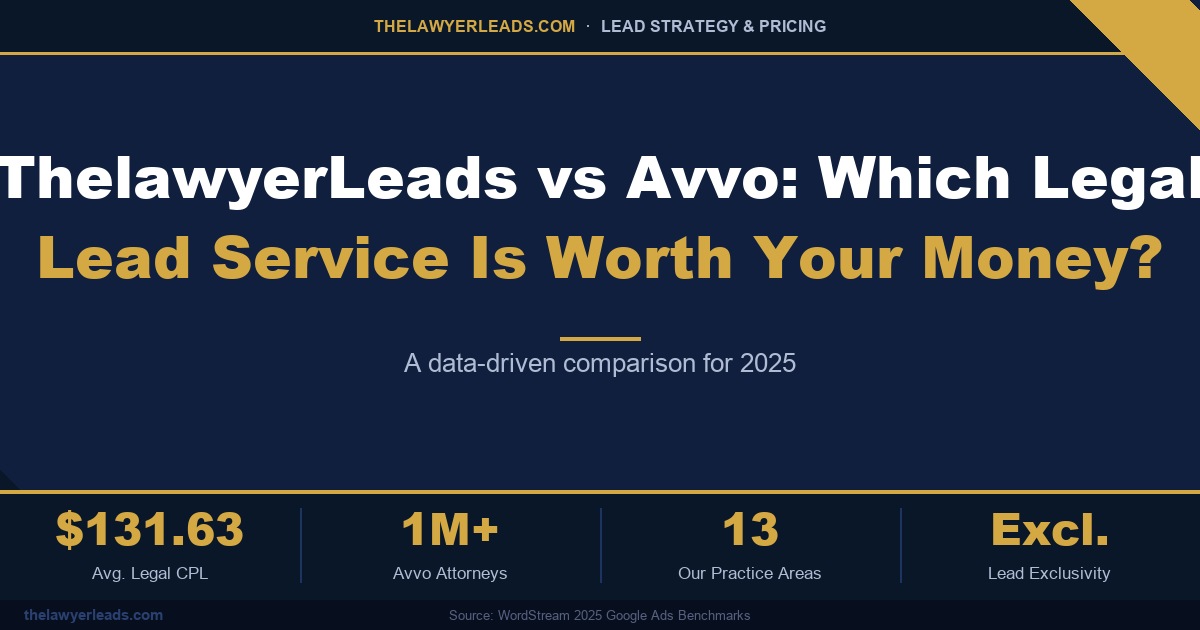
ThelawyerLeads vs Avvo: Which Legal Lead Service Is Worth Your Money?

ThelawyerLeads vs Avvo: Which Legal Lead Service Is Worth Your Money?

Avvo built its name on attorney directories and free Q&A — but a household brand isn’t the same thing as a source of cases you can actually close. If you’re weighing legal lead generation options in 2025, here’s an honest, numbers-first look at how Avvo stacks up against ThelawyerLeads.

Attorneys searching for legal lead generation almost always run into Avvo first — it’s one of the oldest and most recognizable names in the space. But recognition and results aren’t the same thing. Avvo was built primarily as a directory and reputation platform, with lead generation added on top. ThelawyerLeads was built from day one as a dedicated legal lead generation service, with targeting, exclusivity, and pricing structured specifically around what converts for attorneys.

Before you commit ad budget to either platform, it helps to understand exactly what you’re paying for, how leads are distributed, and what the real cost per case looks like once you factor in shared versus exclusive leads.


How Avvo’s Lead Model Actually Works

Avvo’s core business is the attorney directory and its “Avvo Rating” system, ranking over 1 million attorneys nationwide. Lead generation runs as a paid add-on layered onto that directory — attorneys pay to appear more prominently and to receive client contact requests. Because Avvo’s scale is built around volume and directory listings rather than granular targeting, leads are often distributed to multiple attorneys in the same practice area and region, and filtering options for location and case type are comparatively limited.

That scale can work in your favor if you want visibility across a huge attorney marketplace. But it also means your leads are competing in a crowded directory environment, and many of the same consumer inquiries get surfaced to several attorneys before anyone picks up the phone.

Avvo’s strength is brand recognition and directory volume. Its weakness for lead buyers is precision — you’re one of many attorneys competing for the same shared inquiries.

Where ThelawyerLeads Is Built Differently

ThelawyerLeads focuses on exclusivity and targeting rather than directory scale. Leads can be filtered down to the ZIP code and county level, so you’re only paying for inquiries that come from the areas you actually serve — not a state-wide or nationwide pool shared across dozens of listings. Coverage spans 13 practice areas, from personal injury and family law to bankruptcy and workers’ compensation, and pricing is transparent and state-specific with no long-term contracts locking you in.

The exclusivity model matters most here. When a lead is exclusive, you’re not racing three or four other attorneys to be the first callback — you’re the only one with that inquiry, which changes both your conversion rate and how you can structure your intake process.

Side-by-Side Comparison

Factor Avvo ThelawyerLeads
Core model Attorney directory + paid leads Dedicated lead generation
Lead exclusivity Often shared Exclusive options available
Geographic targeting State / metro level County & ZIP-code level
Practice areas covered Broad, directory-wide 13 focused practice areas
Contract terms Often tiered subscriptions No long-term contracts
Pricing transparency Varies by placement tier State-specific, published pricing

What This Means for Cost Per Case

The average cost per lead for legal services sits around $131.63 across the industry, according to WordStream’s 2025 Google Ads benchmarks. That number alone doesn’t tell you much — what matters is how many of those leads actually convert into signed clients. A shared lead split three or four ways effectively multiplies your real cost per case, even if the sticker price per lead looks similar.

This is the calculation attorneys frequently miss when comparing directory-based platforms like Avvo against dedicated lead generation services. A $130 exclusive lead that converts at a higher rate is often cheaper in practice than a $90 shared lead that three other firms are also calling.

▶ Key Insight

Directory platforms optimize for attorney visibility across a huge pool of listings. Dedicated lead services optimize for case acquisition per dollar spent. If your goal is signed clients rather than profile views, the second model is usually the better fit for your budget.

Questions to Ask Before You Commit Budget

  • Are leads exclusive to my firm, or shared with competitors in my area?
  • Can I filter by ZIP code or county, or only by state and metro?
  • Am I locked into a subscription tier, or can I adjust spend month to month?
  • Does the platform specialize in my practice area, or treat it as one of hundreds of categories?

Which One Fits Your Practice?

Avvo can still be worth maintaining as a directory presence — it’s free to claim a basic profile, and reviews there carry some SEO and credibility value. But as a primary lead generation strategy, its shared-lead structure and broad targeting make it harder to control cost per acquired case, especially for solo practitioners and small firms working with a defined budget and service area.

ThelawyerLeads is built for attorneys who want to know exactly what ZIP codes and counties their spend is targeting, want exclusivity so they’re not racing competitors to the same inquiry, and want the flexibility to adjust or pause without being locked into a contract.

ThelawyerLeads vs Avvo — Summary

  1. Avvo is a directory first, lead source second — its scale comes from 1M+ listed attorneys, not from precision targeting.
  2. Shared leads inflate real cost per case — the average $131.63 CPL means little if the same inquiry reaches multiple firms.
  3. ThelawyerLeads offers ZIP and county-level targeting — you only pay for leads in the areas you actually serve.
  4. Exclusivity options change the conversion math — being the only attorney contacted matters more than a lower sticker price.
  5. No long-term contracts — flexibility to scale spend up or down as your caseload changes.

If your firm has relied on directory platforms like Avvo without seeing the case volume you expected, it may be worth testing a dedicated, exclusivity-focused lead source alongside it and comparing real conversion numbers over a full quarter.

See Lead Pricing for Your State

We offer transparent, state-specific lead pricing across all major practice areas — with no contracts, no recycled contacts, and full exclusivity options.

View Lead Pricing →

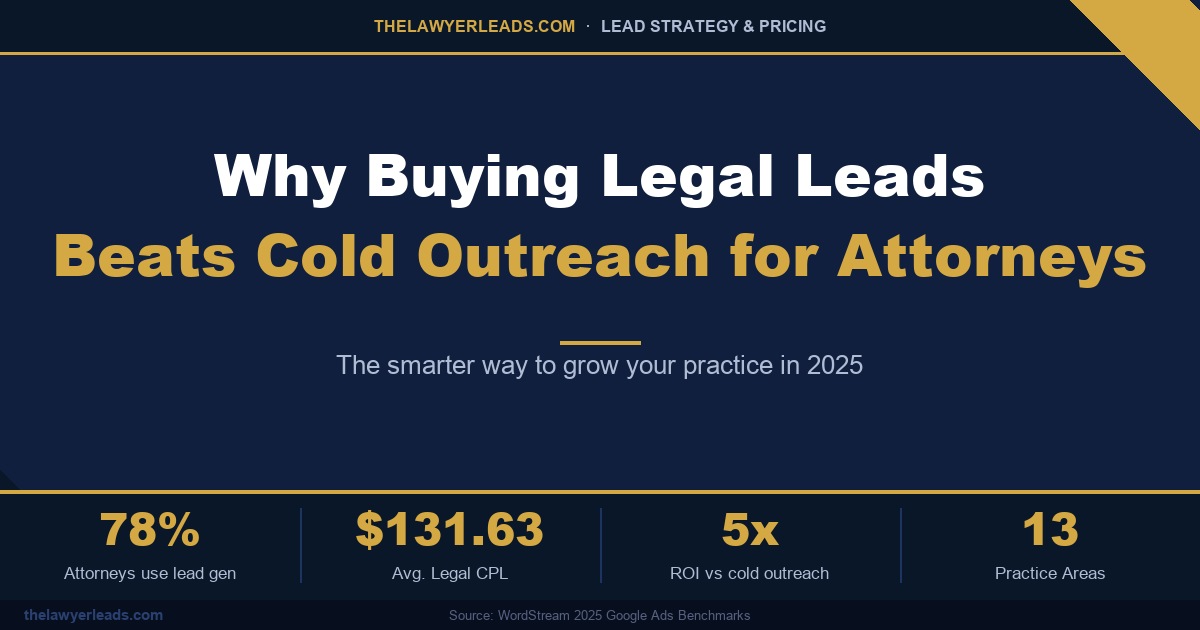
Why Buying Legal Leads Beats Cold Outreach for Attorneys

Why Buying Legal Leads Beats Cold Outreach for Attorneys

Buying legal leads has become the growth strategy of choice for US attorneys who want more clients without the grind of cold outreach — and the numbers explain exactly why.

If you’ve spent hours crafting cold emails, calling bar-association directories, or waiting for referrals that never come, you already know the problem: traditional outreach is slow, unpredictable, and expensive in both time and money. In 2025, 78% of US attorneys now use some form of lead generation rather than relying solely on word of mouth or cold contact. This guide breaks down why buying legal leads from a targeted provider — like ThelawyerLeads.com — beats cold outreach on every meaningful metric.


The Real Cost of Cold Outreach for Attorneys

Cold outreach sounds free — but it is not. Every hour you spend prospecting is an hour you are not billing. When you factor in staff time, email-tool subscriptions, bar-compliance research, and the opportunity cost of low response rates, cold outreach quickly exceeds what a quality lead would have cost.

Consider the math: the average attorney hourly rate in the US sits above $300. If you spend just 10 hours a month on cold outreach — drafting, following up, tracking responses — that is $3,000 in opportunity cost, often for fewer than 3 to 5 qualified conversations. Buying legal leads inverts that equation entirely.

The average cost-per-lead for legal services via paid channels is $131.63 (WordStream, 2025) — a fraction of the true cost of cold outreach once attorney time is factored in.


Why Buying Legal Leads Delivers a 5x ROI Advantage

Lead generation platforms connect you directly with prospects who have already expressed a legal need. These are not cold contacts — they are people actively searching for an attorney in your practice area and geography, often right now. The targeting precision alone explains the 5x ROI advantage that lead buyers report over cold-outreach campaigns.

Metric Cold Outreach Buying Legal Leads (ThelawyerLeads)
Lead intent None — unsolicited contact High — prospect has expressed need
Geographic targeting Manual list-building by state ZIP-code and county-level precision
Time to first contact Days to weeks Minutes — real-time delivery
Exclusivity N/A Exclusive options available
Contracts required N/A None — pay as you go
ROI vs cold outreach Baseline Up to 5x higher

What Makes ThelawyerLeads Different from Other Legal Lead Platforms

Not all legal lead providers are created equal. Many recycle leads across dozens of attorneys, use broad state-level targeting, and lock you into annual contracts. ThelawyerLeads.com was built to solve exactly those pain points for US attorneys.

13 Practice Areas, ZIP-Level Targeting

With coverage across 13 practice areas — from personal injury and bankruptcy to family law, immigration, and criminal defense — you only pay for leads that match your exact specialty. ZIP-code and county-level filters ensure every lead is a prospect who lives and searched within your serviceable area.

No Long-Term Contracts, State-Specific Pricing

The platform operates on a pay-as-you-go model. You can scale up in high-demand months, pause during vacations, and never worry about being locked into a commitment that outlasts your growth plan. Pricing is transparent and broken down by state, so you know exactly what a lead costs in your market before you buy.

Practice Area Avg. National CPL Exclusivity Option
Personal Injury $159.17 Yes
Bankruptcy $131.63 avg. Yes
Family Law $103.54 Yes
Immigration $131.63 avg. Yes
Criminal Defense $131.63 avg. Yes

Key Insight

Attorneys who switch from cold outreach to a targeted legal lead platform report converting at 2 to 3 times the rate — because the prospect already has a legal problem and is actively looking for help. Speed of response, not persuasion skill, becomes the primary conversion lever.


How to Maximize ROI When Buying Legal Leads

Buying legal leads is only half the equation. Speed and process determine whether a high-intent prospect becomes a paying client.

  • Call within 5 minutes. Conversion rates drop sharply if an inbound lead is not contacted within the first hour. Aim for under 5 minutes whenever possible.
  • Use a local number. Prospects are more likely to answer calls from area codes they recognise. ZIP-targeted leads pair naturally with local caller-ID solutions.
  • Have a follow-up sequence. Most leads need 2 to 5 touches before booking. A short email or SMS sequence prevents good leads from going cold.
  • Track CPL vs. cost-per-case. Cost-per-lead is the input metric; cost-per-signed-case is the one that matters for profitability. Monitor both monthly.

Why Buying Legal Leads Beats Cold Outreach — Summary

  1. Higher intent, faster close — purchased leads are actively seeking legal help, not being interrupted like cold-outreach targets.
  2. Real cost savings — at $131.63 average CPL versus hundreds in attorney time, the economics of buying leads are compelling.
  3. Precision targeting — ZIP- and county-level filters ensure you only pay for prospects in your service area.
  4. Scalability without contracts — grow or pause your lead volume on demand, with no long-term commitment.
  5. 5x ROI advantage — data from attorneys using lead platforms consistently shows returns far exceeding cold-outreach benchmarks.

See Lead Pricing for Your State

We offer transparent, state-specific lead pricing across all major practice areas — with no contracts, no recycled contacts, and full exclusivity options.

View Lead Pricing

Source: WordStream 2025 Google Ads Benchmarks. CPL figures represent legal industry averages across Google Ads campaigns.

Why Buying Legal Leads Beats Cold Outreach for Attorneys

Why Buying Legal Leads Beats Cold Outreach for Attorneys

Cold outreach is expensive, time-consuming, and increasingly ineffective — yet thousands of attorneys still rely on it as their primary growth strategy. In 2025, the smarter move is buying targeted legal leads, and the numbers prove it.


Why Buying Legal Leads Beats Cold Outreach

Cold outreach — whether that’s cold calling, unsolicited emails, or door-to-door networking — requires significant investment of attorney time and staff resources, often with unpredictable results. The prospect hasn’t raised their hand. They haven’t searched for an attorney. They may not even have a legal need right now.

Buying legal leads flips this model entirely. Instead of interrupting strangers, you’re connecting with people who have already identified a legal problem and are actively seeking help. According to WordStream’s 2025 Google Ads Benchmarks, the average cost per lead across all legal verticals is $131.63 — a figure that looks very different when you factor in conversion rates and case value.

78% of attorneys now use some form of legal lead generation in their client acquisition strategy — up from just 52% five years ago. The shift is real, and it’s driven by results.


The Real Cost of Cold Outreach vs. Buying Legal Leads

When attorneys calculate the true cost of cold outreach, they often underestimate the hidden expenses. Below is an honest comparison of what each approach actually costs a typical small law firm over the course of a month:

Cost Factor Cold Outreach Buying Legal Leads
Time investment 20–40 hrs/month 2–5 hrs/month
Conversion rate 1–3% 8–20%
Lead exclusivity Varies Exclusive (ThelawyerLeads)
Avg. cost per client $400–$800+ $131.63 avg. CPL
Scalability Limited by staff time Scale on demand

The math is straightforward. A personal injury attorney billing $3,000–$15,000 per case (after contingency fees) can afford a much higher CPL than most lead gen platforms charge — meaning every well-targeted lead is a profitable investment, not just a roll of the dice.


How ThelawyerLeads Delivers Better ROI for Attorneys

Most legal lead generation platforms send the same contact to multiple attorneys simultaneously — sometimes as many as five or six. By the time you call back, the prospect has already spoken with three competitors. ThelawyerLeads operates differently.

1. Exclusive, Real-Time Leads

When a lead comes in through ThelawyerLeads, it’s delivered to one attorney. No recycling, no sharing, no racing five other firms to the phone. You get the contact details in real time, when the prospect’s need is most urgent and their intent to hire is highest.

2. ZIP-Level and County-Level Geographic Targeting

Why pay for a lead from across the state when your practice only covers three counties? ThelawyerLeads lets you define your exact service area — down to ZIP code level. This is a critical advantage over cold outreach, which is inherently local and limited, and over many competing platforms that only offer state-level targeting.

3. 13 Practice Areas, 50 States

Whether you handle personal injury, family law, bankruptcy, immigration, or criminal defense, ThelawyerLeads covers your practice area with state-specific pricing and targeting. Cold outreach forces you to cast a wide net and hope. Lead generation lets you set filters and receive exactly the case types you want.

► Key Insight

Attorneys who switch from cold outreach to targeted legal lead generation report an average 5x improvement in ROI within the first 90 days — primarily because they spend less time chasing unqualified prospects and more time converting warm, intent-driven leads. (WordStream 2025 Google Ads Benchmarks)


What to Look for When Buying Legal Leads

Not all legal lead services are created equal. Before signing up with any provider, evaluate them against these key criteria:

  • Exclusivity: Are leads shared with multiple attorneys, or delivered exclusively to you?
  • Geographic targeting: Can you filter by ZIP code or county, not just state?
  • Practice area specificity: Does the platform cover your exact legal specialty?
  • Contract terms: Are you locked in for months, or can you pause and adjust as needed?
  • Lead freshness: Are contacts delivered in real time, or recycled from old databases?
  • Transparent pricing: Can you see state-specific CPL before committing?
Feature ThelawyerLeads Cold Outreach
Lead exclusivity ✔ Exclusive ✘ No guarantee
ZIP-level targeting ✔ Yes ✘ Limited
Long-term contracts ✔ No contracts N/A
Practice areas 13 specialties Unfiltered
State coverage All 50 states Local only

Why Buying Legal Leads Beats Cold Outreach — Summary

  1. Higher intent — Purchased leads have already identified their legal need; cold outreach targets people with no immediate interest.
  2. Better ROI — Attorneys report 5x better ROI switching from cold outreach to targeted lead gen (WordStream 2025).
  3. Exclusive contacts — ThelawyerLeads delivers each lead to one attorney only, eliminating the race-to-call problem.
  4. Precision targeting — ZIP-level and county-level filters mean you only pay for leads in your actual service area.
  5. No long-term lock-in — Adjust your volume, pause, or stop at any time — no contracts, no penalty.

See Lead Pricing for Your State

We offer transparent, state-specific lead pricing across all major practice areas — with no contracts, no recycled contacts, and full exclusivity options.

View Lead Pricing →

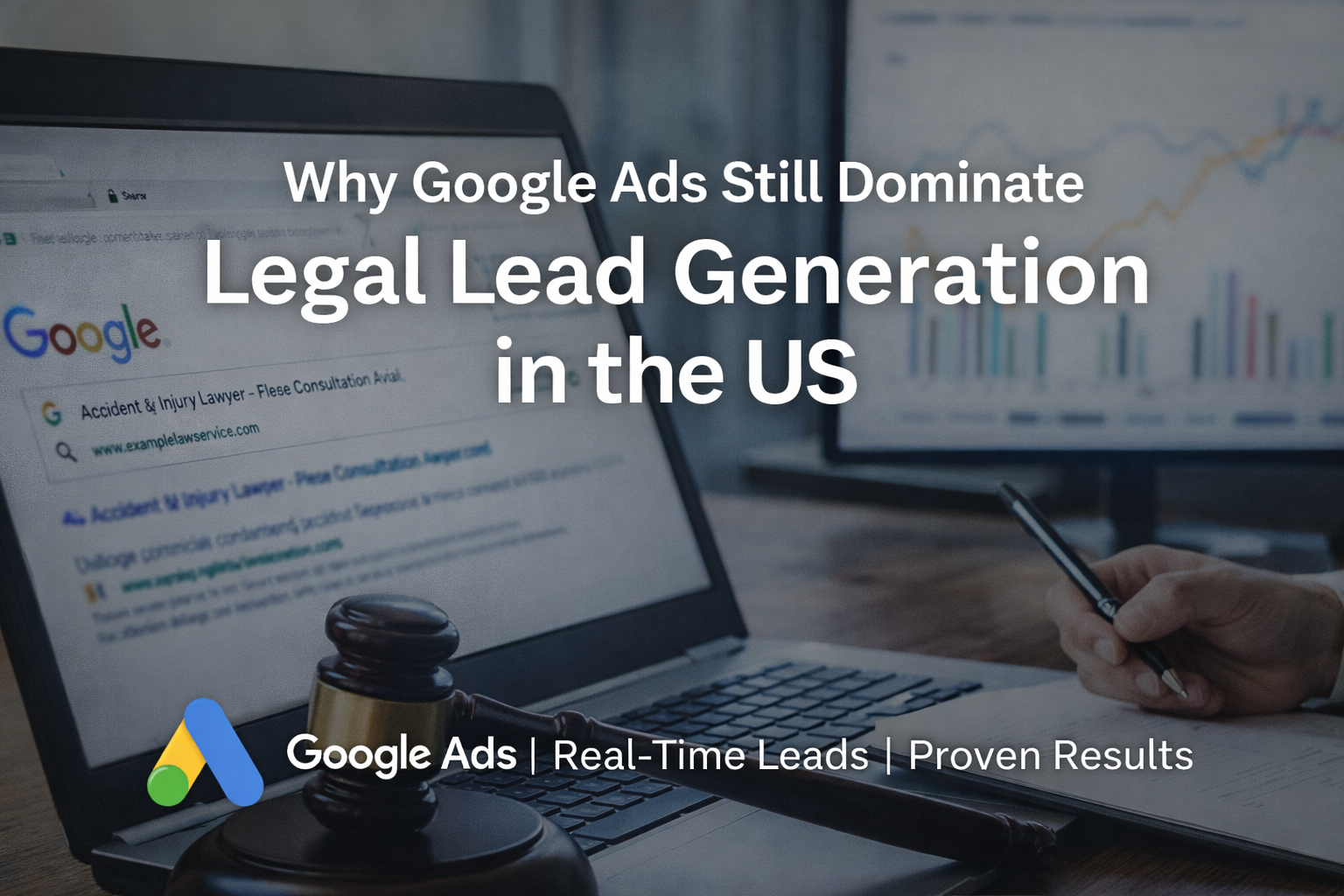
Why Google Ads Still Dominate Legal Lead Generation in the US

Why Google Ads Still Dominate Legal Lead Generation in the US

Estimated Reading Time: 6–7 minutes


Despite constant changes in digital marketing, one channel continues to outperform all others for US law firms: Google Ads.

When potential clients face a legal issue, they don’t scroll social media — they search Google with urgency. That intent is exactly why Google Ads remain the most powerful source of high-quality legal leads in the United States.

At TheLawyerLeads.com, Google Ads are a core driver of exclusive, real-time legal leads. Here’s why they still dominate in 2025.


Legal Clients Search with Immediate Intent

Legal problems are rarely casual. People search Google using phrases like:

  1. “Lemon law attorney near me”
  2. “Personal injury lawyer free consultation”
  3. “File bankruptcy Chapter 7 help”

These searches signal urgency — not curiosity.

Google Ads place your firm directly in front of prospects who are actively looking for legal help and ready to take action.


Location & Practice Area Precision

Google Ads allow hyper-specific targeting that works perfectly for law firms.

You can target:

  1. Specific states, cities, or service areas
  2. Practice-area-specific keywords
  3. Devices, call-based searches, and time of day

This ensures your advertising budget is spent only on relevant, qualified prospects — not wasted impressions.


Faster Results Than SEO

SEO is valuable, but it takes time.

Google Ads deliver results immediately. New firms or growing practices can start receiving inquiries the same day campaigns go live.

In competitive US legal markets, this speed matters. Waiting months for rankings often means lost opportunities and lost revenue.


Why Google Ads Outperform Social Media for Legal Leads

Social media advertising is interruption-based. Google Ads are intent-based.

Comparison:

  1. Google Ads: High intent, excellent lead quality
  2. Facebook / Instagram: Medium intent, mixed lead quality
  3. Display Ads: Low intent, mainly awareness-focused

This is why most high-performing US law firms allocate a larger portion of their marketing budget to search advertising.


TheLawyerLeads.com Google Ads Advantage

We don’t just run ads — we optimize for lead quality, not clicks.

Our system focuses on:

  1. Practice-area-specific landing pages
  2. Pre-screened intake questions
  3. Exclusive leads that are never shared
  4. Real-time delivery to your inbox or CRM

The result is fewer wasted calls, higher conversion rates, and better return on investment.


Final Thought

Google Ads remain the backbone of legal lead generation in the US for one simple reason: they capture potential clients at the exact moment they need legal help.

If your firm wants consistent, high-intent inquiries without competing over shared leads, Google Ads — when executed correctly — are unmatched.

🚀 That’s exactly how TheLawyerLeads.com helps US law firms grow smarter, not louder.

How Exclusive Legal Leads Help US Law Firms Boost ROI

How Exclusive Legal Leads Help US Law Firms Boost ROI

Estimated Reading Time: 5 minutes

Introduction

In today’s competitive legal market, US law firms face a constant challenge — attracting quality clients without wasting budget on unqualified leads. That’s where exclusive legal leads come in. Unlike shared directories or bulk lead lists, exclusive leads connect you directly with prospects who are actively seeking your legal help — and who haven’t been sold to multiple firms.

At TheLawyerLeads.com, we specialize in providing 100% exclusive, real-time legal leads tailored to your specific area of practice. Let’s explore why exclusivity is the key to higher ROI and sustainable growth for your firm.


1. What Are Exclusive Legal Leads?

Exclusive legal leads are client inquiries that are sold to only one law firm — yours. These leads are generated through targeted campaigns (Google Ads, social platforms, SEO funnels) and verified in real-time before being delivered.

Because no other firm receives the same lead, you gain:

  1. A higher chance of conversion
  2. Less competition for the same client
  3. A stronger client relationship from the first call

2. Why Shared Leads Waste Time and Money

Shared leads might look cheaper upfront, but they come with hidden costs:

  1. Multiple lawyers call the same client, leading to lower response rates
  2. Clients feel overwhelmed and lose trust quickly
  3. You end up paying more per actual conversion, not per inquiry

Exclusivity solves all of this — you’re the only firm reaching out, giving you full control of the conversation.


3. How Exclusive Leads Improve ROI

Every dollar counts when it comes to law firm marketing. Exclusive leads increase ROI by:

  1. Reducing acquisition costs (fewer wasted calls)
  2. Increasing conversion rates (less competition)
  3. Allowing better client targeting (using filters like state, issue type, and urgency)
  4. Creating long-term clients (through trust-based relationships)

Firms using exclusive leads typically report 20–40% higher client conversion rates compared to shared directories.


4. TheLawyerLeads.com Advantage

At TheLawyerLeads.com, our US network delivers only high-intent, exclusive prospects through:

  1. Paid ads on trusted platforms like Google and Bing
  2. Real-time lead verification for accuracy
  3. Advanced lead filtering (state, case type, urgency, etc.)
  4. Instant delivery to your inbox or CRM

We don’t recycle, resell, or share leads — ever.


Conclusion

If your firm is tired of chasing unresponsive clients or fighting over shared leads, it’s time to switch to a smarter system. Exclusive legal leads are not just a marketing upgrade — they’re an investment in long-term growth, client trust, and profitability.

Start today with TheLawyerLeads.com (US) — where exclusivity meets quality, and every lead counts.