
A solo practitioner in Ohio drafted forty wills last year, almost all from referrals, and wondered why her calendar was feast or famine. Her estate planning attorney client acquisition had no system behind it, only goodwill.
Estate planning attorney client acquisition is unusual among practice areas. The work is rarely urgent, the buyer is rarely in crisis, and the competition is rarely about who is cheapest. It is about who is present and responsive at the moment a family decides that procrastination has become a risk. Firms that understand this build a steady pipeline; firms that wait for referrals ride the wave.
This guide breaks down how estate planning demand actually forms, how to respond to it, and how to measure whether your pipeline is healthy. It is written for owners and partners who want predictable growth, not a marketing lecture.
Understanding Estate Planning Client Acquisition Demand
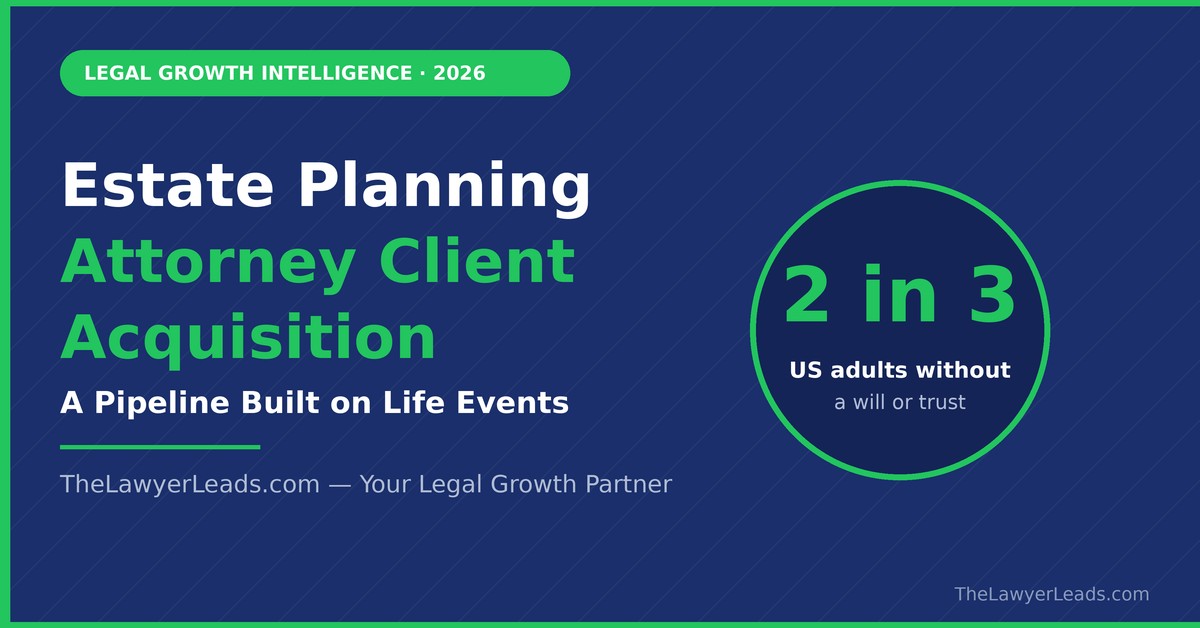
Unlike personal injury, where the trigger is an accident, estate planning demand is driven by life events. Industry surveys consistently show that roughly two-thirds of American adults have no will or trust, and most who eventually act do so after a specific prompt.
The Five Highest-Intent Triggers
The prospects most likely to sign share a recent event: the birth of a child, a home purchase, a marriage or remarriage, a parent’s decline, or a personal health scare. Each has a different message. New parents want guardianship certainty. Homeowners want to avoid probate. Adult children caring for a parent want powers of attorney, immediately.
Segmenting your outreach and intake scripts by trigger is the single easiest improvement most firms can make, because it lets the first conversation start with the prospect’s actual worry instead of a generic pitch.
Planning insight: most estate planning prospects research for weeks but hire the first firm that responds with a clear price and a booked consultation. Speed and fee transparency routinely beat reputation at this stage.
Estate Planning Lead Quality: What a Signed Engagement Looks Like
Not every inquiry is equal. A homeowner aged 58 with children and a rental property is a very different client from a 24-year-old asking about a free template. Quality screening protects your team’s time and your close rate.
Screening Questions That Qualify Without Interrogating
Three questions do most of the work: Do you own real estate? Do you have minor children or dependents? Has anything changed recently that prompted this call? Answers place the prospect on a value ladder, from a simple will package to a revocable trust with asset protection provisions.
Firms that embed these questions in a short pre-consultation form see fewer no-shows and walk into meetings already knowing which package to propose. The prospect also feels heard before they meet an attorney.
| Metric | Traditional Approach | With TheLawyerLeads.com |
|---|---|---|
| Primary trigger | Birth of a child, marriage, or a health scare | Same life events, reached before the competitor is |
| First response | Next business day, voicemail | Under five minutes, with a consultation link |
| Consultation format | Office-only, weekday hours | Video or phone, evenings and weekends offered |
| Follow-up | One call, then silence | Seven-touch sequence over 21 days |
| Fee clarity | Quoted only at the meeting | Flat-fee packages published up front |
| Measured outcome | Calls and form fills | Signed engagements and revenue per consultation |
Estate Planning Intake: Speed, Price Clarity, and Show Rate
Estate planning prospects tend to contact two to four firms in the same week. The firm that replies within minutes with a calendar link frequently never faces the others at all. Slow replies are the most common and most expensive leak in the pipeline.
Publish Packages, Not Mystery
Many attorneys avoid posting fees. In this practice area that is a mistake. Flat-fee packages (for example a will-based plan, a revocable trust plan, and a family protection plan) let prospects self-select and arrive prepared to buy. Firms that publish them report more qualified consultations and fewer price-shopping calls.
Raise the Show Rate
Offer video consultations, send a text reminder 24 hours and 2 hours before, and email a one-page checklist of documents to gather. Each step reduces friction. A show rate rising from 60 percent to 80 percent is the equivalent of a one-third increase in marketing spend, at no additional cost.
Key Insight
An estate planning pipeline is built on consultations kept, not inquiries received. A firm that books ten consultations and keeps eight will outperform a firm that collects thirty inquiries and keeps six, at a fraction of the acquisition cost.
Measuring Your Estate Planning Pipeline
Raw inquiry volume tells you very little. The metrics that matter are the consultation show rate, signed-engagement rate, cost per signed engagement, and average revenue per client, including the trust updates, funding work, and probate administration that follow.
Estate planning also has an unusually strong lifetime value profile. A satisfied client refers a spouse, parents, and friends, and returns every few years for updates. When you evaluate any client acquisition channel, compare it on three-year value per signed client, not on first-engagement fees alone. A channel that looks expensive at the front can be the cheapest on that basis.
Review these numbers monthly. If cost per signed engagement is climbing while show rate falls, the problem lives in intake, not in the channel. If show rate is healthy but signing is weak, revisit your package pricing and the consultation itself.
Estate Planning Pipeline Summary
- Target life events — new parents, new homeowners, second marriages, and recent diagnoses drive the most urgent demand.
- Respond in minutes — the first firm to offer a booked consultation wins a disproportionate share of signed engagements.
- Publish flat-fee packages — price transparency filters out poor-fit inquiries and builds trust before the meeting.
- Protect the show rate — reminders, video options, and a pre-consultation questionnaire lift attendance.
- Track the right numbers — cost per signed engagement and lifetime value from referrals and trust updates, not raw inquiry volume.
Build an Estate Planning Pipeline That Signs
Exclusive, practice-area-matched inquiries delivered to your firm, so your team spends its time on consultations instead of chasing cold contacts.