
A three-attorney personal injury firm in Phoenix was spending $14,000 a month on Google Ads and could not explain why intake kept fielding calls about slip-and-fall jobs they never take, workers’ comp, and people searching for free legal advice. Nothing was broken in the account. It simply had never been audited.
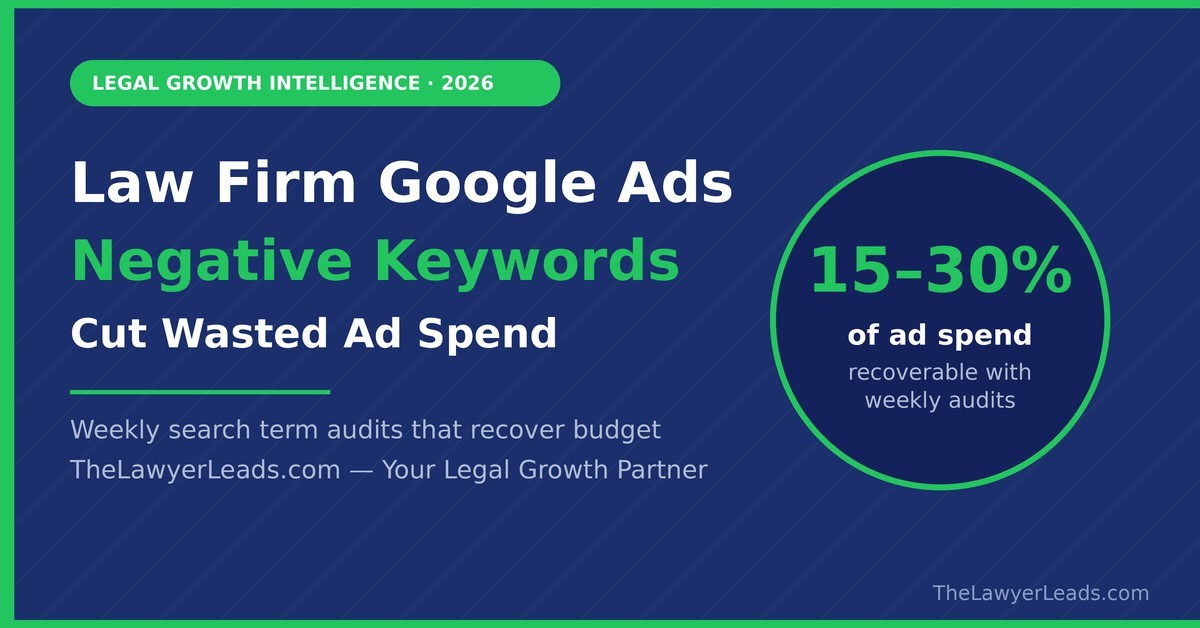
Every managing partner who runs paid search eventually discovers the same uncomfortable truth: a meaningful share of the budget is quietly funding clicks that were never going to become clients. Law firm Google Ads negative keywords are the most direct, least glamorous lever for fixing that. Done well, a weekly search term audit can recover 15–30% of spend without sacrificing a single qualified inquiry.
This guide walks through how to build a negative keyword system, how to read a search terms report like an operator, and how to connect the discipline to what actually matters: signed cases and cost per signed client.
Why Law Firm Google Ads Waste Money by Default
Legal is one of the most expensive verticals in paid search. Clicks for competitive practice areas such as personal injury, mesothelioma and DUI routinely cost $50 to $200 or more. At those prices, one irrelevant click is not a rounding error; it is a real line item.
The problem is structural. Google’s broad match and phrase match behaviour expands your reach to searches that merely resemble your keywords. Someone looking for a “lawyer salary”, “law school application”, or “how to file a complaint against a lawyer” can trigger an ad meant for a prospective client. Without negatives, the algorithm treats every click as equally valuable.
Benchmark to remember: in most unaudited legal accounts we see, 20–35% of clicks come from search terms with no realistic path to a signed case. That is the pool you are recovering.
Law Firm Google Ads Negative Keywords: A Three-Tier System
Treat negatives as a structured asset, not a list you add to when something annoys you. Organise them in three tiers so they can be reused and audited.
Tier 1: Account-level exclusions
These apply to every campaign and block intent that no law firm wants. Examples include jobs, careers, salary, internship, law school, LSAT, paralegal course, template, free, pro bono, DIY, forum, reddit, definition, movie, TV show. Build this list once and apply it through a shared negative keyword list.
Tier 2: Practice-area exclusions
A personal injury campaign should exclude workers’ comp, disability and Social Security terms if you do not handle them. A divorce campaign should exclude “annulment” or “prenup template” if those are not profitable matters for you. These live at the campaign or ad group level because a term that is waste in one practice area may be gold in another.
Tier 3: Geographic and qualification exclusions
Exclude states and cities you are not licensed or staffed to serve, and add qualification filters that reflect your case criteria, such as “dui first offense free consultation” if your firm only takes aggravated matters. Use exact and phrase negatives deliberately. A broad negative like “free” will also block “free consultation”, which is exactly the kind of query you may want.
| Metric | Unaudited Account | Account With Weekly Negative Audit |
|---|---|---|
| Irrelevant click share | 20–35% of clicks | Under 8% of clicks |
| Cost per qualified call | Climbs as broad match expands | Stable or declining |
| Intake time spent on poor-fit calls | Several hours a week | Minimal |
| Reporting confidence | Clicks and impressions | Cost per signed case |
How to Run a Weekly Search Term Audit
The search terms report is where the money is. Block 45 minutes every week, or assign it to your marketing partner with a clear checklist.
1. Sort by cost, not by volume. The expensive terms with zero conversions are where recovery is fastest. Start with anything that has spent more than twice your target cost per lead without producing a qualified call.
2. Classify each term. Is it a client, a researcher, a job seeker, a competitor, or an off-practice-area searcher? Only the first group deserves your budget.
3. Choose the right match type. Add a single irrelevant word as a phrase negative, a whole intent pattern as phrase negatives, and a one-off oddity as an exact negative.
4. Promote winners. The audit is not only defensive. When a long-tail term converts, such as “rear-end collision lawyer near me no upfront fees”, add it as an exact match keyword with its own ad copy and landing page.
Key Insight
The audit is a feedback loop between marketing and intake. Ask your intake team to flag every call that was a poor fit and record the caller’s exact words. Those phrases frequently reveal the search term that triggered the click, and they become your next batch of negatives.
Connecting Negative Keywords to Signed Cases
Cutting waste only matters if the clicks that remain convert. Pair your audit with three habits that tie spend to outcomes.
Track calls and forms by keyword. Use call tracking with dynamic number insertion so you know which search term produced each call, not just which campaign.
Import offline conversions. Send “signed retainer” events back into Google Ads. Smart bidding trained on signed cases behaves very differently from bidding trained on form fills.
Judge by cost per signed case. A $90 click that signs one in ten is far better than a $30 click that signs one in a hundred. Cost per click is a vanity metric; cost per signed case is the business metric.
Where Google Ads Fits in a Diversified Pipeline
Even a perfectly tuned account is exposed to auction inflation, policy changes and seasonal volatility. The strongest firms treat paid search as one channel inside a broader client acquisition system, alongside local SEO, referral development and exclusive, pre-qualified inquiries that arrive without competing in an auction.
Summary: Your Negative Keyword Action Plan
- Build three tiers — account-level, practice-area and geographic or qualification negatives.
- Audit weekly — sort search terms by cost and classify intent before adding exclusions.
- Mind match types — use exact and phrase negatives so you never block valuable queries like “free consultation”.
- Promote winners — move converting long-tail terms into their own exact match ad groups.
- Measure signed cases — import offline conversions and report cost per signed case, not cost per click.
- Diversify — pair paid search with local SEO and exclusive client inquiries to reduce auction risk.
Build a Client Pipeline That Does Not Depend on Ad Auctions Alone
Pair a disciplined Google Ads account with exclusive, practice-area-specific client inquiries delivered straight to your intake team.