
A two-partner personal injury firm in Phoenix had better results than the firm down the street, yet kept losing the click. Prospects compared 4.9 stars on 38 reviews against 4.6 stars on 410, and the bigger number won every time.
Law firm online reviews now sit at the centre of how legal consumers choose an attorney. They influence your placement in the local map pack, the percentage of searchers who call, and how much trust a prospect brings to the first conversation. Yet most firms treat reviews as an afterthought, asking only when a happy client happens to mention it. This guide shows how to turn reviews into a repeatable system inside your client acquisition pipeline.
Why Law Firm Online Reviews Drive Pipeline Growth
Reviews work on three levels at once. First, they are a local ranking signal: review quantity, recency, and keyword-rich content all feed Google’s local algorithm. Second, they are a conversion signal: a prospect deciding between three similar firms will usually call the one that looks safest. Third, they shorten the intake call, because a prospect who has read ten detailed client stories arrives half-persuaded.
The legal market adds a wrinkle. Clients are often in distress, hiring infrequently, and unable to judge legal quality directly. Social proof becomes the substitute for expertise they cannot evaluate, which is why a review profile carries more weight for a law firm than for a restaurant or a plumber.
Benchmark to watch: in most competitive metro markets, firms in the top three map-pack positions hold a meaningful lead in both review count and review velocity. Match the leaders on recency first, then close the volume gap.
Building a Review Engine, Not a Review Campaign
A campaign is a burst of effort that fades. An engine is a standing process with an owner, a trigger, and a metric. Firms that earn a steady stream of reviews almost always share the same three habits.
Ask at the Moment of Peak Satisfaction
Timing matters more than wording. Request a review when the client has just received good news: a settlement check, a granted petition, a dismissed charge, a discharge order. Build the ask into your case-closing checklist so it never depends on someone remembering.
Make the Ask Frictionless
Send a direct Google review link by text message, not a generic “find us online” email. Every extra click costs responses. A short personal note from the attorney or case manager, followed by one tap to the review form, typically outperforms a polished automated sequence.
Assign One Owner
Someone must own the number. Whether it is an office manager or a client-experience coordinator, one named person should track monthly new reviews, response rate, and average rating, and report them alongside your intake metrics.
| Element | Ad Hoc Approach | Review Engine Approach |
|---|---|---|
| Timing | Whenever someone remembers | Triggered at case resolution |
| Delivery | Generic email with no link | Personal text with direct link |
| Ownership | Nobody in particular | One named owner, monthly KPI |
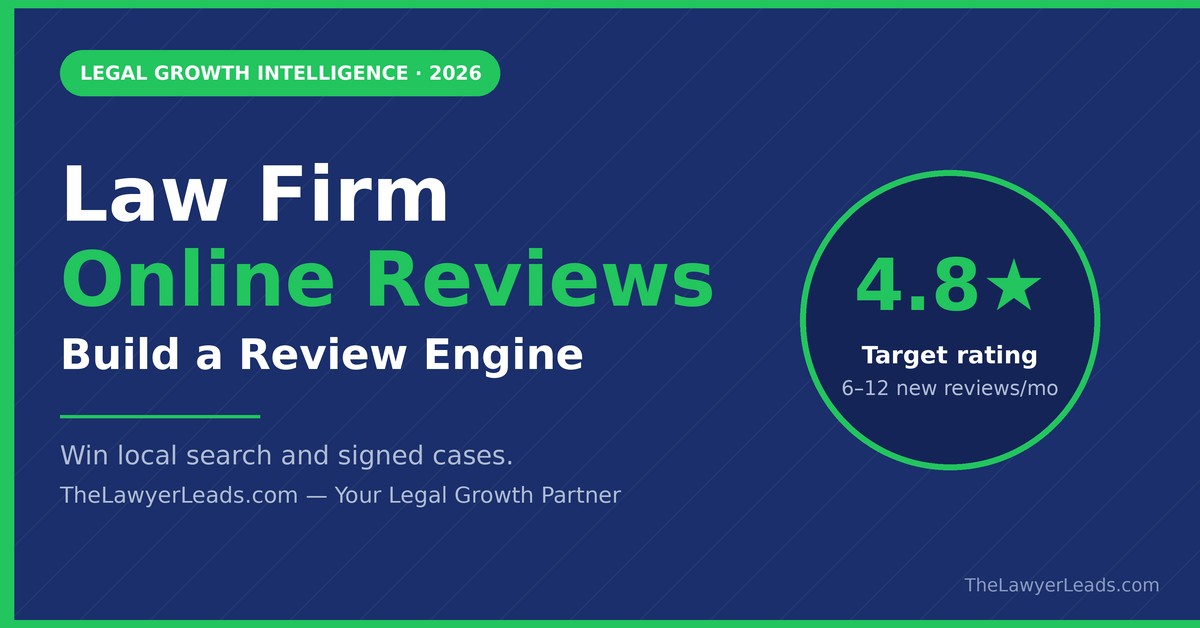
| Monthly volume | 0–2 reviews | 6–12 reviews |
| Response to reviews | Occasional | Every review, within 48 hours |
Measure the engine the way you measure intake. Track reviews per closed case, average star rating over the trailing 90 days, and the share of reviews that mention a specific practice area or city. If reviews per closed case sits below five percent, the problem is almost always the process, not your clients. Review the workflow quarterly, test a new message or timing, and keep what lifts response.
Staying Ethical: Bar Rules and Platform Policies
Reviews carry compliance risk that other industries ignore. Never offer payment, discounts, or any incentive in exchange for a review, as platforms prohibit it and several state bars treat it as a misleading or improper inducement. Avoid “review gating,” meaning screening for happy clients and routing unhappy ones elsewhere, because it violates Google’s guidelines.
Responses need even more care. Replying to a review can easily disclose confidential client information, even by confirming that the person was a client. Use a standard template that thanks the reviewer without referencing facts of the matter, and check your state’s advertising rules before you publish.
Key Insight
A calm, non-defensive reply to a negative review is read by far more prospects than the review itself. Acknowledge the concern, invite an offline conversation, and reveal nothing about the matter. A thoughtful reply turns your worst review into evidence of professionalism.
Turning Reviews Into Local SEO and Conversion Gains
Once the engine runs, put the content to work. Encourage clients to mention the practice area and city naturally, because a review that says “handled my DUI case in Tucson” does more for relevance than five stars alone. Feature your strongest testimonials on practice-area pages near the contact form, and embed a live review feed so the proof stays fresh.
Pair this with a strong pipeline. Reviews amplify whatever demand reaches your intake team. A firm that receives well-matched, exclusive inquiries from its target practice area gives its review engine a steady supply of satisfied clients to draw on. Growth compounds when acquisition and reputation feed each other.
Your Review Engine Checklist
- Assign an owner — one person tracks reviews, rating, and response rate monthly.
- Trigger the ask — build the request into the case-closing workflow at peak satisfaction.
- Remove friction — send a direct review link by text, personalised by the attorney.
- Stay compliant — no incentives, no review gating, and no confidential details in replies.
- Reply to everything — respond to every review within 48 hours using a vetted template.
- Leverage the content — feature testimonials on practice-area pages and encourage location and service mentions.
Build a Pipeline That Compounds Your Reputation
TheLawyerLeads.com is your legal growth partner for exclusive, practice-area-matched client inquiries that give your review engine more signed clients to work with.