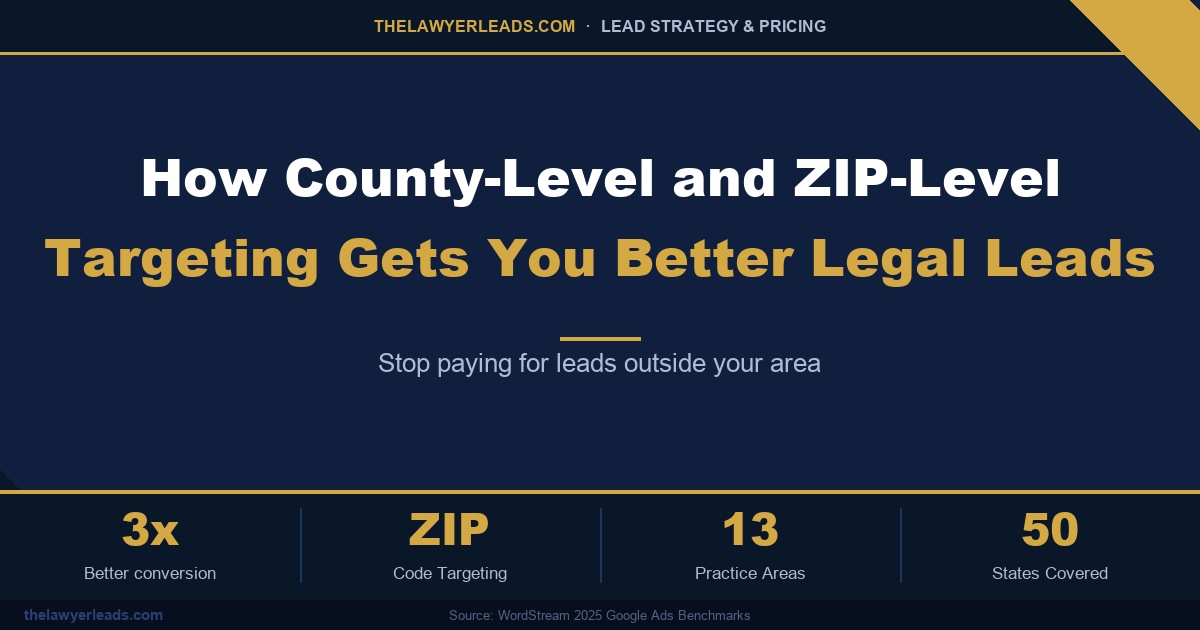
How County-Level and ZIP-Level Targeting Gets You Better Legal Leads

How County-Level and ZIP-Level Targeting Gets You Better Legal Leads

Every legal lead you pay for outside your service area is money wasted. County-level and ZIP-level targeting gets you better legal leads because every inquiry comes from someone you can actually meet, represent, and sign — in the courts you already know.

Most attorneys who have bought leads before have a story about it: a promising divorce inquiry that turned out to be three counties away, or a personal injury claimant in a state where the firm isn’t even licensed. Broad, state-wide lead buying looks efficient on paper. In practice it fills your pipeline with contacts you can’t convert. This guide explains why precise geographic targeting matters, and how to use it to lower your real cost per signed client.


Why State-Wide Legal Leads Waste Your Budget

According to WordStream’s 2025 Google Ads benchmarks, the average cost per lead in the legal industry is $131.63, and personal injury leads average $159.17. At those prices, every lead has to count. Yet many lead platforms still sell by state, or even by “region,” so a firm in Austin pays the same for a lead from El Paso — almost 600 miles away — as for one down the street.

Distance hurts conversion in ways that are easy to underestimate:

  • Clients want a local lawyer. People facing a DUI, a custody dispute, or an injury claim want someone who knows their local courthouse and can meet them in person.
  • Travel eats your margin. Hearings in a distant county add hours of unbilled time to every matter.
  • Local competitors respond faster. A prospect who is two hours away will usually sign with the firm around the corner.

The true cost of a lead isn’t its price. It’s the price divided by the chance you’ll sign that client. A cheap lead from the wrong county is still an expensive lead.

How County-Level and ZIP-Level Targeting Works

With ThelawyerLeads, you choose the exact counties or ZIP codes where you want legal leads. Only people who submit an inquiry from inside those boundaries are sent to you. You can set it up tightly around your office, or spread it across several counties where you regularly appear in court.

Targeting Level Best For Typical Result
State-wide Firms with offices across the state High volume, many out-of-area leads
County-level Firms tied to specific courthouses Leads in the courts you already practice in
ZIP-level Solo and neighborhood practices, dense metros The tightest match to your office — up to 3x better conversion

Combine Geography With Practice Area

Geography is only half of the filter. ThelawyerLeads covers 13 practice areas across all 50 states, so you can pair your ZIP codes with the exact case types you want — personal injury in one set of counties, family law in another. You can also leave out case types you don’t handle, so you never pay for a lead you would have to turn away.


Setting Up ZIP-Level Targeting for Better Legal Leads

To get the most from geographic targeting, start with where your clients already come from, then grow outward:

  • Look at your signed cases. Pull the ZIP codes of your last 20–30 retained clients. That is your core area.
  • Add the counties you practice in. Include every county where you’re comfortable appearing in court.
  • Test, then widen. Start tight, track how many leads you sign, and add nearby ZIP codes only once your core area is performing.
  • Check state pricing. Lead prices vary by state and practice area, so compare before you commit budget.

▶ Key Insight

Fewer, closer leads usually beat more, scattered ones. Because ThelawyerLeads has no long-term contracts, you can adjust your ZIP codes and counties at any time as you learn which areas sign best.

Why Attorneys Choose ThelawyerLeads

Many large lead platforms lock attorneys into annual contracts and share each lead with several competing firms. ThelawyerLeads takes a different approach: transparent state-specific pricing, exclusive lead options, county and ZIP filters, and no long-term commitment. You pay for the leads you want, in the places you want them — nothing more.

How County-Level and ZIP-Level Targeting Gets You Better Legal Leads — Summary

  1. Out-of-area leads cost money — at $131.63 average legal CPL, every lead you can’t serve hurts your ROI.
  2. Local clients convert better — people want a lawyer who knows their local courthouse.
  3. ZIP and county filters — send leads only from the areas you actually serve.
  4. Pair geography with practice area — 13 practice areas across all 50 states.
  5. Stay flexible — no contracts, so you can refine your targeting at any time.

Stop paying for leads outside your area. With county-level and ZIP-level targeting, your budget goes to the prospects most likely to become signed clients — right where you practice.

Source: WordStream 2025 Google Ads Benchmarks.

See Lead Pricing for Your State

We offer transparent, state-specific lead pricing across all major practice areas — with no contracts, no recycled contacts, and full exclusivity options.
View Lead Pricing →

Law Firm Review Generation: The SEO and Conversion Strategy Most Firms Get Backwards

Law Firm Review Generation: The SEO and Conversion Strategy Most Firms Get Backwards

A managing partner at a six-attorney PI firm couldn’t understand why a competitor with a weaker trial record kept outranking her in the Google Map Pack and out-converting her on every consultation call. The answer wasn’t ad spend or a slicker website. It was 140 more Google reviews, collected on purpose, month after month, while her firm waited for happy clients to volunteer one.

Most law firms treat reviews as an afterthought — something the office manager remembers to ask about once a quarter, if at all. But a deliberate law firm review generation strategy has quietly become one of the highest-leverage, lowest-cost levers in legal marketing. Reviews now sit at the intersection of two things every firm needs: local SEO visibility and the trust that turns a phone call into a signed retainer. Firms that systematize this outperform firms that don’t, even when the underlying legal work is identical.


Why a Review Generation Strategy Is Now an SEO Requirement

Google’s local ranking algorithm weighs review count, review recency, and review quality alongside the traditional signals of proximity and relevance. A firm that hasn’t earned a new review in eight months sends a quiet signal that it isn’t actively practicing, isn’t actively trusted, or both. Meanwhile, a competitor generating five to ten fresh reviews a month tells Google — and every prospective client scrolling the Map Pack — that real people are choosing this firm right now.

This is why review generation belongs in the same strategic conversation as your client pipeline and intake process, not filed under “nice to have.” A firm without a repeatable system is relying on luck. A firm with one is compounding an asset every single month.

Firms in the top three Map Pack positions for competitive legal keywords average significantly more total reviews — and a faster review velocity — than firms ranked below them. Velocity, not just volume, is what Google and prospective clients both notice.

Building a Review Generation Strategy That Runs Without You

The firms winning this game aren’t asking harder — they’re asking at the right moment, through the right channel, with the right script. Three elements make the difference:

1. Timing the ask to the emotional peak

The best moment to request a review is not the day the case closes — it’s the moment the client feels relief: a settlement check clears, a charge gets dismissed, a green card arrives. Build the ask into your case-closing workflow so it happens automatically, not when someone remembers.

2. Removing every point of friction

A text message with a direct Google review link converts far better than an email buried in an inbox. Clients who have to search for your firm, find the right listing, and then figure out how to leave a review will simply not finish the task. Shorten the path to two taps.

3. Assigning ownership, not hoping

Review generation that depends on attorneys remembering to ask will always underperform. Assign it to intake staff or a paralegal as a tracked task tied to case closure, with a simple weekly count reported to the partner. What gets measured gets done.

Metric Ad Hoc Asking Systematic Review Generation
New reviews per month 0–2 8–15+
Response window Weeks, if at all Same day
Map Pack trend Flat or declining Steadily climbing
Ownership Nobody, informally “everyone” Named staff member, tracked weekly

Handling Negative Reviews Without Losing Rankings or Reputation

A robust review generation strategy also means you’ll occasionally absorb a one-star review from a disgruntled former client or opposing party. Don’t panic and don’t argue publicly. Respond within 24–48 hours, acknowledge the concern in general terms without discussing case specifics or violating client confidentiality, and offer to continue the conversation offline. A calm, professional response — visible to every future prospect reading that review — often does more for your credibility than the negative review does damage.

Key Insight

A steady flow of new five-star reviews dilutes the visibility of any single negative one mathematically and psychologically — prospects read the last five reviews far more often than they read all of them. Volume and velocity are your best defense against the occasional bad review.

Turning Reviews Into a Client Acquisition Asset

Once the system is running, put the reviews to work beyond your Google Business Profile. Pull your strongest, most specific testimonials — the ones that mention outcomes, communication, and how a client felt during a stressful time — into your website’s practice area pages, your intake follow-up sequence, and your paid ad creative. A five-star aggregate score next to your firm’s name in a Google Ad listing measurably improves click-through rate, which lowers your cost per acquisition on every dollar you spend.

This is the compounding effect a real growth partner builds toward: reviews feed your local SEO, local SEO feeds your inbound call volume, and strong social proof at every touchpoint feeds your intake conversion rate. None of it requires a bigger ad budget — it requires a system that runs whether or not anyone remembers to ask.

Building Your Review Generation Strategy: The Fast Version

  1. Automate the ask — trigger a text request at the emotional high point of case resolution, every time.
  2. Remove friction — send a direct, one-click link to your Google review page, not a search instruction.
  3. Assign ownership — one staff member tracks and reports review count weekly, tied to case closures.
  4. Respond fast to negatives — professional, confidential, offline follow-up within 48 hours.
  5. Redeploy your best reviews — into your website, ads, and intake sequence to lower cost per acquisition.

Reviews Build Trust. We Build the Pipeline Around It.

TheLawyerLeads.com pairs your firm’s reputation with exclusive, real-time, practice-area-filtered client opportunities — so every review you earn works alongside a growing pipeline, not instead of one.

Browse Practice Areas

Law Firm Website Conversion Rate Optimization: Turning More Visitors Into Signed Clients

Law Firm Website Conversion Rate Optimization: Turning More Visitors Into Signed Clients

A managing partner at a mid-size PI firm doubles her Google Ads budget for the third quarter in a row. Traffic climbs. Phone calls barely move. The website is getting more visitors than ever — it’s just not turning them into signed clients.

This is one of the most common — and most expensive — blind spots in law firm marketing. Firms chase law firm website conversion rate optimization as an afterthought, if they think about it at all, while pouring the bulk of their budget into driving more clicks to a site that was never built to close. The math is brutal: if your site converts visitors into leads at 1% instead of 4%, you need four times the ad spend to hit the same number of signed cases. No amount of SEO or PPC volume fixes a conversion problem — it just makes the problem more expensive.

The good news is that conversion rate optimization (CRO) for a law firm website is not a redesign project. It’s a set of specific, measurable changes to how a visitor experiences your site in the first 15 seconds, and how easy you make it for them to take the next step. Firms that treat CRO as an ongoing discipline — not a one-time fix — consistently pull more signed cases out of the same traffic, the same ad budget, and the same practice areas.


Why Law Firm Website Conversion Rate Optimization Gets Ignored

Most firms measure marketing success by traffic, rankings, and cost per click — metrics that are easy to see in a dashboard. Conversion rate requires actually watching what happens after someone lands on the page, which means tracking phone calls, form fills, and live chat starts against total visitors. It’s a harder number to get right, so it’s the number most firms skip.

That gap matters because a prospective client deciding between three or four law firm websites in a single browsing session is not evaluating your firm’s credentials in depth. They are scanning for trust signals, checking how fast they can reach a human, and moving on within seconds if the page feels generic, slow, or confusing. Website conversion optimization for attorneys is really about removing every point of friction between “I have a legal problem” and “I just contacted this firm.”

Industry benchmarks put the average law firm website conversion rate between 2% and 5%. Firms with optimized intake pages, clear calls to action, and fast-loading mobile experiences routinely see 8–12% — without spending a dollar more on traffic.

The Five Levers That Actually Move Conversion Rate

1. Above-the-fold clarity

A visitor should know within three seconds what practice area they’re on, what makes your firm different, and how to contact you — without scrolling. Vague headlines like “Experienced Attorneys You Can Trust” say nothing a competitor’s site doesn’t also say. Specific headlines built around outcomes and practice area language perform better and reinforce the keyword relevance search engines reward.

2. Contact friction

Every extra form field costs conversions. A consultation request form that asks for name, phone, and a one-line case description converts meaningfully better than one asking for full case history, referral source, and mailing address. Save the detailed intake for the phone call or the retained-client stage, not the first touch.

3. Mobile load speed

A majority of legal searches now happen on mobile, often from someone dealing with an urgent situation — an accident, an arrest, a served notice. A site that takes more than three seconds to load loses a significant share of that traffic before the page even renders. Compressed images, minimal plugins, and a lean homepage template matter more than most firms realize.

4. Trust signals placed where decisions happen

Case results, bar admissions, and client testimonials only help conversion if they sit near the call-to-action — not buried on a separate “About” page three clicks deep. Place a short proof point directly next to the contact form or click-to-call button, where the visitor is actually making the decision to reach out.

5. Multiple, low-commitment contact paths

Not every visitor wants to fill out a form, and not every visitor wants to call. Live chat, click-to-text, and a short consultation form covering the same ground in parallel capture visitors who would otherwise bounce because their preferred contact method wasn’t offered.

Key Insight

A firm that improves conversion rate from 3% to 6% doesn’t need to double its marketing budget to double its signed cases — it needs to fix its website. That’s the single highest-leverage change most firms haven’t made.

Traffic Volume vs. Conversion: Where the ROI Actually Lives

The comparison below shows why chasing more clicks without fixing conversion is the more expensive path to the same number of signed cases.

Metric Traditional Approach (More Traffic Only) With Conversion-Optimized Intake
Monthly visitors 4,000 4,000 (unchanged)
Conversion rate 2% 7%
Leads generated 80 280
Ad spend required for same lead count 3.5x higher No increase needed

Fixing the Website Only Gets You Halfway

Even a perfectly optimized site can’t outrun a fundamental supply problem: organic and paid traffic alone often isn’t enough volume for firms trying to grow a specific practice area quickly. That’s where a conversion-optimized website and a filtered, exclusive client pipeline work together rather than as substitutes for each other. The website converts the traffic you already have at a higher rate; a growth partner like TheLawyerLeads.com fills the volume gap with prospects who are already actively seeking representation in your practice area and geography, so your improved intake process has more qualified opportunity to work with from day one.

CRO Checklist For Law Firm Sites

  1. Clarify the above-the-fold message — practice area, differentiator, and contact option visible without scrolling.
  2. Shorten the intake form — ask only what you need to make first contact, not the full case file.
  3. Cut mobile load time — compress images and remove unused plugins to keep pages under three seconds.
  4. Move trust signals next to the CTA — case results and reviews belong where the decision happens.
  5. Offer multiple contact paths — call, text, chat, and form, side by side.
  6. Pair CRO with a reliable pipeline — a better-converting site still needs enough qualified traffic to convert.

Your Website Fixes the Rate. We Fix the Volume.

Pair a conversion-optimized site with an exclusive, real-time client pipeline built for your practice area and territory.

Browse Practice Areas

Google Ads for Law Firms: How to Stop Wasting Budget on Clicks That Never Sign

Google Ads for Law Firms: How to Stop Wasting Budget on Clicks That Never Sign

A three-attorney family law firm in Phoenix was spending $9,000 a month on Google Ads. The dashboard looked healthy — plenty of clicks, a respectable click-through rate. But when the managing partner pulled the intake log, fewer than one in five calls came from someone who actually needed a divorce lawyer in Maricopa County. The rest were job seekers, out-of-state callers, and people looking for free forms.

That story is common. Google Ads for law firms can be one of the fastest ways to put your practice in front of people with urgent legal needs — but legal keywords are among the most expensive on the platform, with many personal injury and mass tort terms running $100 to $300+ per click in competitive metros. At those prices, a poorly structured account doesn’t just underperform; it quietly drains the budget you could be using to grow. This guide covers where law firm ad spend typically leaks and how to plug each hole.


Why Google Ads for Law Firms Wastes So Much Budget

Most wasted legal ad spend comes from three sources: broad match keywords without guardrails, loose geographic targeting, and landing pages that don’t convert. Google’s automation is built to spend your budget, not to understand that “lawyer salary” and “lawyer near me” signal completely different intent.

Broad match has become more aggressive over the past few years. A keyword like “car accident lawyer” can trigger your ad for “car accident lawyer jobs,” “car accident report online,” or even “how to handle a car accident without a lawyer.” Each of those clicks costs the same as a genuine prospect — and none of them will ever sign a retainer.

Quick audit: Open your Search Terms report for the last 90 days and sort by cost. In most law firm accounts we review, 25–40% of spend goes to search terms that could never produce a client.


Build a Negative Keyword Wall

Negative keywords are the single highest-ROI fix in most legal accounts. Build a shared negative list and apply it across every campaign. Start with these families:

  • Employment intent: jobs, salary, hiring, careers, paralegal, internship, school
  • DIY intent: free, forms, template, pro bono, legal aid, self-help, without a lawyer
  • Research intent: definition, statute, wiki, reddit, course, exam
  • Wrong practice area: if you only handle plaintiff PI, exclude “defense,” “insurance adjuster,” and “criminal”

Then review the Search Terms report weekly for the first 60 days and monthly after that. New waste patterns appear constantly, especially when you use broad match with Smart Bidding.


Fix Geo-Targeting and Ad Scheduling

By default, Google targets people “in or regularly in, or who’ve shown interest in” your location. For a law firm licensed in one state, that setting lets someone in Ohio researching Texas divorce law trigger your ads. Change the location option to “Presence: people in or regularly in your targeted locations.”

Next, match your ad schedule to your intake capacity. If nobody answers the phone after 7 p.m., either staff a live answering service or reduce bids overnight. A missed call on a $150 click is the most expensive kind of waste.

Setting Default / Common Setup Optimized for Law Firms
Location option Presence or interest Presence only
Match types Broad match, no negatives Phrase/exact + shared negative list
Ad schedule 24/7 at equal bids Bids aligned to intake hours
Conversion goal Any call or form fill Calls 60s+ and qualified consults
Search partners Enabled Off until proven profitable

Track Signed Cases, Not Clicks, in Google Ads for Law Firms

Smart Bidding is only as smart as the signal you feed it. If every 10-second call counts as a conversion, Google will happily find you more 10-second calls. Set your primary conversion to calls lasting 60 seconds or longer and form submissions that pass basic qualification.

The next level is offline conversion imports: when a prospect signs, push that outcome from your CRM or intake software back into Google Ads with the click ID (GCLID). The algorithm then learns which searches produce retained clients rather than just inquiries — a meaningful shift for firms spending $5,000+ per month.

Key Insight

Your true metric is cost per signed case, not cost per click or cost per lead. A campaign at $250 per inquiry that signs one in three beats a campaign at $90 per inquiry that signs one in fifteen.


Diversify Your Client Acquisition Mix

Even a perfectly tuned account has a ceiling: auction prices rise, competitors enter, and Google’s policies shift. Firms with the steadiest growth treat paid search as one channel in a portfolio — alongside local SEO, referrals, and exclusive, pre-filtered client inquiries matched to their practice area and geography. That mix protects your pipeline when cost per click spikes and gives you a benchmark to judge whether ad spend is earning its keep.

Your Google Ads Waste-Reduction Checklist

  1. Audit search terms — sort 90 days by cost and flag irrelevant queries.
  2. Build a shared negative list — block job, DIY, research, and wrong-practice intent.
  3. Switch to presence-only targeting — stop paying for out-of-state researchers.
  4. Align bids with intake hours — never pay for a call nobody answers.
  5. Optimize for signed cases — use 60s+ calls and offline conversion imports.
  6. Diversify channels — benchmark paid search against other acquisition sources.

Stop Paying for Clicks That Never Become Clients

Add exclusive, real-time client inquiries filtered to your practice area and location — a predictable pipeline that complements your paid search.

Browse Practice Areas

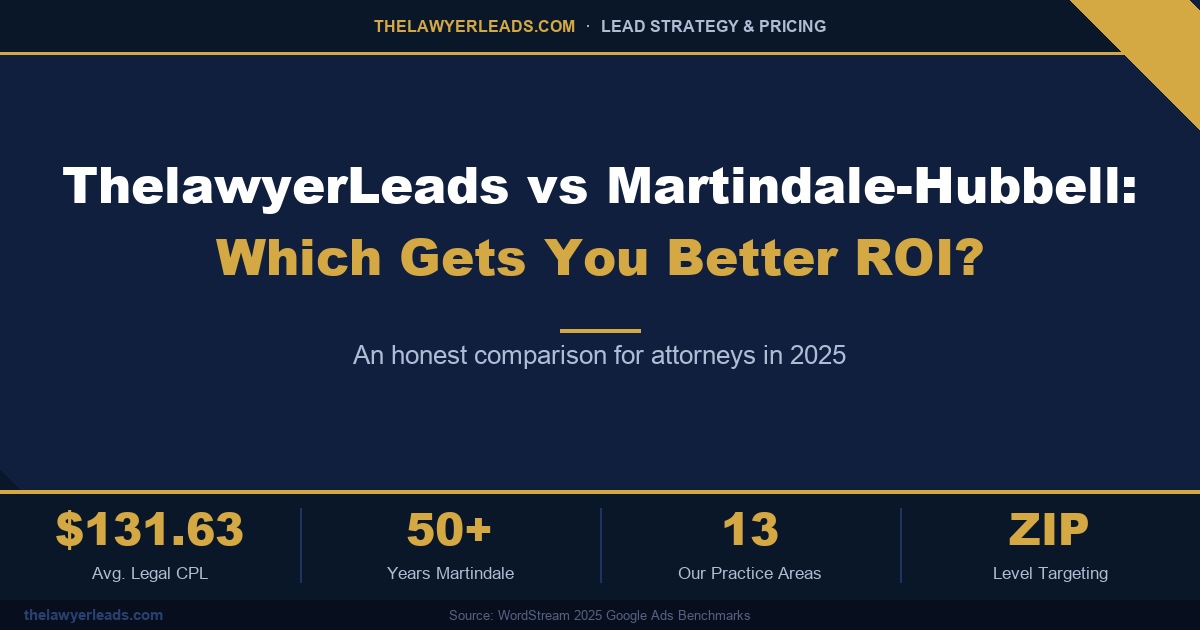
ThelawyerLeads vs Martindale-Hubbell: Which Gets You Better ROI?

ThelawyerLeads vs Martindale-Hubbell: Which Gets You Better ROI?

Martindale-Hubbell built its reputation over five decades as the directory attorneys trusted for referrals and peer ratings. But directory presence and lead generation are not the same thing — and for attorneys trying to fill their intake calendar in 2025, that difference matters more than ever.

If you’re an attorney comparing legal lead generation options, you’ve almost certainly come across Martindale-Hubbell. It’s a household name in the legal industry, and its peer-review ratings carry real prestige. But prestige doesn’t always translate into a full pipeline of qualified, ready-to-hire clients. This post breaks down how ThelawyerLeads and Martindale-Hubbell actually compare on the things that matter most to your bottom line: lead quality, targeting precision, cost, and contract flexibility.

What Martindale-Hubbell Actually Offers

Martindale-Hubbell’s core strength is its legacy: over 50 years as a legal directory and peer-review rating system. Attorneys list their profiles, collect peer ratings, and hope prospective clients find them through search or referral. It’s a credibility play more than a demand-generation engine — the platform was built for reputation management long before “lead generation” was a marketing category.

The tradeoff is that Martindale-Hubbell’s model relies heavily on broad directory traffic rather than precision targeting. Attorneys are grouped by practice area and general location, but there’s limited ability to filter prospective clients by county or ZIP code, and lead exclusivity isn’t a given — profiles compete for the same visitor’s attention on the same page.

Head-to-Head: ThelawyerLeads vs Martindale-Hubbell

Factor Martindale-Hubbell ThelawyerLeads
Model Directory listing + peer ratings Direct-to-attorney lead delivery
Geographic targeting General location only County and ZIP-level precision
Practice areas covered All fields, broadly 13 focused legal practice areas
Lead exclusivity Shared directory traffic Exclusivity options available
Contract terms Annual directory subscriptions No long-term contracts
Avg. cost per lead (legal) Bundled into subscription pricing $131.63 industry average

Martindale-Hubbell sells you visibility. ThelawyerLeads sells you a prospective client who has already indicated they need an attorney in your practice area and your service area — right now.

Why Targeting Precision Drives ROI

The average legal cost-per-lead sits at $131.63 across the industry, according to WordStream’s 2025 Google Ads benchmarks. That number is an average — attorneys who pay for broad, untargeted exposure (like a general directory listing) often end up with a worse effective cost-per-case, because a large share of the traffic they’re paying for falls outside their actual service radius or isn’t ready to hire.

ThelawyerLeads addresses this with county and ZIP-level targeting across 13 practice areas, so the leads reaching your intake team are already filtered by geography and case type before they ever hit your phone or inbox. That’s the structural difference between a directory model built for brand visibility and a lead-generation model built to convert.

What This Means for Your Intake Team

  • Fewer out-of-area calls that waste staff time and never convert
  • Leads pre-filtered by the specific practice area you handle
  • State-specific pricing instead of a flat national subscription rate
  • No annual contract locking you into a channel that isn’t performing

▶ Key Insight

A 50-year legacy builds trust with peers — it doesn’t guarantee a prospective client is on your website today. Lead quality depends on real-time intent and precise geographic match, not directory tenure.

Which One Fits Your Firm?

Martindale-Hubbell still has a place for attorneys who want peer-review credibility and long-term brand presence in a legacy directory. But if your priority is filling your calendar with prospective clients who match your practice area and service area right now, a targeted lead-generation model is built for that job in a way a directory listing simply isn’t.

That’s the gap ThelawyerLeads was built to close — county and ZIP-level targeting, 13 dedicated practice areas, exclusivity options, and no long-term contract forcing you to keep paying for underperforming traffic.


ThelawyerLeads vs Martindale-Hubbell — Summary

  1. Different models — Martindale-Hubbell is a directory and reputation platform; ThelawyerLeads is direct lead delivery.
  2. Targeting precision wins — county and ZIP-level filtering beats general location listings for conversion.
  3. Flexibility matters — no long-term contracts means you can allocate budget to what’s actually working.
  4. Exclusivity is available — unlike shared directory traffic, exclusive leads reduce competition for the same prospective client.

See Lead Pricing for Your State

We offer transparent, state-specific lead pricing across all major practice areas — with no contracts, no recycled contacts, and full exclusivity options.
View Lead Pricing →

The 2026 Local SEO Checklist for Law Firms: How to Rank in the Google Map Pack

The 2026 Local SEO Checklist for Law Firms: How to Rank in the Google Map Pack

A personal injury firm in Tampa spends $4,200 a month on paid search and gets a trickle of clicks. Three blocks away, a two-partner firm with a fraction of that budget shows up in the Map Pack for “personal injury lawyer near me” every single time someone searches it — and their phone rings before the ad ever loads.

That gap isn’t luck. It’s a local SEO checklist for law firms that most practices never fully execute. Local search — the Google Business Profile listing, the Map Pack, the “near me” results — drives a disproportionate share of legal client inquiries, and it costs nothing per click. Yet most firm websites are set up to chase organic blog traffic or national keywords while leaving the three-pack, the highest-intent real estate on the entire search results page, half-optimized or outright neglected.

Ranking there in 2026 requires more precision than it did even two years ago. Google’s local algorithm now weighs review velocity, citation consistency, and on-page proximity signals more heavily than raw backlink counts. Here is the full local SEO checklist for law firms that actually moves the needle — and where most firms are quietly losing ground.


What Local SEO Actually Means for a Law Firm in 2026

Local SEO is the set of signals Google uses to decide which three firms appear in the Map Pack when someone searches “divorce attorney [city]” or “car accident lawyer near me.” It is governed by three factors: relevance (does your profile and website match the search), distance (how close is your office to the searcher), and prominence (how established and trusted does Google consider your firm, based on reviews, citations, and links).

Firm owners often confuse local SEO with general SEO — blog posts, backlinks, domain authority. Those still matter for organic rankings further down the page, but the Map Pack runs on a separate set of rules, and a firm can rank #1 organically while being invisible in the three-pack because its Google Business Profile is thin or its citations are inconsistent.

Why This Matters More for Attorneys Than Most Industries

Legal searches are almost entirely local and high-intent. Nobody searches “bankruptcy attorney” out of curiosity — they search it because they are days from a filing deadline or a wage garnishment. That urgency is why the Map Pack converts better than a display ad: the searcher is choosing from three visible, verified options, not scrolling past ten blue links.

Firms that appear in the Map Pack for their core practice-area keyword typically see 2–3x the call volume of firms ranking only in the organic results below it, at zero marginal cost per lead.


The Google Business Profile Checklist

Your Google Business Profile (GBP) is the single highest-leverage asset in local SEO for law firms. Most firms claim it once, fill in the basics, and never touch it again — which is precisely why an actively maintained profile outperforms a dormant one, even when the dormant firm has more years in practice.

GBP Element Typical Firm Setup Optimized Setup
Categories “Lawyer” only Primary + 3–5 specific categories (e.g. “Personal Injury Attorney”)
Review Cadence A handful from years ago 4–8 new reviews per month, ongoing
Photos Logo only Office, team, and case-result photos updated quarterly
Q&A Section Empty Firm pre-seeds 5–10 common client questions
Posts Never used Weekly update or case-type spotlight

Review velocity deserves special attention: Google weighs the rate of new reviews, not just total count. A firm with 40 reviews trickling in over six years signals less current activity than a firm with 25 reviews added steadily over the last twelve months — even though the second firm has a smaller total.


On-Site and Citation Signals That Move the Needle

A strong GBP only works alongside a website that reinforces the same signals. Google cross-references your listing against your site and third-party directories — when they disagree, rankings suffer.

NAP Consistency

Your firm’s Name, Address, and Phone number (NAP) must be identical, character-for-character, across your website, GBP, and every legal directory listing — Avvo, FindLaw, Justia, the state bar directory, and local chamber sites. “Suite 200” versus “Ste. 200” is enough of a mismatch to dilute prominence signals.

Location-Specific Landing Pages

Firms serving multiple cities or counties need a dedicated page per location — not a single “areas we serve” list. Each page should include unique content about that location, embedded map, local testimonials where available, and the practice-area keyword paired with the city name in the title tag and H1.

Key Insight

A firm with five well-built location pages consistently outranks a firm with one generic “service area” page listing the same five cities in a sentence. Depth beats breadth in local SEO.

Schema Markup

LegalService and Attorney schema markup tells Google explicitly what your firm does, where it operates, and what it charges (or that consultations are free) — removing ambiguity that would otherwise be inferred, often incorrectly, from unstructured text.


Common Mistakes That Keep Firms Out of the Map Pack

The most common failure isn’t a missing tactic — it’s inconsistency. A firm runs a review campaign for one month, stops, and wonders why rankings plateaued. Local SEO rewards sustained activity more than any single optimization.

Other frequent errors: using a call-tracking number on the GBP that doesn’t match the website (a major NAP violation), stuffing the business name field with keywords like “Smith Law — Personal Injury & Car Accident Attorneys” (a violation of Google’s guidelines that risks suspension), and ignoring negative reviews instead of responding professionally, which signals inactivity to both Google and prospective clients.

Google Business Profile suspensions for keyword-stuffed business names are among the most common — and most preventable — ranking losses firms report each year.


Local SEO Checklist Summary

  1. Claim and fully complete your GBP — categories, hours, services, and attributes, not just name and address.
  2. Build a steady review cadence — 4–8 new reviews per month beats a one-time push to 50.
  3. Lock down NAP consistency across your site, GBP, and every legal directory.
  4. Build dedicated location pages for every city or county you actively serve.
  5. Add LegalService schema markup to remove ambiguity for search engines.
  6. Respond to every review, positive and negative, within a few days.

Local SEO compounds. A firm that executes this checklist consistently for two quarters typically sees Map Pack visibility firm up before organic rankings catch up — and unlike paid search, that visibility doesn’t disappear when the budget pauses. Even a firm doing everything right locally still needs a way to fill gaps in slow months or new practice areas.

Build Your Pipeline While Your SEO Compounds

TheLawyerLeads.com pairs exclusive, filtered client opportunities with your organic growth strategy — so your intake stays full while your Map Pack rankings climb.

Browse Practice Areas

How Immigration Law Firms Can Build a Predictable Client Pipeline in 2026

How Immigration Law Firms Can Build a Predictable Client Pipeline in 2026

It’s Tuesday morning and an immigration attorney in Houston is staring at a calendar with three open consultation slots for the week. Her paralegal has posted on Facebook, boosted a few ads, and answered the phone every time it rings — but the firm’s intake numbers have been flat for two quarters. The problem isn’t effort. It’s that most immigration firms are still marketing like it’s 2015, while the cases that actually convert — family-based petitions, employment visas, asylum, naturalization — now get found, compared, and chosen almost entirely online before a prospective client ever picks up the phone.

Building a client pipeline for immigration law firms in 2026 requires a different playbook than general practice marketing. Immigration clients are often navigating a legal system for the first time, frequently in a second language, under real time pressure (visa deadlines, court dates, renewal windows), and they are comparison-shopping harder than almost any other legal vertical. Firms that understand this — and build intake systems around it — are the ones pulling ahead.


Why Immigration Client Acquisition Is Different

Personal injury and workers’ comp cases tend to arrive in a single acute moment — an accident, an injury, a clear trigger. Immigration matters are different: they’re often ongoing relationships that start with a single question (“Can I sponsor my spouse?”) and evolve into years of representation across multiple filings. That means your client acquisition strategy for immigration attorneys has to account for two very different buyer types: the urgent case (removal proceedings, an expiring visa, an ICE detainer) and the planning case (green card renewal, naturalization timeline, business visa strategy).

Treating both with the same intake script is where most firms lose signed cases. Urgent cases need same-day callback and a bilingual intake team ready to triage. Planning cases need nurture — a client researching a marriage-based green card today may not be ready to retain for three to six weeks, and firms that only chase immediate conversions let that pipeline evaporate.

Language and Trust Are Conversion Variables

Roughly two-thirds of immigration case inquiries in the US involve a non-English-primary household. A firm’s intake conversion rate correlates directly with whether that first call is answered in the client’s preferred language, and whether the website and follow-up messaging reflect cultural fluency, not just translated copy. This is a filtering criterion worth building into any lead source you use — generic, unfiltered leads waste ad spend on prospects your team can’t serve well.

Firms offering intake in a client’s native language see meaningfully higher retention-to-signed rates than firms relying on English-only front desks, according to intake benchmarking across multi-language legal call centers.


Building the Pipeline: Traditional vs. Filtered Approach

Most immigration firms still rely on a mix of referrals, community events, and broad-match Google Ads. That approach works, but it scales slowly and makes cost per acquisition unpredictable month to month. Here’s how a filtered, growth-partner approach compares:

Metric Traditional Approach With TheLawyerLeads.com
Case-type targeting Broad “immigration” keyword bidding Filtered by visa category, urgency, and language
Exclusivity Shared across 3–5 competing firms 100% exclusive to your firm
Speed to contact Hours to days Real-time delivery for same-day outreach
Budget predictability Fluctuates with ad auction pricing Fixed cost per filtered case type

What “Filtering” Actually Means for Immigration

A well-built pipeline filters on more than location and case type. For immigration specifically, useful filters include current immigration status, whether the person already has a pending filing, urgency (deadline within 30 days vs. general inquiry), and preferred language. Firms that specify these filters up front spend less time disqualifying prospects on the phone and more time signing the ones who fit their practice.

Key Insight

A predictable immigration pipeline isn’t built on volume — it’s built on match quality. Ten well-filtered inquiries a week will out-convert fifty generic ones almost every time, and your intake team will burn out far less doing it.


Turning Inquiries Into Signed Retainers

Even a perfectly filtered pipeline fails without the right follow-up cadence. For urgent cases, the standard is a callback within five minutes during business hours — beyond that, conversion rates drop sharply as prospects call the next firm on their list. For planning cases, a structured nurture sequence (an educational email or text sequence explaining the visa process, timelines, and what documents to gather) keeps your firm top of mind through the weeks it takes someone to decide to retain.

The firms growing fastest in this space treat immigration client acquisition as a system, not a series of one-off campaigns: consistent case-type filtering, language-matched intake, fast urgent-case response, and patient nurture for planning cases. That system is what turns a flat quarter into a full calendar.


Quick Recap

  1. Separate urgent from planning cases — they need different response speeds and follow-up strategies.
  2. Match language and intake to your client base — this alone can lift your intake conversion rate.
  3. Filter by visa category, urgency, and language before spending on any client source.
  4. Respond to urgent inquiries within minutes, not hours.
  5. Build a nurture sequence for planning cases so weeks-long decision cycles don’t go cold.

Build a Predictable Immigration Client Pipeline

TheLawyerLeads.com filters by visa category, urgency, and language — so your firm spends time signing clients, not disqualifying them.

Browse Practice Areas

How Personal Injury Firms Build a Client Pipeline That Actually Converts in 2026

How Personal Injury Firms Build a Client Pipeline That Actually Converts in 2026

A PI firm in Phoenix was closing 1 in 20 inquiries. Three months after rebuilding its personal injury client pipeline around exclusive, pre-qualified cases, that ratio was 1 in 6 — with no increase in ad spend.

Personal injury is the most competitive practice area in legal marketing, and it shows in the numbers: PI keywords routinely run $80–$150+ per click on Google Ads, and shared-lead marketplaces sell the same case file to four or five firms simultaneously. Building a durable personal injury client pipeline in this environment isn’t about spending more — it’s about restructuring how cases enter your intake process in the first place.

This piece breaks down what separates firms that scale their PI caseload profitably from firms stuck refreshing their inbox and hoping. It’s written for managing partners and marketing directors who are past the “try more ads” phase and want a structural fix.


Why Most Personal Injury Client Pipelines Leak

The typical PI firm pipeline has three leak points: shared inquiries (the same accident victim calling five firms), unfiltered intake (cases with no coverage, no liability, or outside statute), and slow follow-up (the first firm to call back wins the case roughly 78% of the time, per industry intake studies). Fix any one of these and conversion improves. Fix all three, and the entire economics of client acquisition change.

The Real Cost of an Unfiltered Pipeline

Every intake call your team takes on a case with no insurance, no liability, or a blown statute of limitations is a call they didn’t take on a viable one. When a firm calculates true cost-per-signed-case rather than cost-per-lead, the number of shared or unfiltered inquiries usually explains most of the gap between marketing spend and case volume.

Firms that switch from shared PI leads to exclusive, pre-screened intake typically see signed-case rates rise by 3–5x, even when the raw inquiry volume stays flat — because the intake team stops competing against itself.


Traditional PI Marketing vs. a Structured Growth Pipeline

The table below reflects the difference in outcomes when firms move from a traditional, ad-spend-only acquisition model to a structured pipeline that combines exclusive intake sourcing with practice-specific filtering.

Metric Traditional Approach With TheLawyerLeads.com
Case exclusivity Shared with 3–5 firms 100% exclusive to your firm
Pre-screening None — raw form fills Filtered for liability, coverage, injury severity
Delivery speed Batched, delayed hours Real-time, direct to intake
Cost predictability Fluctuates with ad auction pricing Fixed cost per exclusive case
Signed-case rate 5–8% of inquiries 20–35% of inquiries

Four Filters Top PI Firms Apply Before a Case Reaches Intake

1. Liability Clarity

Cases where fault is disputed or unclear consume disproportionate intake time relative to their conversion odds. Firms that filter for clear-liability incidents (rear-end collisions, premises hazards with documentation, commercial vehicle incidents) see faster case evaluation and higher acceptance rates from referral attorneys and co-counsel.

2. Insurance Coverage Confirmation

An injury claim against an uninsured or underinsured party changes the entire value calculation. Structured pipelines confirm coverage status at intake rather than after weeks of case development.

3. Statute and Jurisdiction Fit

A pipeline that filters by jurisdiction and statute window before a case reaches your team eliminates the routine problem of accepting inquiries your firm legally cannot pursue.

4. Injury Severity Threshold

Firms that set a minimum injury/damages threshold for their intake pipeline consistently report higher average case value and better use of attorney time, since paralegal and intake staff aren’t triaging low-value soft-tissue claims that rarely clear a contingency fee’s break-even point.

Key Insight

The firms winning in personal injury right now aren’t necessarily outspending competitors — they’re out-filtering them. A smaller volume of well-matched, exclusive cases consistently outperforms a larger volume of shared, unscreened ones.


Measuring Whether Your PI Pipeline Is Actually Working

Track three numbers monthly, not just total inquiry count: signed-case rate (signed retainers divided by qualified inquiries), average days-to-first-contact, and cost per signed case (not cost per lead). A pipeline generating a high volume of inquiries but a low signed-case rate is not a growth engine — it’s an intake bottleneck dressed up as marketing success.

Building the Pipeline: Summary

  1. Prioritize exclusivity — a shared case is a race you’re likely to lose.
  2. Filter before intake, not after — liability, coverage, statute, and severity should be screened upstream.
  3. Measure signed-case rate, not raw lead volume, as your core growth metric.
  4. Respond fast — speed-to-contact remains one of the strongest predictors of PI case conversion.

Build a Pipeline of Exclusive PI Cases

TheLawyerLeads.com filters every personal injury case for liability, coverage, and severity before it reaches your intake team — no shared leads, no guesswork.

Browse Practice Areas

6 Red Flags to Avoid When Buying Legal Leads for Your Firm

6 Red Flags to Avoid When Buying Legal Leads for Your Firm

A managing partner at a mid-sized personal injury firm signed a six-month contract with a lead provider after one confident sales call. Three months in, her intake team was fielding disconnected numbers, duplicate submissions, and cases three states outside her firm’s licensing footprint. She had never asked to see a sample lead before signing.

That scenario repeats itself across the country every week. Firms that would never sign a lease without a walkthrough, or hire an associate without an interview, will commit thousands of dollars a month to a legal lead provider based on a pitch deck alone. Knowing the red flags when buying legal leads before you sign a contract is the single highest-leverage skill in client acquisition — it determines whether your marketing spend turns into retained clients or into a wasted intake team.

This guide walks through the warning signs that separate a legitimate legal growth partner from a volume-first vendor selling recycled data, and gives you a practical framework for evaluating any provider before you commit budget.


Red Flag #1: No Sample Leads or Trial Batch

Any provider confident in their intake quality will let you review a small sample batch, or run a limited trial, before you commit to a monthly volume. If a sales rep pushes back hard on this request — citing “exclusivity rules” or “proprietary process” as a reason to skip it — treat that as a signal, not an excuse. Legitimate providers welcome scrutiny because their filtering process holds up under it.

Ask specifically for a trial batch filtered to your practice area and geography, then track it the same way you’d track a paid campaign: contact rate, retained rate, and cost per signed case. Numbers from a real trial tell you more than any case study on a vendor’s website.


Red Flag #2: Vague or Unverifiable Exclusivity Claims

“Exclusive” is one of the most overused words in the legal lead space. Some providers use it loosely to mean “not resold within our own network,” while quietly allowing the same consumer inquiry to be captured by five different intake forms across five different ad networks before it ever reaches you. That is not exclusivity — it is a shared lead with better branding.

Ask your provider directly: “Is this consumer’s contact information sold or shared with any other law firm, aggregator, or affiliate network, at any point in the funnel?” Get the answer in writing.

Real exclusivity means the consumer’s information is captured once, on a form you control or that your growth partner controls end-to-end, and routed to a single firm. Anything less inflates competition for the same case and drives down your conversion rate.


Red Flag #3: No Filtering by Case-Specific Criteria

Why generic filtering wastes intake hours

A provider that only filters by ZIP code and practice area is doing the bare minimum. Case-specific filtering — statute of limitations windows, injury severity, liability clarity, insurance status, prior representation — is what separates a pipeline that converts from one that buries your intake team in disqualified calls.

Evaluation Criteria Traditional Volume Vendor With TheLawyerLeads.com
Filtering depth ZIP code and practice area only Case-specific criteria matched to your intake rules
Exclusivity Often resold across networks Single-firm delivery, no resale
Trial availability Rare, discouraged Sample batches available on request
Contract terms Long lock-ins, opaque refund policy Transparent replacement policy for bad data

Red Flag #4: No Replacement Policy for Bad Data

Even the best filtering process occasionally lets through a disconnected number or a duplicate submission — that happens with any data source. The question is whether your provider has a clear, written policy for replacing or crediting bad leads, and whether that policy is enforced without friction. If getting a credit requires three phone calls and a week of back-and-forth, the policy exists on paper only.

Key Insight

Before signing any contract, ask to see the replacement policy in writing and ask how many credits were issued to a comparable firm in the last quarter. A provider that tracks and shares this number is confident in their data quality.


Red Flag #5: Pressure to Sign Long-Term Contracts Immediately

What healthy onboarding looks like

A growth partner interested in a long relationship will start with a smaller commitment, prove the pipeline works, and scale volume as your intake team demonstrates capacity to convert. A vendor optimizing for a quick close will push a 12-month contract at maximum volume before you’ve seen a single case file. The difference in incentive structure shows up fast: one wants your renewal, the other wants your signature.

Month-to-month or short-term initial terms are increasingly standard across reputable providers. Treat resistance to this as a bargaining position worth pushing on, not a fixed industry norm.


Red Flag #6: No Transparency on Lead Source

Where does the inquiry actually originate — a paid search campaign the provider runs directly, a co-registration form buried in an unrelated survey, or a purchased list scraped from public records? Firms rarely ask this question, but the answer predicts intent quality more reliably than almost any other factor. A consumer who searched “car accident lawyer near me” and filled out a dedicated intake form is a fundamentally different prospect than someone who checked a box on a sweepstakes page.

A transparent growth partner will explain, in plain terms, exactly how their traffic is generated and captured. If the answer is evasive or generic (“proprietary marketing channels”), that opacity usually hides a lower-intent source.


Six Red Flags Checklist

  1. No sample or trial batch offered — a confident provider lets you test before you commit.
  2. Vague exclusivity language — get the resale policy in writing.
  3. Filtering limited to ZIP code and practice area — insist on case-specific criteria.
  4. No written replacement policy for bad data — ask for enforcement history, not just a policy line.
  5. Pressure toward long-term contracts before results — start small, scale on proof.
  6. No transparency on lead source — know exactly how the inquiry was captured.

Building a reliable client pipeline is not about finding the cheapest cost-per-lead — it’s about finding a growth partner whose incentives are structured around your firm’s long-term retention rate, not their next sale. Firms that run every provider through this checklist consistently report better conversion rates and lower wasted intake hours within the first 90 days.

Ready for a Pipeline Built on Transparency, Not Pressure?

TheLawyerLeads.com filters every inquiry to your practice area’s exact criteria and gives you the sample data to prove it before you commit.

Browse Practice Areas

Exclusive vs. Shared Legal Leads: What the Contract Fine Print Really Means

Exclusive vs. Shared Legal Leads: What the Contract Fine Print Really Means

A managing partner at a mid-size PI firm signs a six-month lead contract without reading past the pricing table. Three months in, she realizes “exclusive” only applied to her ZIP code for 48 hours — after that, the same case file was resold twice. The leads weren’t bad. The contract was.

When firms talk about exclusive vs shared legal leads, the conversation usually stops at price per lead. That’s the wrong place to stop. The real difference between a lead program that grows your practice and one that quietly drains your marketing budget is buried in the contract language — exclusivity windows, return policies, and how “verified” is actually defined. This guide breaks down what to read before you sign, not after.


What “Exclusive” Actually Means (And Where Firms Get Burned)

In legal lead contracts, “exclusive” is a defined term — and every provider defines it differently. Some mean the lead is sold to one firm, permanently. Others mean it’s exclusive for a rolling window — 24, 48, or 72 hours — before it re-enters a shared pool. A few use “exclusive” to describe the delivery method (you’re the only firm receiving that specific data file) while quietly allowing a competitor to buy a near-identical lead sourced from the same intake form five minutes later.

Questions to ask before you sign

Ask the provider, in writing, for the exact exclusivity duration, whether it applies per case type or per practice area broadly, and what happens to a lead you don’t contact within the window. If the answer is vague or takes more than one email to get a straight response, treat that as data about how the relationship will go after you’ve paid.

Firms that negotiate a written, permanent exclusivity clause into their lead agreement report intake staff spending less time on “have we spoken to you before?” calls — a small operational detail that compounds over hundreds of leads a month.

Reading the Fine Print: Five Clauses That Matter More Than Price

Contract Clause What Weak Providers Do What a Real Growth Partner Does
Exclusivity Window Undefined or resets after 24-48 hrs Permanent, written, one firm per case
Return/Credit Policy No returns, or disputes go unanswered Clear criteria, 48-72 hr dispute window
Verification Standard “Verified” undefined in contract Named checks: phone, intent, case facts
Minimum Commitment Long lock-in with no volume floor Month-to-month or volume guarantee
Data Ownership Provider retains resale rights Lead data becomes the firm’s asset

The Return Policy Test: Ask For It Before You Pay a Dollar

A provider confident in lead quality will put a return or credit policy in writing before you’ve committed a budget. One that stalls, hedges, or says “we’ll handle disputes case by case” is telling you the policy doesn’t really exist — it’s a goodwill gesture they’ll apply selectively. Ask specifically: what counts as a returnable lead (wrong practice area, disconnected number, out-of-jurisdiction), how long you have to flag it, and whether credits expire.

Key Insight

A return policy isn’t a sign the leads are bad — it’s the single clearest signal of whether a provider is building a pipeline partnership with your firm or just moving inventory. Firms should treat “no returns, no exceptions” as a disqualifying answer, not a minor inconvenience.

Shared Leads Aren’t Always the Wrong Choice — Know When They Fit

Exclusive leads cost more per unit because you’re the only firm paying to reach that prospect — but for practice areas with long sales cycles and high case value, such as mass tort intake or complex civil litigation, the math usually favors exclusivity. Shared leads can make sense for firms testing a new practice area on a limited budget, where the goal is volume and market signal rather than immediate close rate. The mistake is defaulting to shared leads for a high-value, high-competition practice area like personal injury or workers’ compensation, where speed to contact determines who signs the client — and a shared lead means you’re racing two or three other firms to the phone.

Match the lead type to the practice area’s economics

Run the numbers before choosing: divide average case value by your realistic close rate to get a target cost per acquisition, then compare that to what exclusive versus shared pricing actually costs per signed case — not per lead. A shared lead that’s 40% cheaper but converts at a third of the rate isn’t a discount; it’s a more expensive way to sign the same client.

Contract Checklist Before You Sign

  1. Get exclusivity in writing — permanent, not a rolling window, with the exact terms spelled out.
  2. Demand a defined verification standard — ask exactly what checks a lead passes before it reaches you.
  3. Confirm the return/credit policy in the contract itself, not a verbal promise from a sales rep.
  4. Avoid long lock-ins without a volume guarantee — a confident partner will earn renewal, not require it.
  5. Match lead type to practice economics — exclusive for high-value, competitive practice areas; shared only for controlled testing.

Buying legal leads is a client acquisition strategy, not a one-time purchase — and the contract you sign shapes every intake call that follows. Firms that read past the pricing table and negotiate the exclusivity, verification, and return terms up front consistently report a more predictable pipeline and fewer wasted intake hours than firms that shop on price per lead alone.

Ready for Leads With Contract Terms That Actually Protect Your Firm?

TheLawyerLeads.com delivers permanently exclusive, verified leads with clear return policies — built as a growth partnership, not a one-time sale.

Browse Practice Areas