
The 2026 Local SEO Checklist for Law Firms: How to Rank in the Google Map Pack

The 2026 Local SEO Checklist for Law Firms: How to Rank in the Google Map Pack

A personal injury firm in Tampa spends $4,200 a month on paid search and gets a trickle of clicks. Three blocks away, a two-partner firm with a fraction of that budget shows up in the Map Pack for “personal injury lawyer near me” every single time someone searches it — and their phone rings before the ad ever loads.

That gap isn’t luck. It’s a local SEO checklist for law firms that most practices never fully execute. Local search — the Google Business Profile listing, the Map Pack, the “near me” results — drives a disproportionate share of legal client inquiries, and it costs nothing per click. Yet most firm websites are set up to chase organic blog traffic or national keywords while leaving the three-pack, the highest-intent real estate on the entire search results page, half-optimized or outright neglected.

Ranking there in 2026 requires more precision than it did even two years ago. Google’s local algorithm now weighs review velocity, citation consistency, and on-page proximity signals more heavily than raw backlink counts. Here is the full local SEO checklist for law firms that actually moves the needle — and where most firms are quietly losing ground.


What Local SEO Actually Means for a Law Firm in 2026

Local SEO is the set of signals Google uses to decide which three firms appear in the Map Pack when someone searches “divorce attorney [city]” or “car accident lawyer near me.” It is governed by three factors: relevance (does your profile and website match the search), distance (how close is your office to the searcher), and prominence (how established and trusted does Google consider your firm, based on reviews, citations, and links).

Firm owners often confuse local SEO with general SEO — blog posts, backlinks, domain authority. Those still matter for organic rankings further down the page, but the Map Pack runs on a separate set of rules, and a firm can rank #1 organically while being invisible in the three-pack because its Google Business Profile is thin or its citations are inconsistent.

Why This Matters More for Attorneys Than Most Industries

Legal searches are almost entirely local and high-intent. Nobody searches “bankruptcy attorney” out of curiosity — they search it because they are days from a filing deadline or a wage garnishment. That urgency is why the Map Pack converts better than a display ad: the searcher is choosing from three visible, verified options, not scrolling past ten blue links.

Firms that appear in the Map Pack for their core practice-area keyword typically see 2–3x the call volume of firms ranking only in the organic results below it, at zero marginal cost per lead.


The Google Business Profile Checklist

Your Google Business Profile (GBP) is the single highest-leverage asset in local SEO for law firms. Most firms claim it once, fill in the basics, and never touch it again — which is precisely why an actively maintained profile outperforms a dormant one, even when the dormant firm has more years in practice.

GBP Element Typical Firm Setup Optimized Setup
Categories “Lawyer” only Primary + 3–5 specific categories (e.g. “Personal Injury Attorney”)
Review Cadence A handful from years ago 4–8 new reviews per month, ongoing
Photos Logo only Office, team, and case-result photos updated quarterly
Q&A Section Empty Firm pre-seeds 5–10 common client questions
Posts Never used Weekly update or case-type spotlight

Review velocity deserves special attention: Google weighs the rate of new reviews, not just total count. A firm with 40 reviews trickling in over six years signals less current activity than a firm with 25 reviews added steadily over the last twelve months — even though the second firm has a smaller total.


On-Site and Citation Signals That Move the Needle

A strong GBP only works alongside a website that reinforces the same signals. Google cross-references your listing against your site and third-party directories — when they disagree, rankings suffer.

NAP Consistency

Your firm’s Name, Address, and Phone number (NAP) must be identical, character-for-character, across your website, GBP, and every legal directory listing — Avvo, FindLaw, Justia, the state bar directory, and local chamber sites. “Suite 200” versus “Ste. 200” is enough of a mismatch to dilute prominence signals.

Location-Specific Landing Pages

Firms serving multiple cities or counties need a dedicated page per location — not a single “areas we serve” list. Each page should include unique content about that location, embedded map, local testimonials where available, and the practice-area keyword paired with the city name in the title tag and H1.

Key Insight

A firm with five well-built location pages consistently outranks a firm with one generic “service area” page listing the same five cities in a sentence. Depth beats breadth in local SEO.

Schema Markup

LegalService and Attorney schema markup tells Google explicitly what your firm does, where it operates, and what it charges (or that consultations are free) — removing ambiguity that would otherwise be inferred, often incorrectly, from unstructured text.


Common Mistakes That Keep Firms Out of the Map Pack

The most common failure isn’t a missing tactic — it’s inconsistency. A firm runs a review campaign for one month, stops, and wonders why rankings plateaued. Local SEO rewards sustained activity more than any single optimization.

Other frequent errors: using a call-tracking number on the GBP that doesn’t match the website (a major NAP violation), stuffing the business name field with keywords like “Smith Law — Personal Injury & Car Accident Attorneys” (a violation of Google’s guidelines that risks suspension), and ignoring negative reviews instead of responding professionally, which signals inactivity to both Google and prospective clients.

Google Business Profile suspensions for keyword-stuffed business names are among the most common — and most preventable — ranking losses firms report each year.


Local SEO Checklist Summary

  1. Claim and fully complete your GBP — categories, hours, services, and attributes, not just name and address.
  2. Build a steady review cadence — 4–8 new reviews per month beats a one-time push to 50.
  3. Lock down NAP consistency across your site, GBP, and every legal directory.
  4. Build dedicated location pages for every city or county you actively serve.
  5. Add LegalService schema markup to remove ambiguity for search engines.
  6. Respond to every review, positive and negative, within a few days.

Local SEO compounds. A firm that executes this checklist consistently for two quarters typically sees Map Pack visibility firm up before organic rankings catch up — and unlike paid search, that visibility doesn’t disappear when the budget pauses. Even a firm doing everything right locally still needs a way to fill gaps in slow months or new practice areas.

Build Your Pipeline While Your SEO Compounds

TheLawyerLeads.com pairs exclusive, filtered client opportunities with your organic growth strategy — so your intake stays full while your Map Pack rankings climb.

Browse Practice Areas

How Immigration Law Firms Can Build a Predictable Client Pipeline in 2026

How Immigration Law Firms Can Build a Predictable Client Pipeline in 2026

It’s Tuesday morning and an immigration attorney in Houston is staring at a calendar with three open consultation slots for the week. Her paralegal has posted on Facebook, boosted a few ads, and answered the phone every time it rings — but the firm’s intake numbers have been flat for two quarters. The problem isn’t effort. It’s that most immigration firms are still marketing like it’s 2015, while the cases that actually convert — family-based petitions, employment visas, asylum, naturalization — now get found, compared, and chosen almost entirely online before a prospective client ever picks up the phone.

Building a client pipeline for immigration law firms in 2026 requires a different playbook than general practice marketing. Immigration clients are often navigating a legal system for the first time, frequently in a second language, under real time pressure (visa deadlines, court dates, renewal windows), and they are comparison-shopping harder than almost any other legal vertical. Firms that understand this — and build intake systems around it — are the ones pulling ahead.


Why Immigration Client Acquisition Is Different

Personal injury and workers’ comp cases tend to arrive in a single acute moment — an accident, an injury, a clear trigger. Immigration matters are different: they’re often ongoing relationships that start with a single question (“Can I sponsor my spouse?”) and evolve into years of representation across multiple filings. That means your client acquisition strategy for immigration attorneys has to account for two very different buyer types: the urgent case (removal proceedings, an expiring visa, an ICE detainer) and the planning case (green card renewal, naturalization timeline, business visa strategy).

Treating both with the same intake script is where most firms lose signed cases. Urgent cases need same-day callback and a bilingual intake team ready to triage. Planning cases need nurture — a client researching a marriage-based green card today may not be ready to retain for three to six weeks, and firms that only chase immediate conversions let that pipeline evaporate.

Language and Trust Are Conversion Variables

Roughly two-thirds of immigration case inquiries in the US involve a non-English-primary household. A firm’s intake conversion rate correlates directly with whether that first call is answered in the client’s preferred language, and whether the website and follow-up messaging reflect cultural fluency, not just translated copy. This is a filtering criterion worth building into any lead source you use — generic, unfiltered leads waste ad spend on prospects your team can’t serve well.

Firms offering intake in a client’s native language see meaningfully higher retention-to-signed rates than firms relying on English-only front desks, according to intake benchmarking across multi-language legal call centers.


Building the Pipeline: Traditional vs. Filtered Approach

Most immigration firms still rely on a mix of referrals, community events, and broad-match Google Ads. That approach works, but it scales slowly and makes cost per acquisition unpredictable month to month. Here’s how a filtered, growth-partner approach compares:

Metric Traditional Approach With TheLawyerLeads.com
Case-type targeting Broad “immigration” keyword bidding Filtered by visa category, urgency, and language
Exclusivity Shared across 3–5 competing firms 100% exclusive to your firm
Speed to contact Hours to days Real-time delivery for same-day outreach
Budget predictability Fluctuates with ad auction pricing Fixed cost per filtered case type

What “Filtering” Actually Means for Immigration

A well-built pipeline filters on more than location and case type. For immigration specifically, useful filters include current immigration status, whether the person already has a pending filing, urgency (deadline within 30 days vs. general inquiry), and preferred language. Firms that specify these filters up front spend less time disqualifying prospects on the phone and more time signing the ones who fit their practice.

Key Insight

A predictable immigration pipeline isn’t built on volume — it’s built on match quality. Ten well-filtered inquiries a week will out-convert fifty generic ones almost every time, and your intake team will burn out far less doing it.


Turning Inquiries Into Signed Retainers

Even a perfectly filtered pipeline fails without the right follow-up cadence. For urgent cases, the standard is a callback within five minutes during business hours — beyond that, conversion rates drop sharply as prospects call the next firm on their list. For planning cases, a structured nurture sequence (an educational email or text sequence explaining the visa process, timelines, and what documents to gather) keeps your firm top of mind through the weeks it takes someone to decide to retain.

The firms growing fastest in this space treat immigration client acquisition as a system, not a series of one-off campaigns: consistent case-type filtering, language-matched intake, fast urgent-case response, and patient nurture for planning cases. That system is what turns a flat quarter into a full calendar.


Quick Recap

  1. Separate urgent from planning cases — they need different response speeds and follow-up strategies.
  2. Match language and intake to your client base — this alone can lift your intake conversion rate.
  3. Filter by visa category, urgency, and language before spending on any client source.
  4. Respond to urgent inquiries within minutes, not hours.
  5. Build a nurture sequence for planning cases so weeks-long decision cycles don’t go cold.

Build a Predictable Immigration Client Pipeline

TheLawyerLeads.com filters by visa category, urgency, and language — so your firm spends time signing clients, not disqualifying them.

Browse Practice Areas

How Personal Injury Firms Build a Client Pipeline That Actually Converts in 2026

How Personal Injury Firms Build a Client Pipeline That Actually Converts in 2026

A PI firm in Phoenix was closing 1 in 20 inquiries. Three months after rebuilding its personal injury client pipeline around exclusive, pre-qualified cases, that ratio was 1 in 6 — with no increase in ad spend.

Personal injury is the most competitive practice area in legal marketing, and it shows in the numbers: PI keywords routinely run $80–$150+ per click on Google Ads, and shared-lead marketplaces sell the same case file to four or five firms simultaneously. Building a durable personal injury client pipeline in this environment isn’t about spending more — it’s about restructuring how cases enter your intake process in the first place.

This piece breaks down what separates firms that scale their PI caseload profitably from firms stuck refreshing their inbox and hoping. It’s written for managing partners and marketing directors who are past the “try more ads” phase and want a structural fix.


Why Most Personal Injury Client Pipelines Leak

The typical PI firm pipeline has three leak points: shared inquiries (the same accident victim calling five firms), unfiltered intake (cases with no coverage, no liability, or outside statute), and slow follow-up (the first firm to call back wins the case roughly 78% of the time, per industry intake studies). Fix any one of these and conversion improves. Fix all three, and the entire economics of client acquisition change.

The Real Cost of an Unfiltered Pipeline

Every intake call your team takes on a case with no insurance, no liability, or a blown statute of limitations is a call they didn’t take on a viable one. When a firm calculates true cost-per-signed-case rather than cost-per-lead, the number of shared or unfiltered inquiries usually explains most of the gap between marketing spend and case volume.

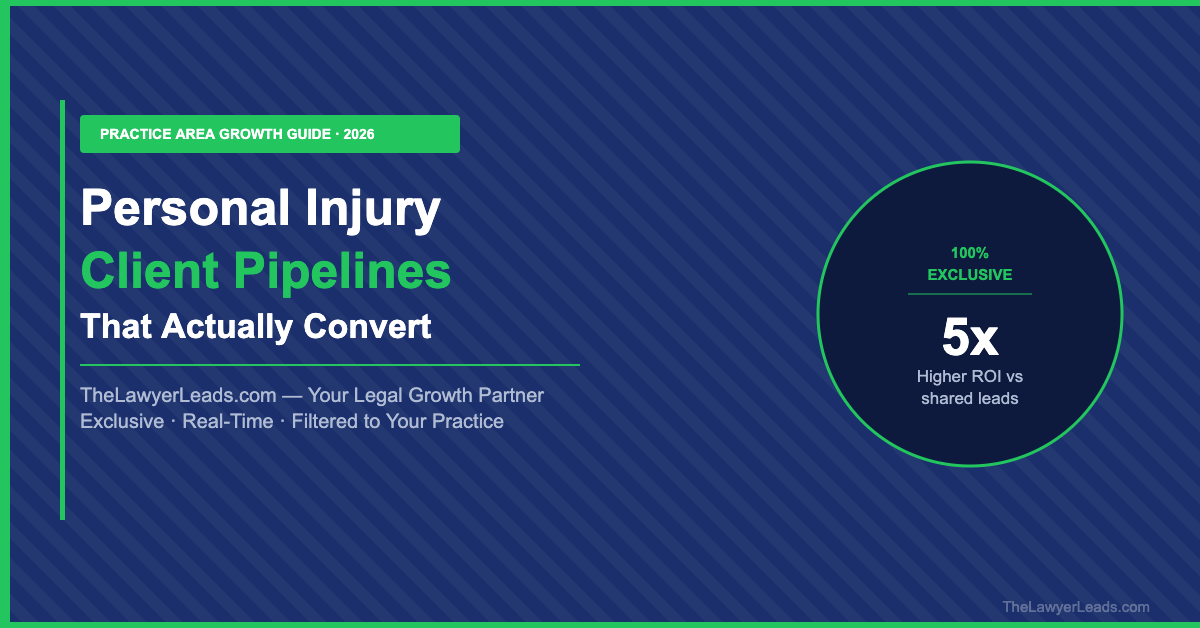
Firms that switch from shared PI leads to exclusive, pre-screened intake typically see signed-case rates rise by 3–5x, even when the raw inquiry volume stays flat — because the intake team stops competing against itself.


Traditional PI Marketing vs. a Structured Growth Pipeline

The table below reflects the difference in outcomes when firms move from a traditional, ad-spend-only acquisition model to a structured pipeline that combines exclusive intake sourcing with practice-specific filtering.

Metric Traditional Approach With TheLawyerLeads.com
Case exclusivity Shared with 3–5 firms 100% exclusive to your firm
Pre-screening None — raw form fills Filtered for liability, coverage, injury severity
Delivery speed Batched, delayed hours Real-time, direct to intake
Cost predictability Fluctuates with ad auction pricing Fixed cost per exclusive case
Signed-case rate 5–8% of inquiries 20–35% of inquiries

Four Filters Top PI Firms Apply Before a Case Reaches Intake

1. Liability Clarity

Cases where fault is disputed or unclear consume disproportionate intake time relative to their conversion odds. Firms that filter for clear-liability incidents (rear-end collisions, premises hazards with documentation, commercial vehicle incidents) see faster case evaluation and higher acceptance rates from referral attorneys and co-counsel.

2. Insurance Coverage Confirmation

An injury claim against an uninsured or underinsured party changes the entire value calculation. Structured pipelines confirm coverage status at intake rather than after weeks of case development.

3. Statute and Jurisdiction Fit

A pipeline that filters by jurisdiction and statute window before a case reaches your team eliminates the routine problem of accepting inquiries your firm legally cannot pursue.

4. Injury Severity Threshold

Firms that set a minimum injury/damages threshold for their intake pipeline consistently report higher average case value and better use of attorney time, since paralegal and intake staff aren’t triaging low-value soft-tissue claims that rarely clear a contingency fee’s break-even point.

Key Insight

The firms winning in personal injury right now aren’t necessarily outspending competitors — they’re out-filtering them. A smaller volume of well-matched, exclusive cases consistently outperforms a larger volume of shared, unscreened ones.


Measuring Whether Your PI Pipeline Is Actually Working

Track three numbers monthly, not just total inquiry count: signed-case rate (signed retainers divided by qualified inquiries), average days-to-first-contact, and cost per signed case (not cost per lead). A pipeline generating a high volume of inquiries but a low signed-case rate is not a growth engine — it’s an intake bottleneck dressed up as marketing success.

Building the Pipeline: Summary

  1. Prioritize exclusivity — a shared case is a race you’re likely to lose.
  2. Filter before intake, not after — liability, coverage, statute, and severity should be screened upstream.
  3. Measure signed-case rate, not raw lead volume, as your core growth metric.
  4. Respond fast — speed-to-contact remains one of the strongest predictors of PI case conversion.

Build a Pipeline of Exclusive PI Cases

TheLawyerLeads.com filters every personal injury case for liability, coverage, and severity before it reaches your intake team — no shared leads, no guesswork.

Browse Practice Areas

6 Red Flags to Avoid When Buying Legal Leads for Your Firm

6 Red Flags to Avoid When Buying Legal Leads for Your Firm

A managing partner at a mid-sized personal injury firm signed a six-month contract with a lead provider after one confident sales call. Three months in, her intake team was fielding disconnected numbers, duplicate submissions, and cases three states outside her firm’s licensing footprint. She had never asked to see a sample lead before signing.

That scenario repeats itself across the country every week. Firms that would never sign a lease without a walkthrough, or hire an associate without an interview, will commit thousands of dollars a month to a legal lead provider based on a pitch deck alone. Knowing the red flags when buying legal leads before you sign a contract is the single highest-leverage skill in client acquisition — it determines whether your marketing spend turns into retained clients or into a wasted intake team.

This guide walks through the warning signs that separate a legitimate legal growth partner from a volume-first vendor selling recycled data, and gives you a practical framework for evaluating any provider before you commit budget.


Red Flag #1: No Sample Leads or Trial Batch

Any provider confident in their intake quality will let you review a small sample batch, or run a limited trial, before you commit to a monthly volume. If a sales rep pushes back hard on this request — citing “exclusivity rules” or “proprietary process” as a reason to skip it — treat that as a signal, not an excuse. Legitimate providers welcome scrutiny because their filtering process holds up under it.

Ask specifically for a trial batch filtered to your practice area and geography, then track it the same way you’d track a paid campaign: contact rate, retained rate, and cost per signed case. Numbers from a real trial tell you more than any case study on a vendor’s website.


Red Flag #2: Vague or Unverifiable Exclusivity Claims

“Exclusive” is one of the most overused words in the legal lead space. Some providers use it loosely to mean “not resold within our own network,” while quietly allowing the same consumer inquiry to be captured by five different intake forms across five different ad networks before it ever reaches you. That is not exclusivity — it is a shared lead with better branding.

Ask your provider directly: “Is this consumer’s contact information sold or shared with any other law firm, aggregator, or affiliate network, at any point in the funnel?” Get the answer in writing.

Real exclusivity means the consumer’s information is captured once, on a form you control or that your growth partner controls end-to-end, and routed to a single firm. Anything less inflates competition for the same case and drives down your conversion rate.


Red Flag #3: No Filtering by Case-Specific Criteria

Why generic filtering wastes intake hours

A provider that only filters by ZIP code and practice area is doing the bare minimum. Case-specific filtering — statute of limitations windows, injury severity, liability clarity, insurance status, prior representation — is what separates a pipeline that converts from one that buries your intake team in disqualified calls.

Evaluation Criteria Traditional Volume Vendor With TheLawyerLeads.com
Filtering depth ZIP code and practice area only Case-specific criteria matched to your intake rules
Exclusivity Often resold across networks Single-firm delivery, no resale
Trial availability Rare, discouraged Sample batches available on request
Contract terms Long lock-ins, opaque refund policy Transparent replacement policy for bad data

Red Flag #4: No Replacement Policy for Bad Data

Even the best filtering process occasionally lets through a disconnected number or a duplicate submission — that happens with any data source. The question is whether your provider has a clear, written policy for replacing or crediting bad leads, and whether that policy is enforced without friction. If getting a credit requires three phone calls and a week of back-and-forth, the policy exists on paper only.

Key Insight

Before signing any contract, ask to see the replacement policy in writing and ask how many credits were issued to a comparable firm in the last quarter. A provider that tracks and shares this number is confident in their data quality.


Red Flag #5: Pressure to Sign Long-Term Contracts Immediately

What healthy onboarding looks like

A growth partner interested in a long relationship will start with a smaller commitment, prove the pipeline works, and scale volume as your intake team demonstrates capacity to convert. A vendor optimizing for a quick close will push a 12-month contract at maximum volume before you’ve seen a single case file. The difference in incentive structure shows up fast: one wants your renewal, the other wants your signature.

Month-to-month or short-term initial terms are increasingly standard across reputable providers. Treat resistance to this as a bargaining position worth pushing on, not a fixed industry norm.


Red Flag #6: No Transparency on Lead Source

Where does the inquiry actually originate — a paid search campaign the provider runs directly, a co-registration form buried in an unrelated survey, or a purchased list scraped from public records? Firms rarely ask this question, but the answer predicts intent quality more reliably than almost any other factor. A consumer who searched “car accident lawyer near me” and filled out a dedicated intake form is a fundamentally different prospect than someone who checked a box on a sweepstakes page.

A transparent growth partner will explain, in plain terms, exactly how their traffic is generated and captured. If the answer is evasive or generic (“proprietary marketing channels”), that opacity usually hides a lower-intent source.


Six Red Flags Checklist

  1. No sample or trial batch offered — a confident provider lets you test before you commit.
  2. Vague exclusivity language — get the resale policy in writing.
  3. Filtering limited to ZIP code and practice area — insist on case-specific criteria.
  4. No written replacement policy for bad data — ask for enforcement history, not just a policy line.
  5. Pressure toward long-term contracts before results — start small, scale on proof.
  6. No transparency on lead source — know exactly how the inquiry was captured.

Building a reliable client pipeline is not about finding the cheapest cost-per-lead — it’s about finding a growth partner whose incentives are structured around your firm’s long-term retention rate, not their next sale. Firms that run every provider through this checklist consistently report better conversion rates and lower wasted intake hours within the first 90 days.

Ready for a Pipeline Built on Transparency, Not Pressure?

TheLawyerLeads.com filters every inquiry to your practice area’s exact criteria and gives you the sample data to prove it before you commit.

Browse Practice Areas

Exclusive vs. Shared Legal Leads: What the Contract Fine Print Really Means

Exclusive vs. Shared Legal Leads: What the Contract Fine Print Really Means

A managing partner at a mid-size PI firm signs a six-month lead contract without reading past the pricing table. Three months in, she realizes “exclusive” only applied to her ZIP code for 48 hours — after that, the same case file was resold twice. The leads weren’t bad. The contract was.

When firms talk about exclusive vs shared legal leads, the conversation usually stops at price per lead. That’s the wrong place to stop. The real difference between a lead program that grows your practice and one that quietly drains your marketing budget is buried in the contract language — exclusivity windows, return policies, and how “verified” is actually defined. This guide breaks down what to read before you sign, not after.


What “Exclusive” Actually Means (And Where Firms Get Burned)

In legal lead contracts, “exclusive” is a defined term — and every provider defines it differently. Some mean the lead is sold to one firm, permanently. Others mean it’s exclusive for a rolling window — 24, 48, or 72 hours — before it re-enters a shared pool. A few use “exclusive” to describe the delivery method (you’re the only firm receiving that specific data file) while quietly allowing a competitor to buy a near-identical lead sourced from the same intake form five minutes later.

Questions to ask before you sign

Ask the provider, in writing, for the exact exclusivity duration, whether it applies per case type or per practice area broadly, and what happens to a lead you don’t contact within the window. If the answer is vague or takes more than one email to get a straight response, treat that as data about how the relationship will go after you’ve paid.

Firms that negotiate a written, permanent exclusivity clause into their lead agreement report intake staff spending less time on “have we spoken to you before?” calls — a small operational detail that compounds over hundreds of leads a month.

Reading the Fine Print: Five Clauses That Matter More Than Price

Contract Clause What Weak Providers Do What a Real Growth Partner Does
Exclusivity Window Undefined or resets after 24-48 hrs Permanent, written, one firm per case
Return/Credit Policy No returns, or disputes go unanswered Clear criteria, 48-72 hr dispute window
Verification Standard “Verified” undefined in contract Named checks: phone, intent, case facts
Minimum Commitment Long lock-in with no volume floor Month-to-month or volume guarantee
Data Ownership Provider retains resale rights Lead data becomes the firm’s asset

The Return Policy Test: Ask For It Before You Pay a Dollar

A provider confident in lead quality will put a return or credit policy in writing before you’ve committed a budget. One that stalls, hedges, or says “we’ll handle disputes case by case” is telling you the policy doesn’t really exist — it’s a goodwill gesture they’ll apply selectively. Ask specifically: what counts as a returnable lead (wrong practice area, disconnected number, out-of-jurisdiction), how long you have to flag it, and whether credits expire.

Key Insight

A return policy isn’t a sign the leads are bad — it’s the single clearest signal of whether a provider is building a pipeline partnership with your firm or just moving inventory. Firms should treat “no returns, no exceptions” as a disqualifying answer, not a minor inconvenience.

Shared Leads Aren’t Always the Wrong Choice — Know When They Fit

Exclusive leads cost more per unit because you’re the only firm paying to reach that prospect — but for practice areas with long sales cycles and high case value, such as mass tort intake or complex civil litigation, the math usually favors exclusivity. Shared leads can make sense for firms testing a new practice area on a limited budget, where the goal is volume and market signal rather than immediate close rate. The mistake is defaulting to shared leads for a high-value, high-competition practice area like personal injury or workers’ compensation, where speed to contact determines who signs the client — and a shared lead means you’re racing two or three other firms to the phone.

Match the lead type to the practice area’s economics

Run the numbers before choosing: divide average case value by your realistic close rate to get a target cost per acquisition, then compare that to what exclusive versus shared pricing actually costs per signed case — not per lead. A shared lead that’s 40% cheaper but converts at a third of the rate isn’t a discount; it’s a more expensive way to sign the same client.

Contract Checklist Before You Sign

  1. Get exclusivity in writing — permanent, not a rolling window, with the exact terms spelled out.
  2. Demand a defined verification standard — ask exactly what checks a lead passes before it reaches you.
  3. Confirm the return/credit policy in the contract itself, not a verbal promise from a sales rep.
  4. Avoid long lock-ins without a volume guarantee — a confident partner will earn renewal, not require it.
  5. Match lead type to practice economics — exclusive for high-value, competitive practice areas; shared only for controlled testing.

Buying legal leads is a client acquisition strategy, not a one-time purchase — and the contract you sign shapes every intake call that follows. Firms that read past the pricing table and negotiate the exclusivity, verification, and return terms up front consistently report a more predictable pipeline and fewer wasted intake hours than firms that shop on price per lead alone.

Ready for Leads With Contract Terms That Actually Protect Your Firm?

TheLawyerLeads.com delivers permanently exclusive, verified leads with clear return policies — built as a growth partnership, not a one-time sale.

Browse Practice Areas

Legal Lead Filtering Criteria: What to Verify Before You Buy

Legal Lead Filtering Criteria: What to Verify Before You Buy

A managing partner at a mid-sized PI firm signed a six-month contract with a lead provider, paid for 40 leads a month, and three months in still couldn’t say what “exclusive” actually meant in the fine print. That’s not a rare story — it’s the default outcome when firms buy leads without a filtering checklist.

Every law firm eventually faces the same decision: build a client pipeline through paid leads, or keep relying on referrals and organic growth alone. Most firms that choose the paid route make the purchase decision backwards — they ask “how much per lead?” before they ask “what does this lead actually filter for?” Legal lead filtering criteria should be the first conversation, not the last, because a cheap lead that doesn’t match your practice area, geography, or case value threshold is not cheap. It’s a wasted intake call.

This guide breaks down the filtering criteria that actually separate a strong client acquisition partner from a volume-first vendor, so you can evaluate any provider — including us — with a clear framework instead of a sales pitch.


Why Lead Filtering Criteria Matter More Than Price Per Lead

A $40 lead that converts at 8% costs you $500 per signed client. A $90 lead that converts at 25% costs you $360 per signed client. Price per lead is the number vendors advertise; cost per signed client is the number that determines whether your marketing spend is working. The gap between those two numbers is almost entirely explained by filtering — how tightly a lead is matched to your practice area, jurisdiction, case type, and intent before it ever reaches your intake team.

The Three Layers of Filtering

Strong legal lead filtering criteria operate on three layers: demographic and jurisdictional match (does this person live where you practice, and does their issue fall within your practice area), case-quality screening (statute of limitations, injury severity, liability clarity, or comparable qualifiers for your practice type), and intent verification (did this person actively seek legal help, or did they click an ad without real urgency). Vendors who skip layer two and three can still call a lead “qualified” — technically true, and still useless to your firm.

Firms that add case-quality screening on top of basic demographic filters typically see intake-to-retainer conversion improve by 30–60%, even when the per-lead price rises.


Exclusive vs. Shared: What “Exclusive” Should Actually Mean

“Exclusive” is the most misused word in the legal lead industry. Some providers define it as “sold to one firm at a time” — meaning the same lead can still be resold after a short window, or sold once per practice area even if five firms in your metro area all buy from the same vendor. Ask any provider these three questions before signing: How many total firms receive leads from this campaign in my metro area? Is a lead ever resold after a refund or non-contact period? Can I see the originating source of the lead — a real intake form, not an aggregator?

Filtering Criteria Typical Volume Vendor With TheLawyerLeads.com
Exclusivity Resold after 24–48 hrs Sold to one firm only, no resale
Practice-area match Broad category only Sub-type filtering (e.g. rear-end vs. multi-vehicle)
Real-time delivery Batched, delayed hours Delivered instantly on capture
Source transparency Aggregated, unclear origin Direct-response campaigns, disclosed
Replacement policy Vague or unenforced Documented, reviewed case by case

Speed and Intent: The Two Filters Most Firms Ignore

Filtering isn’t only about who the lead is — it’s about when and why they raised their hand. A lead captured 45 minutes ago from someone who filled out a detailed case form has dramatically higher intent than a lead that sat in a batch queue overnight or came from a broad “get a free consultation” banner ad. Response speed compounds this: research on inbound lead response consistently shows contact rates drop sharply after the first five to ten minutes, and firms that call within that window convert at multiples of firms that wait an hour or more.

Key Insight

A well-filtered lead delivered late still underperforms a moderately-filtered lead delivered instantly. Ask any provider about average delivery latency — not just filtering criteria — before you commit budget.

Practice-Specific Filters Worth Requesting

Personal injury firms should ask for filters on injury severity, treatment status, and liability clarity. Immigration firms should ask for case-type filters (family-based, employment-based, deportation defense) since these have completely different sales cycles and staffing needs. Bankruptcy firms benefit from debt-threshold and income filters. Estate planning firms should filter for net worth range and life-event triggers (retirement, new child, recent death in family). A generic “we send you leads in your practice area” pitch, without these sub-filters, is a red flag regardless of price.


Red Flags That Signal Weak Filtering

Watch for providers who won’t disclose how many firms operate in your territory, who use the word “verified” without explaining what was verified, who offer no replacement or credit policy for bad-contact-info leads, or who can’t tell you where the lead originated. Any provider serious about being a long-term growth partner — not a one-time vendor — will walk you through their filtering logic in detail, because it’s the thing that makes their leads worth the premium.

Filtering Checklist Before You Buy

  1. Confirm true exclusivity — one firm per lead, no resale window.
  2. Ask for sub-practice-area filters, not just broad category matching.
  3. Verify delivery speed — real-time beats batched, every time.
  4. Request source transparency on where and how leads are captured.
  5. Get the replacement policy in writing before you sign anything.

Build a Pipeline on Leads That Are Actually Filtered

TheLawyerLeads.com filters every lead by practice area, jurisdiction, and intent before it reaches your intake team — real-time, exclusive, and transparent about where it came from.

Browse Practice Areas

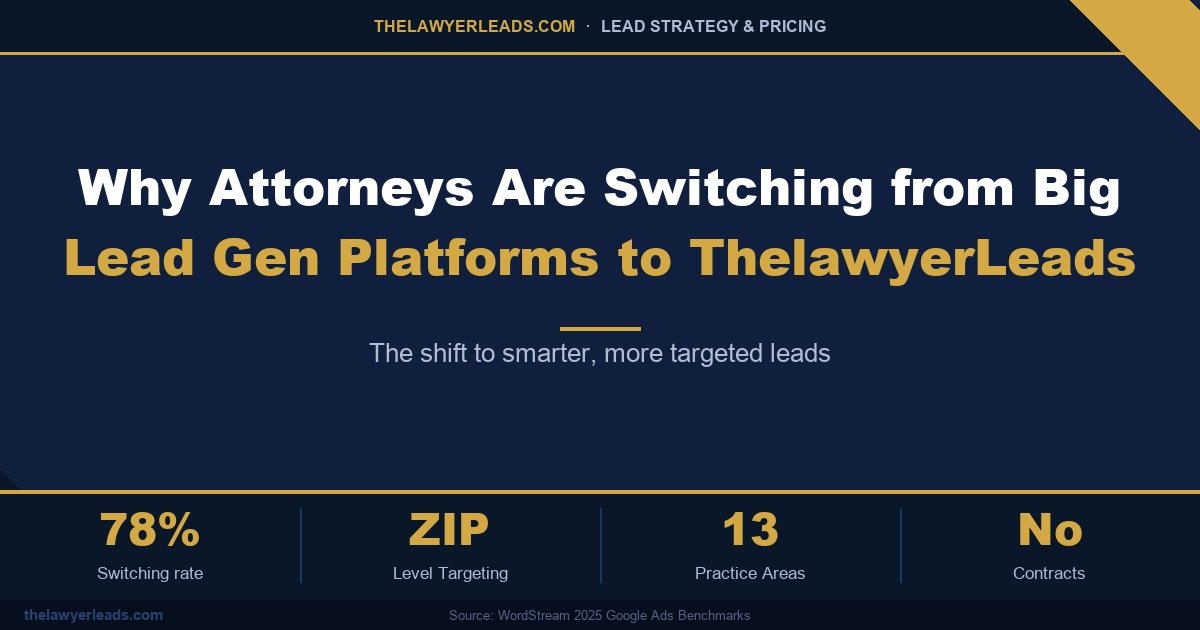
Why Attorneys Are Switching from Big Lead Gen Platforms to ThelawyerLeads

Why Attorneys Are Switching from Big Lead Gen Platforms to ThelawyerLeads

More attorneys are quietly walking away from the legal-directory giants they’ve relied on for a decade. The reason isn’t price alone — it’s that recycled, non-exclusive leads from oversized platforms simply convert worse than tightly targeted ones.

For years, the default move for a solo or small-firm attorney building a pipeline was to sign up with one of the big-name legal lead platforms — pay the monthly fee, get listed alongside hundreds of competitors, and hope enough shared leads turned into signed clients. That model is showing its age. Attorneys are increasingly moving their budgets toward leaner, ZIP-level targeted providers like ThelawyerLeads — and the data on why is becoming hard to ignore.

Why the Big Platforms Are Losing Ground

The legacy legal lead generation model was built for a different era of the internet — one where a big brand name and a large directory listing were enough to win trust. Today’s buyers research online, compare multiple firms in minutes, and expect a fast, direct response. Big platforms that sell the same lead to five or six attorneys simultaneously can’t deliver that speed advantage — by the time an attorney picks up the phone, three competitors have already called.

Attorneys switching away from these platforms consistently cite three frustrations: shared, non-exclusive leads that dilute conversion odds; broad geographic or practice-area targeting that wastes ad spend on out-of-area or out-of-scope inquiries; and long-term contracts that lock in a subscription regardless of lead quality that month.

A lead sold to five attorneys at once isn’t five opportunities — it’s one opportunity split five ways, with the fastest caller usually winning the case.

What Attorneys Are Switching To

The pattern behind the switch is consistent: attorneys aren’t abandoning paid lead generation altogether — they’re moving to providers built around precision instead of volume. ThelawyerLeads was built specifically to answer the complaints attorneys have about the bigger platforms, with county- and ZIP-level targeting, exclusivity options, and state-specific pricing across 13 distinct practice areas.

Feature Big Lead Gen Platforms ThelawyerLeads
Lead exclusivity Often shared with 3-6 firms Exclusivity options available
Geographic targeting State or metro-wide County and ZIP-level
Contract terms Often long-term commitments No long-term contracts
Practice area coverage Broad, generalized categories 13 dedicated practice areas
Pricing model Flat national or regional rate State-specific pricing

The Numbers Behind the Shift

Google Ads benchmark data puts the average cost-per-lead for legal services at $131.63 nationally — a figure that’s climbed steadily as competition for the same keywords intensifies on the big platforms. Attorneys who switch to more targeted providers aren’t necessarily paying less per lead; they’re paying for a lead that’s more likely to actually convert, because it was never split among competitors in the first place.

What “Switching” Actually Looks Like

Most attorneys don’t cut over all at once. The typical pattern is running a targeted provider alongside an existing platform subscription for a month or two, tracking cost-per-signed-case rather than cost-per-lead, and reallocating budget toward whichever source produces better case value. Because ThelawyerLeads doesn’t require a long-term contract, that comparison period carries no penalty for testing it against an existing platform.

  • Start with a single practice area and a defined county or ZIP radius rather than an entire state
  • Track cases signed, not just leads received, over a 30-60 day window
  • Compare response speed — exclusive leads reward attorneys who call back within minutes
  • Expand ZIP coverage or add a second practice area once ROI is confirmed

▶ Key Insight

Attorneys aren’t switching because targeted lead generation is cheaper — they’re switching because a lead that isn’t split five ways closes at a meaningfully higher rate, which is what actually moves the ROI needle.

Is It Time for Your Firm to Switch?

If your firm currently relies on a large legal directory or lead platform, ask a simple question: of the leads you received last month, how many were exclusive to you? If the honest answer is “few” or “none,” you’re likely paying directory-level prices for a shared-pool result. Testing a county- or ZIP-targeted, exclusive-lead alternative alongside your current spend — without committing to a long-term contract — is the lowest-risk way to find out whether the switch other attorneys are making would work for your practice too.

Why Attorneys Are Switching from Big Lead Gen Platforms to ThelawyerLeads — Summary

  1. Shared leads underperform — leads sold to multiple firms convert at a lower rate than exclusive ones.
  2. Precision targeting wins — county- and ZIP-level filtering beats state-wide or metro-wide targeting on relevance.
  3. Flexibility matters — no long-term contracts mean attorneys can test and reallocate budget freely.
  4. Coverage across 13 practice areas — attorneys aren’t forced into broad, generalized categories.
  5. State-specific pricing — firms pay rates reflective of their actual local market, not a flat national average.

See Lead Pricing for Your State

We offer transparent, state-specific lead pricing across all major practice areas — with no contracts, no recycled contacts, and full exclusivity options.

View Lead Pricing →

Client Lifetime Value for Law Firms: The Number That Should Drive Your Marketing Budget

Client Lifetime Value for Law Firms: The Number That Should Drive Your Marketing Budget

A managing partner at a mid-size personal injury firm pulled up her ad dashboard and saw the number that had been bothering her for months: $340 to acquire a new client. “Too expensive,” she said, and cut the budget by a third. Six months later, revenue was down 22% — because she’d never calculated what that $340 client was actually worth over time. That’s the client lifetime value blind spot, and it’s quietly steering marketing decisions at law firms across the country.

Most law firms track cost per lead and cost per case obsessively, but far fewer calculate client lifetime value (LTV) — the total revenue a firm earns from a client across the full relationship, including repeat matters, referrals, and case value beyond the initial engagement. Without LTV, every acquisition decision is made with half the picture. A $340 lead that converts into a $12,000 case, plus two referred clients worth another $9,000 combined, is not expensive. It’s the cheapest growth channel in the firm. This piece walks through how to calculate client lifetime value for a law firm and why it should be the number that actually drives your marketing spend.


Why Client Lifetime Value Matters More Than Cost Per Lead

Cost per lead and cost per acquisition answer a narrow question: what did it cost to get this client in the door? Client lifetime value for a law firm answers the question that actually determines profitability: what will this client be worth before the relationship ends? For practice areas with strong repeat or referral dynamics — estate planning, family law, business law, and personal injury firms with strong referral networks — the gap between those two numbers can be enormous.

Consider an immigration attorney handling a green card case. The initial engagement might bill $3,500. But that same client often returns for citizenship applications, brings family members needing visas, and refers friends from the same community. A firm that only measures the $3,500 case against its $280 acquisition cost sees a decent but unremarkable return. A firm that tracks the full client relationship — often $9,000-$15,000 in lifetime billings plus two or three referred clients — sees an entirely different, far more favorable, math.

Firms that calculate LTV alongside CPA typically discover their real client acquisition cost ratio is 3 to 8 times more favorable than their initial-case math suggested — because referral and repeat revenue rarely gets attributed back to the original acquisition channel.

How to Calculate Client Lifetime Value for Your Law Firm

The formula itself is simple. The discipline is in gathering accurate inputs, which most practice management systems don’t surface by default.

The Core LTV Formula

Client Lifetime Value = (Average Case Value) × (Average Number of Matters per Client) + (Average Referral Value × Referral Rate)

To build this for your firm, pull three data sets from the last 24-36 months: average revenue per closed matter by practice area, the percentage of clients who return for a second matter (and the average time between matters), and the percentage of new clients who arrived via referral from an existing client — along with what those referred clients were worth.

A Worked Example

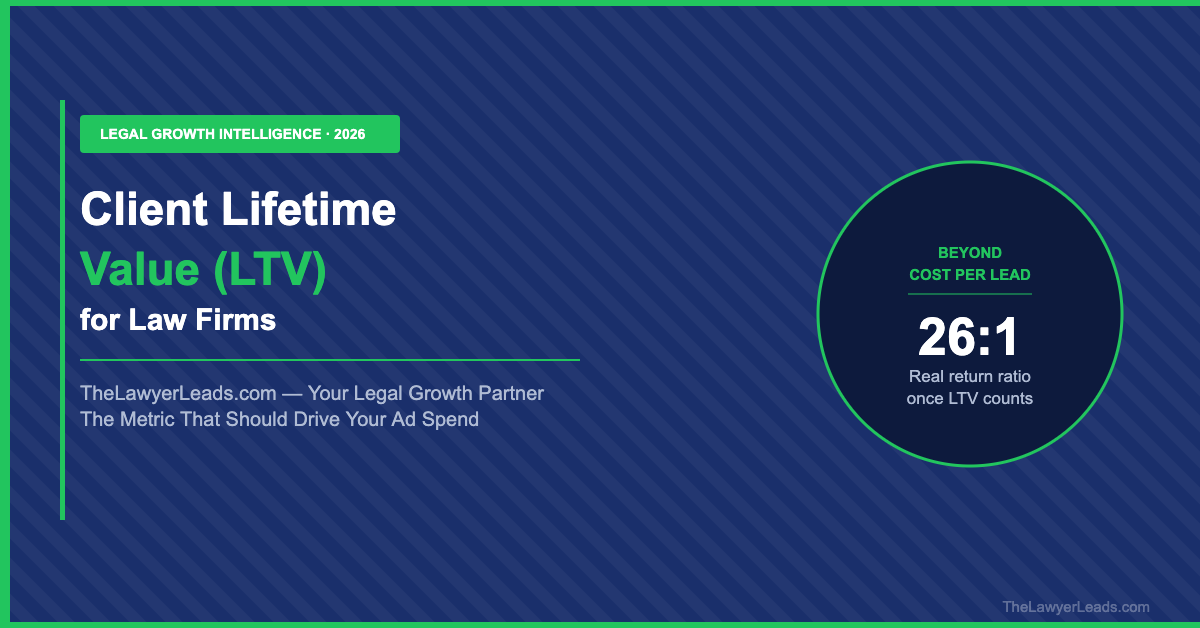
Take a family law firm with an average divorce case value of $6,500. Historical data shows 18% of clients return within three years for a modification, custody dispute, or estate planning need, averaging $2,200 on that second matter. Separately, 22% of clients refer at least one new client, and those referrals average $5,800 in case value. The LTV calculation: $6,500 + (0.18 × $2,200) + (0.22 × $5,800) = $6,500 + $396 + $1,276 = $8,172. Against a $310 acquisition cost, that’s a return ratio of roughly 26:1 — a very different story than the 21:1 ratio the initial case alone would suggest, and one that justifies more aggressive investment in acquisition rather than less.


LTV-Informed Spend vs. CPA-Only Decisions

The practical value of LTV shows up in how a firm decides where to put its marketing dollars. Two firms looking at the identical acquisition cost can reach opposite — and equally correct — conclusions once lifetime value enters the picture.

Decision Point CPA-Only Approach LTV-Informed Approach
Budget allocation Cuts spend when CPA rises, regardless of case type Maintains or grows spend on practice areas with high repeat/referral value
Channel comparison Judges every channel by identical cost thresholds Weighs channels by the practice areas and client types they deliver
Intake investment Treats intake as a cost center to minimize Treats intake as a multiplier on every future referral dollar
Practice area focus Chases the lowest cost-per-case practice area Chases the highest total-relationship-value practice area

Key Insight

A firm that only optimizes for the lowest cost per case will systematically under-invest in the practice areas and client relationships that generate the most long-term revenue — because those relationships often carry a higher upfront acquisition cost that CPA-only thinking flags as a problem.

Building LTV Tracking Into Your Firm’s Growth Process

Most practice management software wasn’t built to track lifetime value out of the box, but you don’t need new software to start. Three practical steps get most firms most of the way there.

First, tag every new matter with a source: which lead channel, or “referral — existing client,” or “referral — external.” Most CRMs and case management tools support a custom field for this; the discipline is in enforcing it at intake, every time, without exception. Second, run a quarterly report pulling repeat-matter rate and referral rate by original acquisition source and practice area. This is the report that reveals which client relationships are compounding and which are one-and-done. Third, feed LTV back into your acquisition targets — set your target cost-per-case ceiling based on the LTV for that specific practice area, not a single firm-wide number.

Where a Growth Partner Adds Leverage

Filtering and targeting client acquisition by practice area — rather than treating every lead the same — is exactly where an experienced legal growth partner earns its keep. Firms building a client pipeline through TheLawyerLeads.com can filter by practice area, geography, and case criteria specifically because different case types carry radically different lifetime value profiles, and pipeline-building decisions should reflect that difference rather than ignore it.


Summary: Client Lifetime Value for Law Firms

  1. CPA alone is an incomplete metric — it ignores repeat matters and referral revenue entirely.
  2. Calculate LTV using three inputs — average case value, repeat-matter rate, and referral rate and value.
  3. LTV-informed firms invest differently — they protect spend on high-relationship-value practice areas even when CPA looks less favorable.
  4. Source-tag every matter — this is the single habit that makes LTV tracking possible without new software.
  5. Set acquisition targets by practice area — not a single firm-wide cost ceiling.

Build a Pipeline Around What Clients Are Actually Worth

TheLawyerLeads.com helps firms filter client acquisition by the practice areas and case criteria that drive real long-term value — not just the lowest sticker price.

Browse Practice Areas

Cost Per Acquisition for Law Firms: The Metric Most Firms Calculate Wrong

Cost Per Acquisition for Law Firms: The Metric Most Firms Calculate Wrong

A managing partner at a mid-size PI firm proudly reports that her Google Ads campaign costs $400 per lead. What she doesn’t track is that only 1 in 12 of those leads ever signs a retainer — and none of the firm’s other channels are measured the same way. Her real cost per acquisition for law firms is nearly four times what she thinks it is, and she’s making budget decisions on the wrong number.

Cost per acquisition (CPA) is the single most misused metric in legal marketing. Most firms calculate it as spend divided by leads. That number is almost meaningless. The number that actually predicts growth is spend divided by signed clients — and getting from one to the other requires tracking data most firms simply don’t collect. This matters because CPA, calculated correctly, is the number that should drive every marketing decision a firm makes: which channels to scale, which to cut, and how much a new client is actually worth acquiring.


Why Lead-Based CPA Lies to You

Marketing platforms report cost per lead by default because that’s the easiest number to generate. But a lead is not a client, and the gap between the two varies enormously by channel. A firm running Google Ads might get leads for $150 each, while a firm working with a filtered, exclusive lead source might pay $600 per lead. On paper, the ads look four times cheaper. In practice, if the ads convert at 8% and the exclusive leads convert at 35%, the true cost per acquisition for law firms flips completely — the “expensive” leads end up costing less per signed case.

The Formula That Actually Matters

True CPA = Total spend on a channel ÷ Number of signed clients from that channel, over the same time window. That’s it. But firms rarely calculate it because it requires two things most intake systems don’t do well: tagging every lead by source at the moment of contact, and following that tag all the way through to signed retainer — not just “contacted” or “consultation scheduled.”

Firms that track CPA by signed client — rather than by raw lead — report reallocating an average of 25–40% of their marketing budget within the first two quarters, usually shifting spend toward higher-intent, better-filtered sources.


Comparing Channels the Right Way

Once a firm tracks CPA by signed client instead of by lead, channel comparisons look very different. Below is a simplified comparison based on typical figures firms report when they start measuring this correctly.

Channel Cost Per Lead Lead-to-Client Rate True CPA
Broad Google Ads $150 7–10% ~$1,700
Shared/Sold Leads $80 4–6% ~$1,600
Referral Network Variable 40–55% ~$400–600
Exclusive, Filtered Leads $500–700 30–40% ~$1,500

The pattern that surprises most firm owners: raw cost per lead and true CPA are often inversely correlated. The cheapest lead sources frequently produce the most expensive clients, once intake staff time, follow-up cost, and low conversion are factored in.


What to Build Before You Trust Your Numbers

1. Source Tagging at First Contact

Every lead needs a source tag applied the moment it enters your system — not after intake, when memory and CRM hygiene both degrade. Whether that’s a UTM parameter, a call-tracking number, or a manual field in your intake software, this is the foundation everything else depends on.

2. A Single Definition of “Signed Client”

Firms that track “consultations” or “qualified leads” as their conversion event consistently overstate channel performance. The only number that should feed your CPA calculation is a signed retainer agreement, dated.

3. A Monthly, Not Quarterly, Review Cadence

Legal sales cycles run long enough that quarterly reviews miss the leads still moving through the pipeline. A rolling 90-day lookback, reviewed monthly, gives a far more accurate read on which channels are actually building your practice.

Key Insight

A firm that can’t tell you its cost per acquisition by signed client, broken down by source, isn’t managing a marketing budget — it’s guessing with a spreadsheet attached. The firms growing fastest right now are the ones that treat intake data as seriously as they treat case files.


Where Exclusive, Filtered Pipelines Change the Math

One reason exclusive, pre-filtered client pipelines tend to outperform on true CPA is straightforward: filtering happens before the lead ever reaches your intake team. When leads are matched to practice area, case type, and jurisdiction before delivery, intake staff spend their time closing qualified prospects instead of disqualifying unfit ones. That shift alone often moves conversion rates enough to offset a higher upfront cost per lead — which is exactly what the CPA math above shows.


In Summary

  1. Stop measuring cost per lead alone — it hides the real cost of a signed client.
  2. Calculate true CPA as spend divided by signed clients, per channel, per month.
  3. Tag every lead at first contact so source data survives the full intake process.
  4. Expect an inverse relationship between cheap leads and low true CPA — it rarely holds.
  5. Weight pre-filtered, exclusive sources more heavily once conversion rate is factored in, not just sticker price.

Ready to Lower Your True Cost Per Acquisition?

TheLawyerLeads.com delivers exclusive, pre-filtered client opportunities matched to your practice area — so your intake team spends time closing, not qualifying.

Browse Practice Areas

Speed to Lead: Why Response Time Decides Client Acquisition for Law Firms

Speed to Lead: Why Response Time Decides Client Acquisition for Law Firms

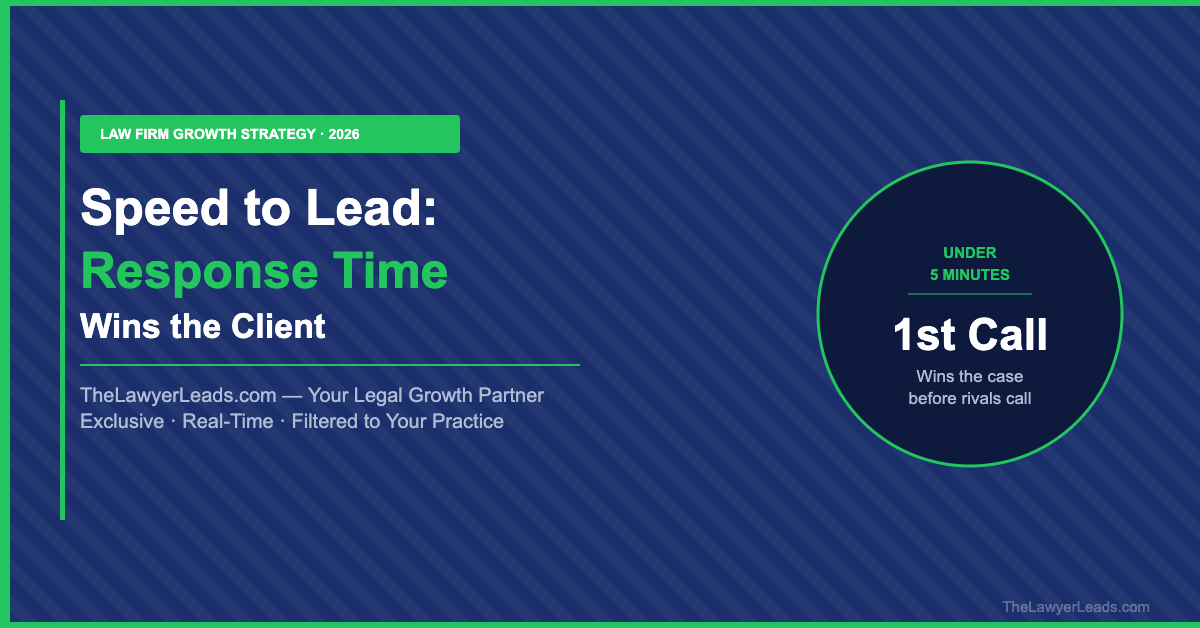
A prospective client fills out a personal injury intake form at 9:47 PM on a Tuesday. Three firms in the market get an alert. The one that calls back first, at 9:52 PM, signs the case. The other two never hear from her again.

That five-minute window is not an anecdote — it is the single most underpriced variable in law firm client acquisition today. Firms spend heavily on ads, SEO, and referral partnerships to generate inbound interest, then let that interest die in a voicemail queue. Speed to lead — how fast your firm responds to a new inquiry — now determines who wins the client more often than the quality of the marketing that produced the lead in the first place.

This matters because prospective clients rarely wait. Someone searching for a personal injury attorney, an immigration lawyer, or bankruptcy counsel is almost always contacting more than one firm at the same time. The firm that engages first frames the conversation, builds the first impression of competence, and often closes the case before a competitor has even called back.


The Real Cost of Slow Intake

Firms rarely track response time as a business metric, but the data from firms that do is consistent: contact attempts made within five minutes of an inquiry convert at dramatically higher rates than those made an hour later, and conversion drops sharply again after 24 hours. By the time a lead sits overnight, most attorneys are no longer competing for the case — they are competing for a callback that may never come.

A firm that responds in under five minutes is statistically far more likely to reach the prospect on the first attempt — and reaching someone live, before a competitor does, is the single biggest predictor of whether that inquiry becomes a signed client.

The cost of slow intake isn’t just lost cases — it’s wasted marketing spend. Every inquiry that goes unreturned represents money already spent on ads, SEO, or a pipeline partnership with nothing to show for it. Firms that treat intake speed as a growth lever, not an administrative afterthought, get more return from the exact same acquisition budget.


What Speed to Lead Actually Looks Like in Practice

Most firms believe they respond quickly. Few actually measure it. A useful exercise is to compare how intake typically works at a traditional firm against a firm that has built a deliberate client pipeline around response speed.

Metric Traditional Approach With TheLawyerLeads.com
Time to first contact Hours to next business day Real-time delivery, minutes
Lead exclusivity Often shared across firms 100% exclusive to your firm
Filtering by practice area Manual, inconsistent Pre-filtered to your criteria
Visibility into pipeline Spreadsheets, guesswork Real-time growth dashboard

The gap isn’t about effort — most intake staff work hard. It’s about infrastructure. A firm built to respond in minutes needs routing rules, mobile alerts, and after-hours coverage designed in advance, not improvised case by case.


Building an Intake System That Wins the Race

1. Assign ownership, not rotation

A lead that rotates through a general inbox before someone claims it loses minutes that matter. High-performing firms assign a specific person — or a specific first-call script — the moment an inquiry arrives, with no ambiguity about whose job it is to make the call.

2. Cover the hours your competitors don’t

A large share of inquiries for personal injury, family law, and criminal defense arrive evenings and weekends — exactly when many firms are unstaffed. Firms that build even lightweight after-hours coverage, even a same-night callback protocol, pick up cases that better-funded competitors quietly lose.

3. Track it like a KPI, because it is one

If your firm doesn’t know its average time-to-first-contact, it can’t improve it. Treat response time with the same discipline as case value or referral rate — measure it weekly, and hold intake accountable to a target.

Key Insight

Response speed is one of the few growth levers a firm fully controls. You can’t always control how much competition exists for a given case type, but you can almost always control how fast your team picks up the phone.


Why the Source of the Lead Still Matters

Even a flawless intake process can’t outrun a bad source. Leads that are shared across multiple firms guarantee a race your firm may not win regardless of how fast you call — someone else may already be talking to the prospect before your alert even arrives. This is why exclusive, pre-filtered leads pair so well with a fast intake system: exclusivity removes the multi-firm race, and speed converts the resulting advantage into a signed client. Together, they turn client acquisition from a numbers game into a repeatable, measurable pipeline.

Building Speed to Lead Into Your Growth Strategy

  1. Assign clear intake ownership — every inquiry needs one accountable owner from the moment it arrives.
  2. Build after-hours coverage — evenings and weekends generate a disproportionate share of inquiries.
  3. Measure time-to-first-contact weekly — you can’t improve a number you don’t track.
  4. Prioritize exclusive sources — speed only wins the race if you’re not racing five other firms for the same prospect.

Build a Pipeline Your Intake Team Can Actually Win

TheLawyerLeads.com delivers exclusive, real-time, practice-area-filtered inquiries — so your speed advantage counts.

Browse Practice Areas