
How to Improve Law Firm Intake Conversion Rates and Stop Losing Signed Cases

How to Improve Law Firm Intake Conversion Rates and Stop Losing Signed Cases

A managing partner at a mid-size personal injury firm once told us she was spending more on marketing every quarter, yet her signed-case count barely moved. The leak wasn’t her ad spend. It was what happened in the 11 minutes after a prospective client first called her office.

Most conversations about growing a law firm start and end with marketing spend — more Google Ads, more SEO, more paid leads. But how to improve law firm intake conversion rates is rarely part of the discussion, even though intake is where the majority of qualified prospects are lost. A firm can generate outstanding demand and still shrink if the intake process leaks 40-60% of that demand before a retainer is ever signed. Fixing intake is usually the fastest, cheapest path to more signed cases — faster than any new marketing channel.


Where Signed Cases Actually Get Lost

When firms audit their intake funnel, the drop-off is rarely at the top. Prospects call, fill out a form, or click through from an ad — that part usually works. The loss happens in three specific places: response speed, qualification quality, and follow-up persistence.

Response Speed Is the Single Biggest Lever

Prospective clients researching an attorney after an accident, arrest, or family crisis are almost always contacting more than one firm. The firm that responds first typically wins the case, regardless of which firm has the stronger track record. A five-minute response window converts dramatically better than a same-day callback, and a same-day callback converts dramatically better than a next-day one.

Firms that call back within 5 minutes convert prospective clients into signed cases at meaningfully higher rates than firms that take an hour or more — and the gap widens the longer the delay stretches.

Qualification Without Alienation

Intake staff are often asked to screen aggressively for case value, which can come across as interrogation rather than help. The best-performing intake scripts lead with empathy and case-relevant questions, then qualify naturally as the conversation progresses. Prospects who feel heard are far more likely to move forward, even if the ultimate case value is modest.


Building a Pipeline That Doesn’t Depend on Guesswork

Sustainable client acquisition isn’t a single tactic — it’s a system. Firms that grow predictably treat intake as a measured, repeatable process rather than something individual staff handle on instinct. That means tracking every prospect from first contact to signed retainer, and knowing exactly where the funnel breaks down.

Intake Metric Traditional Approach With TheLawyerLeads.com
Average response time 30-60+ minutes, staff-dependent Real-time exclusive delivery, no shared queue
Prospect quality Unfiltered form fills, mixed intent Filtered to practice area and case criteria
Cost predictability Variable CPC, seasonal ad volatility Fixed pricing per exclusive client opportunity
Competition per prospect Often shared with 3-5 other firms Exclusive — no other firm sees it

Key Insight

Firms that pair a fast, well-trained intake process with an exclusive, pre-filtered pipeline consistently outperform firms relying on shared leads and reactive follow-up — not because the marketing is more expensive, but because fewer qualified prospects fall through the cracks.


Five Fixes Firms Can Implement This Quarter

Set a Response-Time SLA

Establish an internal standard — five minutes during business hours, thirty minutes after hours — and track adherence weekly. What gets measured gets fixed.

Record and Review Intake Calls

Most firms discover their biggest conversion leak isn’t speed — it’s script quality. Reviewing a sample of calls monthly surfaces coaching opportunities that dramatically improve close rates without spending another marketing dollar.

Build a Structured Follow-Up Cadence

A single missed call rarely means a lost prospect — it means a lost prospect if there’s no follow-up plan. A cadence of call, text, and email over 3-5 days recovers a meaningful share of “no answer” leads.

Text messaging in particular gets read within minutes for most consumers, making it one of the highest-leverage, lowest-cost follow-up channels available to intake teams.

Separate Marketing Spend From Pipeline Quality

Not every growth dollar needs to chase unfiltered web traffic. Supplementing organic and paid marketing with an exclusive, criteria-matched pipeline reduces the volatility that comes from depending on a single channel — and gives intake staff a steadier, more predictable flow of qualified conversations to work.

Review Cost Per Signed Case, Not Cost Per Lead

Cost per lead is a vanity metric. Cost per signed case is the number that determines whether a growth channel is actually working. Firms that make this shift often find their “expensive” channels are their most efficient once conversion rates are factored in.


Quick Recap

  1. Speed wins cases — a five-minute response window beats a five-star reputation with a slow callback.
  2. Qualify with empathy — screening that feels like help converts better than screening that feels like interrogation.
  3. Follow up systematically — a missed call is only a lost prospect if there’s no cadence behind it.
  4. Diversify the pipeline — pairing organic growth with an exclusive, filtered source reduces volatility.
  5. Measure cost per signed case — not cost per lead — to know what’s actually working.

Ready to Build a Predictable Client Pipeline?

TheLawyerLeads.com pairs exclusive, filtered client opportunities with the intake discipline that turns conversations into signed cases.
Browse Practice Areas

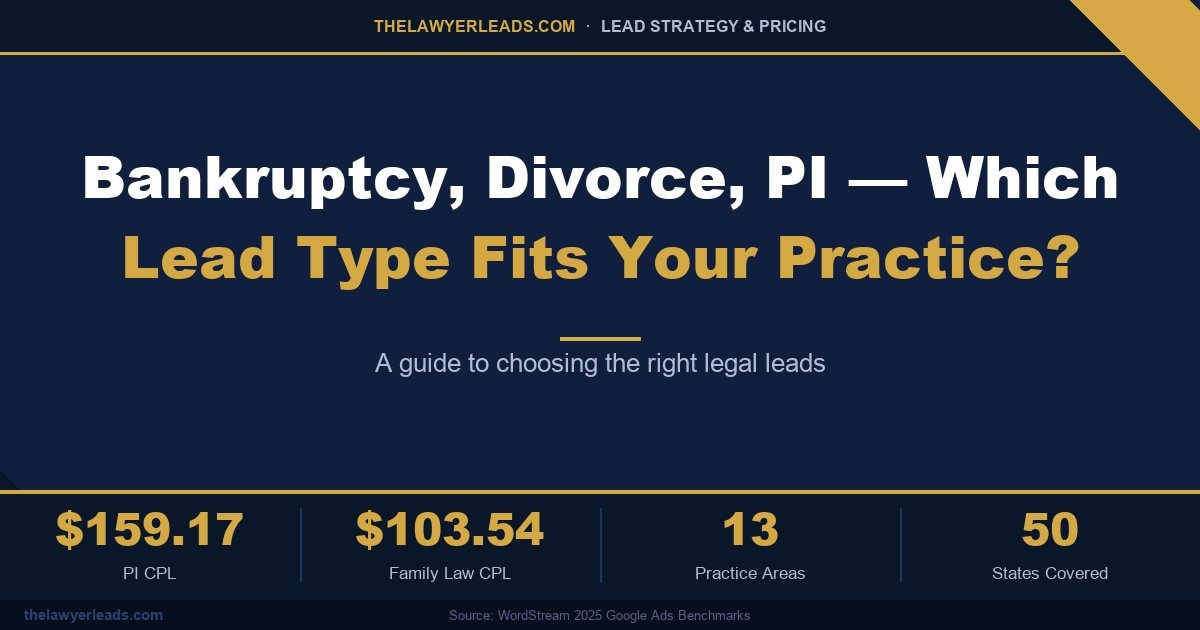
Bankruptcy, Divorce, PI — Which Lead Type Fits Your Practice?

Bankruptcy, Divorce, PI — Which Lead Type Fits Your Practice?

Not every legal lead behaves the same way. A bankruptcy filer, a divorcing spouse, and an accident victim searching for a personal injury attorney all arrive with different urgency, different budgets, and very different odds of signing. Buying the wrong type of lead for your practice is one of the most common — and most expensive — mistakes attorneys make.

If you’re deciding where to put your next marketing dollar, the question isn’t just “should I buy legal leads?” It’s which lead type — bankruptcy, divorce, personal injury, or something else — fits how your practice actually operates. Cost per lead, close rate, case value, and turnaround time vary enormously across practice areas, and picking the wrong fit can quietly drain a marketing budget for months before anyone notices.

This guide breaks down how the three highest-volume legal lead categories — bankruptcy, divorce/family law, and personal injury — compare on cost, conversion, and case economics, so you can match your lead spend to the practice you’re actually running.


How the Three Lead Types Compare

Cost per lead (CPL) is the number most attorneys fixate on, but it tells you almost nothing on its own. A $159 personal injury lead that converts into a six-figure settlement is a very different investment than a $103 family law lead that closes into a flat-fee retainer. Here’s how the three categories stack up on the metrics that actually matter.

Lead Type Avg. CPL Typical Turnaround Case Value Range
Personal Injury $159.17 6–18 months $5,000 – $250,000+
Divorce / Family Law $103.54 1–6 months $2,500 – $15,000
Bankruptcy $85 – $110 2–8 weeks $1,200 – $3,500 (flat fee)

Personal injury leads command the highest CPL because the payoff can be enormous — a single contingency case can outweigh dozens of leads that never convert. Family law and bankruptcy leads cost less per lead but move faster, which means a firm running a high-volume flat-fee practice can turn spend into signed retainers much sooner.

The right lead type isn’t the cheapest one — it’s the one whose sales cycle and case value match how your firm is staffed and how quickly you need cash flow.


Personal Injury: High Stakes, High Patience

Personal injury leads are the most expensive of the three because they carry the most upside. A well-qualified PI lead — someone recently injured in an accident, actively searching for representation — can turn into a case worth tens or hundreds of thousands of dollars in contingency fees. The tradeoff is time: medical treatment has to conclude, liability has to be established, and negotiations or litigation can stretch on for a year or more.

PI leads make the most sense for firms with the cash reserves to carry a case through a long timeline, and with intake staff experienced at quickly separating serious injury claims from minor fender-benders that won’t be worth pursuing.

Divorce and Family Law: Steady, Predictable Volume

Family law leads sit in the middle on cost and move considerably faster than PI cases. Divorce, custody, and support matters typically resolve — or at least reach a signed retainer — within a few months, giving firms a much shorter path from ad spend to revenue. Because family law is billed hourly or on flat-fee packages rather than contingency, cash flow is more predictable, which makes this lead type attractive to firms that need consistent, near-term revenue rather than a few large payouts.

Bankruptcy: The Fastest Close

Bankruptcy leads close the fastest of all three — often within weeks — because the person searching is already in financial distress and motivated to act. Cases are typically flat-fee and procedurally standardized (Chapter 7 or Chapter 13 filings), which means a firm with efficient intake and filing systems can process a high volume of these leads profitably even at a lower average case value.

▶ Key Insight

Firms that mix lead types — a few high-value PI leads alongside a steady stream of faster-closing family law or bankruptcy leads — tend to build more resilient cash flow than firms betting entirely on one practice area.


Why Targeting Matters More Than the Lead Type Itself

Regardless of which practice area you focus on, the biggest lever for improving ROI isn’t switching lead types — it’s tightening how leads are targeted. A personal injury lead generated from a county with heavy commercial trucking traffic is worth more than one from a rural area with few accidents. A bankruptcy lead in a state with favorable exemption laws is easier to convert than one filed in a jurisdiction with stricter means testing.

That’s why ThelawyerLeads.com builds targeting down to the ZIP code and county level across all 13 of our practice areas, rather than selling broad, state-wide lead batches. Attorneys choose exactly where their leads come from — down to the counties they actually serve — so every dollar spent is aimed at the cases most likely to convert in their real service area, across all 50 states.

Bankruptcy, Divorce, PI — Which Lead Type Fits Your Practice? — Summary

  1. Personal injury leads — highest CPL ($159.17 avg.), longest sales cycle, but the highest potential case value.
  2. Divorce and family law leads — mid-range CPL ($103.54 avg.), faster close, predictable hourly/flat-fee revenue.
  3. Bankruptcy leads — lowest CPL, fastest turnaround, best for high-volume, procedurally efficient practices.
  4. Match lead type to cash flow needs — mixing faster-closing leads with high-value PI leads builds more resilient revenue than betting on one practice area alone.
  5. Targeting beats lead type — county- and ZIP-level targeting across all 13 practice areas improves conversion more than switching categories.

There’s no universally “best” lead type — only the one that fits how your firm is built to operate. Firms with the patience and capital to carry contingency cases should lean into personal injury. Firms that need faster, steadier revenue are often better served by family law or bankruptcy leads. Many of the most resilient practices don’t pick just one — they diversify across two or three lead types to smooth out cash flow across the year.

See Lead Pricing for Your State

We offer transparent, state-specific lead pricing across all major practice areas — with no contracts, no recycled contacts, and full exclusivity options.

View Lead Pricing →

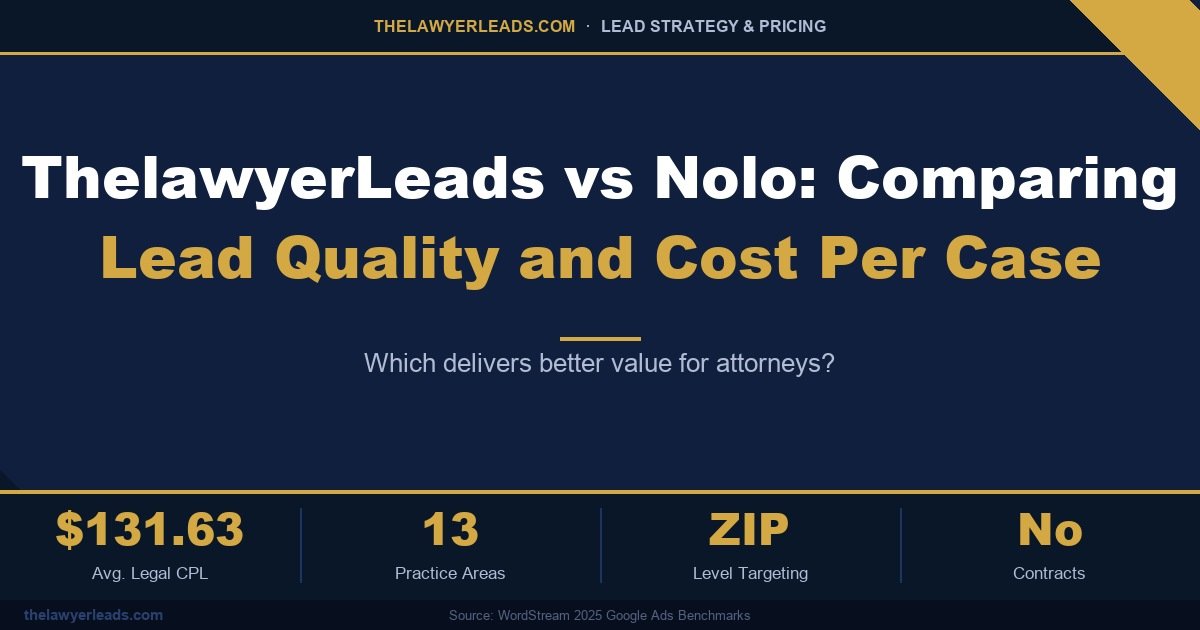
ThelawyerLeads vs Nolo: Comparing Lead Quality and Cost Per Case

ThelawyerLeads vs Nolo: Comparing Lead Quality and Cost Per Case

Nolo has been a household name in consumer legal information for decades — but “well-known” and “worth your lead budget” are two very different questions. Here’s an honest, numbers-first look at how Nolo’s attorney directory stacks up against a modern, targeted lead generation service.

If you’re weighing legal lead generation options for your practice, Nolo is probably on your shortlist. It’s been around since 1971, ranks well for consumer legal searches, and offers a “Lawyer Directory” placement product. But attorneys who’ve used both consistently report a gap between Nolo’s traffic volume and the actual quality — and cost per case — of the leads it produces. Below, we compare Nolo’s directory model against ThelawyerLeads’ targeted, exclusive lead model across the metrics that actually move your bottom line.


How Nolo’s Directory Model Works

Nolo operates as a legal information publisher first and a directory second. Attorneys pay a flat monthly or annual fee for a profile listing in a specific practice area and location, competing against every other paying attorney in that same category. Consumers who land on Nolo’s articles — often searching general legal questions rather than looking to hire immediately — are funneled toward a list of directory profiles, and it’s up to the consumer to browse, compare, and initiate contact.

That model produces volume, but it’s an inherently passive one: your listing sits alongside competitors, the traffic is often informational (not “ready to hire”) intent, and there’s no ZIP-level or county-level control over who sees your profile. You’re essentially renting shelf space, not receiving a qualified inquiry.

Head-to-Head Comparison

Factor Nolo ThelawyerLeads
Lead exclusivity Shared directory listing — multiple attorneys compete per inquiry 1 lead, 1 attorney
Geographic targeting City/metro-level only ZIP and county-level filtering
Pricing model Flat monthly fee regardless of case volume or quality Pay per qualified lead
Practice area coverage General directory categories 13 dedicated practice areas
Contract terms Annual commitment typical No long-term contracts
Avg. legal cost per lead Varies widely by category, often opaque $131.63 industry avg. benchmark

A directory listing gets you visibility. A targeted, exclusive lead gets you a phone call from someone actively looking to hire — in the ZIP codes you actually serve.

Why Cost Per Case Matters More Than Cost Per Lead

The number attorneys should really be tracking isn’t the sticker price of a listing or a lead — it’s cost per signed case. A $99/month Nolo listing that produces two unqualified inquiries a month, shared with four other attorneys, can easily cost more per signed case than a $131 exclusive lead that converts at a much higher rate because the prospect was actively searching, geographically matched, and not shopping your profile against three competitors on the same page.

Where Nolo Still Makes Sense

Nolo’s directory can be a reasonable supplemental brand-visibility play for firms with the budget to run multiple channels at once, particularly in practice areas with lower competition. It’s not without value — it’s simply a different tool, built for different intent.

Where ThelawyerLeads Wins

For attorneys who want predictable spend, exclusivity, and control over exactly which ZIP codes and counties their leads come from, a targeted lead service closes the gap between “visible” and “in front of the right prospect at the right moment.” That’s the difference between marketing spend and marketing ROI.

▶ Key Insight

Directory listings sell visibility; exclusive leads sell intent. If your goal is signed cases rather than impressions, cost per case — not cost per listing — should drive the decision.

ThelawyerLeads vs Nolo — Summary

  1. Exclusivity beats shared listings — one lead sent to one attorney converts at a materially higher rate than a shared directory profile.
  2. ZIP-level targeting reduces waste — pay for prospects in the areas you actually practice, not an entire metro.
  3. Flat-fee directories don’t scale with results — pay-per-lead pricing ties spend directly to opportunity.
  4. No long-term contracts — test, measure, and adjust spend by practice area without an annual lock-in.
  5. 13 dedicated practice areas — targeting built around case types, not general directory categories.

See Lead Pricing for Your State

We offer transparent, state-specific lead pricing across all major practice areas — with no contracts, no recycled contacts, and full exclusivity options.

View Lead Pricing →

How to Build a Workers’ Compensation Client Pipeline That Doesn’t Dry Up

How to Build a Workers’ Compensation Client Pipeline That Doesn’t Dry Up

A workers’ compensation firm in Ohio signs eleven new clients in March, then watches April and May go nearly silent. The attorneys didn’t get worse at their jobs — their intake was never built to run on anything but referrals and seasonal injury spikes.

Workers’ compensation is one of the most referral-dependent practice areas in law. Cases often come from word of mouth, union contacts, or other attorneys declining a file. That’s a strong foundation, but it’s also volatile. Building a real workers’ compensation client pipeline means adding a second, more predictable engine alongside referrals — one you can forecast, staff against, and scale.


Why Workers’ Comp Intake Breaks Down

Three patterns show up again and again in firms that struggle to build a steady workers’ compensation client pipeline: they rely on a single referral source that can dry up overnight, they treat every inbound call the same regardless of claim viability, and they have no system for re-engaging injured workers who called but didn’t retain on the first contact.

The Cost of an Unpredictable Pipeline

When case volume swings wildly month to month, firms either overstaff for the slow months or understaff for the busy ones. Both cost money. A predictable flow of pre-qualified, exclusive workers’ comp inquiries lets you plan intake staffing, marketing spend, and even hiring decisions around real numbers instead of guesswork.

Firms that diversify intake sources typically see 30–40% less month-to-month case volume variance than those relying on a single referral channel.

What Quality Filtering Looks Like for Workers’ Comp

Not every injured worker who fills out a form has a compensable claim. Effective filtering for this practice area screens on injury type, employer coverage status, state jurisdiction, whether a claim has already been filed or denied, and time since injury — since workers’ comp has strict reporting deadlines that vary by state. Firms that skip this step spend attorney time qualifying leads that should never have reached the intake desk.

Factor Unfiltered Intake Filtered Client Pipeline
Claim viability screening Done manually after intake call Pre-screened before it reaches your team
Jurisdiction match Inconsistent, wastes call time Filtered to your licensed states
Exclusivity Shared across multiple firms Single-firm, no competing calls
Volume predictability Feast or famine, referral-dependent Forecastable monthly flow

Speed and Follow-Up Decide Retention

An injured worker calling multiple firms in the same afternoon will typically sign with whoever calls back first and explains the process clearly. Workers’ comp claimants are often dealing with lost wages and medical uncertainty — they want reassurance, not a voicemail. Firms building a durable client pipeline treat first-contact speed as a KPI, not an afterthought, and build a structured follow-up cadence for anyone who doesn’t retain on the first call.

Key Insight

Firms that call back within five minutes of an inquiry convert workers’ comp inquiries at meaningfully higher rates than firms that respond within an hour or more. Speed is a retention strategy, not just a courtesy.

Diversifying Beyond Referrals

A resilient workers’ compensation client pipeline layers referral relationships with a controlled, exclusive intake source that can be scaled up or down based on caseload capacity. This gives firms a lever to pull when referrals slow down — instead of waiting out a dry month, you can increase volume from a filtered, jurisdiction-matched source and keep intake steady year-round.

Building a Stable Pipeline: The Checklist

  1. Diversify your intake sources — don’t let one referral relationship carry the whole book.
  2. Filter on claim viability and jurisdiction before a case reaches your intake team.
  3. Respond within minutes, not hours — workers’ comp claimants call more than one firm.
  4. Build a structured follow-up cadence for inquiries that don’t convert on the first call.
  5. Track volume monthly so you can staff and forecast instead of reacting.

Ready for a Predictable Workers’ Comp Pipeline?

TheLawyerLeads.com filters every inquiry to your practice area and jurisdiction, delivered exclusively — no shared cases, no guesswork.

Browse Practice Areas

Estate Planning Client Acquisition: A 2026 Growth Playbook for Attorneys

Estate Planning Client Acquisition: A 2026 Growth Playbook for Attorneys

A three-attorney estate planning firm in suburban Ohio was booking four consultations a week from referrals alone — until two of their top referring CPAs retired the same year. Within six months, revenue was down 30% and the partners had no idea how to replace that pipeline without spending six figures on advertising they didn’t understand.

Estate planning is one of the hardest practice areas to market. Clients don’t search the way personal injury or criminal defense clients do — they procrastinate, they research quietly for months, and they buy on trust more than urgency. That makes estate planning client acquisition a different discipline from most legal marketing playbooks, and firms that treat it like a PI campaign usually burn budget with little to show for it.

This post breaks down what actually works for building a predictable client pipeline in wills, trusts, and probate — and where firms consistently waste money.


Why Estate Planning Client Acquisition Behaves Differently

Most estate planning clients are not in crisis. There’s no injury, no arrest, no eviction notice forcing a same-day decision. Instead, the trigger is usually a life event — a new grandchild, a health scare, a friend’s messy probate, or simply turning 60 — that starts a slow-burning search. The buying window can stretch from a few weeks to over a year, and trust signals matter more than speed.

This changes the math on client acquisition. A firm that only measures cost-per-lead against personal injury benchmarks will conclude estate planning marketing “doesn’t work,” when in reality the pipeline just needs a longer nurture cycle and a different qualification standard.

Estate planning prospects typically research for 3–9 months before booking a consultation — nearly triple the average timeline for personal injury or family law inquiries.

Where Firms Waste Budget on Estate Planning Marketing

Broad-match search terms

“Estate planning lawyer” and “wills and trusts attorney” are expensive, crowded, and attract a lot of price-shoppers and DIY-curious browsers who never convert. Firms that instead target intent-specific long-tail terms — “trust for blended family,” “probate avoidance for rental property,” “special needs trust attorney near me” — see meaningfully lower cost per qualified consultation.

One-touch nurture

Because the decision cycle is long, a single follow-up call or one email after a form submission loses the majority of prospects. Firms with strong estate planning pipelines typically run 5–8 touches across call, text, and email over 30–60 days before a prospect is considered dead.

Ignoring referral-adjacent channels

CPAs, financial advisors, and elder-care professionals remain the highest-converting referral source for estate planning — but relying on them exclusively, as the Ohio firm in our opening example did, leaves a firm’s entire pipeline exposed to a handful of relationships. The strongest firms treat referrals as one input into a client acquisition system, not the whole system.

Metric Referral-Only Approach Diversified Growth Pipeline
Monthly consultations 3–6, unpredictable 12–20, consistent
Exposure to one channel failing High Low
Average client acquisition cost Low but unscalable Predictable, scalable
Ability to forecast revenue Difficult Quarter-over-quarter planning

Building a Predictable Estate Planning Pipeline

A durable client pipeline for estate planning rests on three legs: educational content that captures long-window searchers early, a nurture sequence built for a multi-month decision cycle, and exclusive, filtered leads that let the firm control volume without diluting quality. The firms that grow fastest in this practice area treat all three as one connected system rather than separate initiatives run by different vendors.

Filtering matters more here than almost any other practice area. A lead generated from a generic “free will template” download is a different prospect than someone actively comparing local attorneys for a revocable living trust — and pricing, follow-up cadence, and even the intake script should reflect that distinction.

Key Insight

Estate planning firms that pair exclusive, intent-filtered leads with a structured multi-touch nurture sequence consistently report higher consultation-to-retention rates than firms relying on shared or broad-audience leads — because the prospect has already been qualified on both intent and readiness.

Practical Filters to Apply Before You Spend

Before committing budget to any channel, ask whether it can answer three questions: Can it identify prospects with a specific triggering life event, not just generic estate planning interest? Can it support a follow-up cadence measured in months, not days? And does it give the firm control over volume and geography, rather than competing for the same shared prospect against other firms in the same ZIP code?


Summary: Estate Planning Client Acquisition

  1. Expect a longer decision cycle — measure success over months, not days, and build nurture sequences accordingly.
  2. Target intent-specific searches instead of broad, expensive keywords that attract browsers over buyers.
  3. Diversify beyond referrals so the pipeline survives the loss of any single relationship.
  4. Filter for readiness, not just interest, using exclusive leads tied to real triggering events.
  5. Treat acquisition as a system, combining content, nurture, and lead quality rather than isolated tactics.

Build a Predictable Estate Planning Pipeline

TheLawyerLeads.com connects estate planning firms with exclusive, filtered prospects — matched to your practice, your geography, and your capacity.

Browse Practice Areas

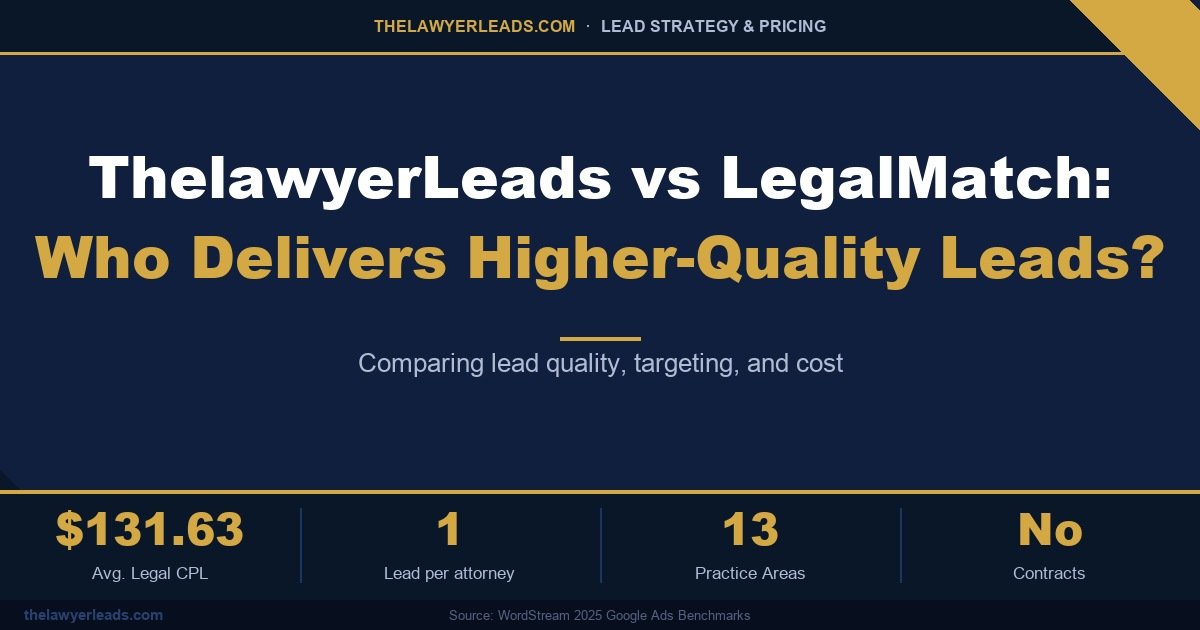
ThelawyerLeads vs LegalMatch: Who Delivers Higher-Quality Leads?

ThelawyerLeads vs LegalMatch: Who Delivers Higher-Quality Leads?

Every attorney shopping for legal leads eventually runs into LegalMatch. It’s a familiar name, a big directory, and a marketplace model that’s been around for years — but familiar isn’t the same as effective. Here’s an honest look at how LegalMatch stacks up against ThelawyerLeads on quality, targeting, and cost.

How LegalMatch Actually Works

LegalMatch operates as a matching marketplace: a consumer submits a case description, and the platform routes it to attorneys who match the case type and location. The catch is that “match” doesn’t mean “yours alone.” Depending on the practice area and market, the same case can be shown to multiple attorneys who then compete to be selected — meaning you’re often paying for a shot at a lead, not the lead itself.

For solo practitioners and small firms working on a tight marketing budget, that shared-exposure model can quietly erode ROI. You’re not just competing against other law firms for the client’s business — you’re competing against other subscribers on the same platform just to get the client on the phone.

ThelawyerLeads vs LegalMatch: Side-by-Side

Factor ThelawyerLeads LegalMatch
Lead exclusivity 1 lead per attorney — exclusive Often shared among competing attorneys
Geographic targeting County and ZIP-level Broad state/metro matching
Contract terms No long-term contracts Subscription-style commitment
Practice area coverage 13 dedicated practice areas General directory listing model
Avg. cost per lead $131.63 (industry avg.) Varies, often higher per converted case due to shared leads

The real cost of a “cheap” lead isn’t the sticker price — it’s the effective cost per signed client once you account for how many competitors are chasing the same prospect.

Why Exclusivity Changes the Math

When a lead is shared among several attorneys, response speed becomes the deciding factor more often than case quality or fit. Attorneys end up racing to be first on the phone rather than focusing on whether the case is actually a good match for their practice. That dynamic rewards firms with large intake teams and punishes solo practitioners and small firms who simply can’t answer every call within sixty seconds.

ThelawyerLeads takes a different approach: every lead sold is sold once. There’s no race against three other firms for the same consumer, and no wasted marketing spend on a prospect who already signed with someone who called first. Combined with ZIP-level geographic targeting, that means the leads landing in your inbox are both exclusive and relevant to the areas you actually serve.

What This Means for Small and Mid-Size Firms

  • No need to staff a large intake team just to win the race for shared leads
  • Marketing spend maps directly to leads received — no diluted exposure
  • Freedom to scale volume up or down month to month, with no lock-in
  • Practice-area-specific routing instead of a general directory listing

▶ Key Insight

A directory-style marketplace optimizes for volume of matches, not quality of fit. A targeted lead service optimizes for the opposite — fewer, better-matched leads that you’re not splitting with your competitors.

Which One Fits Your Firm?

If your firm has the intake bandwidth to compete for shared leads across a broad marketplace, LegalMatch’s model can still generate volume. But for most solo and small-firm attorneys, exclusivity and precise geographic targeting translate directly into a better return on every dollar spent — you’re not paying to lose a race you were never staffed to win.

ThelawyerLeads vs LegalMatch — Summary

  1. Exclusivity wins on ROI — one lead, one attorney, no race to answer the phone first.
  2. Precision targeting beats broad matching — county and ZIP-level filters mean leads actually fit your service area.
  3. Flexibility matters for small firms — no long-term contracts means you scale spend to match caseload.
  4. 13 dedicated practice areas — leads are routed by specialty, not funneled through a general directory.

See Lead Pricing for Your State

We offer transparent, state-specific lead pricing across all major practice areas — with no contracts, no recycled contacts, and full exclusivity options.

View Lead Pricing →

How to Evaluate Exclusive Legal Leads Before You Commit Your Marketing Budget

How to Evaluate Exclusive Legal Leads Before You Commit Your Marketing Budget

A managing partner at a mid-size personal injury firm signs a six-month contract with a lead provider, pays a premium for “exclusive” leads, and three weeks in discovers half the intakes are duplicate submissions from the same IP address. The budget is gone. The pipeline is thin. The lesson is expensive and avoidable.

Every year, US law firms lose six and seven figures to leads that were never truly exclusive, never properly filtered, or never matched to the practice area they claimed to serve. Learning how to evaluate exclusive legal leads before you sign a contract is one of the highest-leverage skills a firm owner can develop — it protects marketing spend, shortens the path to case value, and keeps intake staff focused on prospects who are actually ready to retain counsel.

This guide walks through the specific criteria, questions, and red flags that separate a legal growth partner worth paying for from a vendor selling volume without accountability.


What “Exclusive” Actually Means — And How to Verify It

The word “exclusive” gets used loosely across the legal lead market. A genuinely exclusive lead is sold to one firm only, with a documented timestamp and source, and is never resold or recycled into a second campaign. A lead that is “exclusive” only for the first 24 hours, or shared among a “small group” of firms, is not exclusive — it is shared traffic with better marketing copy.

Before committing budget, ask any provider for their duplicate-detection process. Serious growth partners can explain, in specific technical terms, how they prevent the same consumer from being sold twice — IP fingerprinting, phone number matching, and consent timestamps are the baseline. If a sales rep cannot answer this in one sentence, treat that as a signal.

Firms that ask for duplicate-detection documentation before signing report 30–40% fewer wasted intake hours in their first 90 days compared to firms that skip this step.

The Filtering Criteria That Actually Move Case Value

Not all filters are equal. Basic providers filter on geography and practice area alone. A legal growth partner filters on the variables that correlate with case value and retention likelihood: injury severity or claim size, statute-of-limitations window, prior representation status, and liability clarity. The tighter the filter, the fewer raw leads you receive — but the higher the percentage that convert into signed clients.

Practice-Specific Filters Worth Insisting On

For personal injury: incident date within the statute of limitations, medical treatment already sought, and no prior attorney on file. For immigration: case type (family, employment, asylum, removal defense), current status, and urgency indicators. For bankruptcy: debt threshold, income verification, and prior filing history. Ask any prospective partner exactly which of these fields they capture and verify before a lead reaches your intake team.

Evaluation Criteria Typical Lead Vendor Legal Growth Partner
Exclusivity verification Claimed, not documented Timestamped and auditable
Practice-area filtering Broad category only Sub-criteria matched to case value
Refund/replacement policy Vague or absent Written, enforced consistently
Delivery speed Batched, delayed hours Real-time, minutes not hours
Reporting transparency Monthly summary only Source-level, real-time dashboard

Common Mistakes Attorneys Make When Evaluating Providers

The most common error is anchoring the decision on cost-per-lead alone. A $40 lead that converts at 4% costs more per signed case than a $90 lead that converts at 15%. Firm owners who evaluate providers purely on sticker price consistently overpay on a cost-per-acquisition basis without realizing it.

The second mistake is skipping the trial period. Any legitimate growth partner will support a small initial volume commitment so you can validate lead quality against your own intake data before scaling spend. If a provider insists on a large minimum commitment with no trial option, that is a negotiating position worth pushing back on.

The third mistake is failing to track leads past the intake call. Case value, retention rate, and time-to-signature are the metrics that actually determine whether a lead source is worth renewing — not raw lead count. Firms that build this tracking into their CRM from day one make far better renewal decisions six months later.

Key Insight

Cost-per-lead is a vanity metric. Cost-per-signed-case is the number that determines whether a client pipeline strategy is actually profitable.

Questions to Ask Before You Sign

Bring a short, specific list to every provider conversation: How do you verify exclusivity, and can I see documentation? What is your average lead-to-signed-client rate for firms in my practice area? What happens if a lead fails your own quality filters after delivery? Can I start with a limited trial volume before committing to a larger contract? A growth partner confident in its process will answer all four without hesitation.


Evaluation Checklist Before You Commit Budget

  1. Demand exclusivity proof — timestamps and source documentation, not just a sales claim.
  2. Match filters to case value — insist on practice-specific criteria, not broad categories.
  3. Track cost-per-signed-case — not cost-per-lead — as your real evaluation metric.
  4. Start with a trial volume — validate quality before scaling your commitment.
  5. Confirm a written replacement policy — quality issues should have a documented resolution path.

Build a Pipeline You Can Actually Trust

TheLawyerLeads.com filters every lead to your practice area, verifies exclusivity before delivery, and gives you real-time visibility into where every case comes from.

Browse Practice Areas

How to Improve Law Firm Intake Conversion Rate Without Spending More on Ads

How to Improve Law Firm Intake Conversion Rate Without Spending More on Ads

A mid-sized personal injury firm spends $18,000 a month on ads, phones ring constantly, and yet the partner cannot say with confidence how many of those calls became signed clients. The marketing budget looks busy. The intake conversion rate the number that actually matters has never been measured.

Most firms know their cost per lead. Far fewer know their intake conversion rate the percentage of inquiries, calls, and form fills that turn into signed clients. That single number determines whether a marketing dollar is well spent or wasted, and it is the lever most attorneys never pull. Improving law firm intake conversion rates is usually cheaper and faster than buying more traffic, because the leads are already arriving. The problem is what happens to them after the phone rings.


Why Intake Conversion Rate Is the Metric That Matters Most

Ad spend, SEO rankings, and even lead volume are vanity metrics if the intake process leaks prospects. A firm that converts 45% of qualified inquiries into signed clients is getting roughly twice the return on every marketing dollar as a firm converting 22%, without spending a cent more on acquisition. Yet in our conversations with firm owners, the vast majority track cost-per-lead religiously and have never calculated their own intake-to-signed-client percentage.

The math is simple: if you generate 100 inquiries a month at $150 each ($15,000 spend) and convert 25 into clients, your true cost per client is $600. Raise conversion to 35% with zero additional spend, and cost per client drops to $429 a 29% efficiency gain that shows up directly on the bottom line.

Firms that respond to a new inquiry within 5 minutes are roughly 21 times more likely to qualify that lead than firms that wait 30 minutes, according to widely cited speed-to-lead research across service industries. In legal intake, where consumers routinely call three or four firms back to back, that window is often the entire game.


Where Law Firms Lose Clients in the Intake Funnel

Speed to Contact

Every hour a lead sits unanswered, the probability of ever reaching that person drops sharply. Prospective clients who called an injury or family law firm rarely wait quietly; they move to the next result. A firm serious about improving intake conversion needs a same-hour, ideally same-minute, response standard even if that first contact is just a scheduling text.

Script Quality and Staff Training

Front-desk staff or paralegals answering intake calls without a structured script tend to sound transactional, which undermines trust at the exact moment a prospective client is deciding whether to hire the firm. A consistent, empathetic intake script that qualifies the case while building rapport consistently outperforms ad-hoc conversations.

Follow-Up Cadence

Most firms give up after one or two follow-up attempts. Data across service-based industries shows meaningful conversion lift when follow-up extends to five or more touches across call, text, and email over the first 72 hours. Prospects who do not answer the first call are not lost they are simply busy.

Intake Practice Typical Firm Growth-Focused Firm
Response Time 30-60+ minutes Under 5 minutes
Follow-Up Attempts 1-2 calls 5+ touches over 72 hours
Intake Script Informal, staff-dependent Standardized, tested, and tracked
Lead Source Tracking Not measured by channel Conversion tracked by source and staffer

Building an Intake System That Scales With Your Pipeline

Improving conversion is not a one-time fix; it is an operating system. Firms that sustain high intake conversion rates typically build three things: a documented response-time SLA (with accountability if it slips), a CRM or intake tool that timestamps every touch so nothing falls through, and monthly review of conversion by lead source and by staff member so coaching is based on data, not guesswork.

This is also where the quality of the client pipeline itself matters. A firm feeding its intake team a mix of exclusive, pre-qualified inquiries converts more efficiently than one drowning in shared or unfiltered leads, because staff spend their limited time on prospects who actually match the firm practice areas and case criteria.

Key Insight

Conversion rate optimization compounds. A firm that improves intake conversion from 25% to 35% does not just sign more clients this month it permanently lowers its cost per client for every future dollar of marketing spend, freeing budget to reinvest in growth rather than replace leakage.


Measuring ROI: What to Track Monthly

A firm serious about client acquisition ROI should track four numbers every month: cost per lead by source, intake conversion rate by source, cost per signed client by source, and average case value by source. Together, these reveal which channels and which intake habits are actually building the pipeline versus which are just generating noise. Firms that review this dashboard monthly consistently outperform those that review marketing spend only at renewal time.

Quick-Reference Summary

  1. Measure intake conversion, not just lead volume it is the number that actually drives ROI.
  2. Respond within 5 minutes speed to contact is the single highest-leverage fix most firms can make this week.
  3. Standardize the intake script consistency across staff protects conversion regardless of who answers.
  4. Extend follow-up to 5+ touches most lost clients simply were not reached enough times.
  5. Feed the funnel with quality exclusive, well-filtered inquiries convert at a materially higher rate than shared leads.

Build a Pipeline Your Intake Team Can Actually Convert

TheLawyerLeads.com connects your firm with exclusive, real-time client inquiries filtered to your practice area so your team spends its time converting, not sorting.

Browse Practice Areas

Speed to Lead: Why Response Time Is Quietly Costing Your Law Firm Clients

Speed to Lead: Why Response Time Is Quietly Costing Your Law Firm Clients

A managing partner at a mid-size personal injury firm recently discovered her intake team was averaging 41 minutes to return the first call on a new inquiry. Her conversion rate on paid leads had been sliding for two quarters. Nobody had touched the ad copy, the landing page, or the budget — the case had already been decided before her firm ever picked up the phone.

Law firm growth strategy conversations tend to jump straight to marketing spend: more Google Ads, a new SEO agency, another lead source. But speed to lead — how fast your firm responds to a new inquiry — is one of the highest-leverage, lowest-cost levers in client acquisition, and most firms are leaving it untouched. Improving law firm response time doesn’t require a bigger budget. It requires a process fix, and it can move conversion rates more than almost any other change a firm makes to its client pipeline.


Why Speed to Lead Determines Your Law Firm’s Client Pipeline

A prospective client filling out a contact form or calling after an accident, an arrest, or a denied claim is almost always contacting more than one firm. Research on lead response across service industries consistently shows the odds of making meaningful contact drop sharply after the first five minutes, and drop further after thirty. In legal intake specifically, the pattern is even more pronounced: a person searching “personal injury lawyer near me” at 9 p.m. on a Tuesday is not waiting until Wednesday morning for a callback. They are calling the next firm on the list.

This is where law firm response time becomes a client acquisition problem disguised as an operations problem. Firms often diagnose a “bad lead” or a “soft market” when the actual issue is that the lead sat in an inbox, a voicemail queue, or an unassigned CRM stage for too long. Response time is not a support metric. It is a revenue metric.

Firms that respond to a new inquiry within five minutes convert at meaningfully higher rates than firms that respond within an hour — and the gap widens further against firms that respond the next business day. For a firm spending five or six figures a month on client acquisition, that gap is the difference between a strong quarter and a flat one.


Where Intake Optimization Breaks Down

The After-Hours Gap

Accidents, arrests, and family crises do not follow business hours. A firm that only staffs intake from 9 to 5 is voluntarily forfeiting every inquiry that arrives at night or on a weekend — a significant share of total volume for practice areas like personal injury and criminal defense.

The Routing Problem

Many firms route new inquiries through a general inbox or a single intake coordinator with no backup. When that person is on another call, in a meeting, or out sick, leads simply wait. A pipeline is only as strong as its weakest handoff.

No Follow-Up Cadence

A single missed call and no follow-up sequence is one of the most common — and most fixable — leaks in a law firm’s client pipeline. Prospective clients who don’t answer the first call often will answer the third, if the firm bothers to call three times across a structured cadence instead of once.

Intake Practice Traditional Approach Growth-Focused Approach
Response window Same business day Under 5 minutes, 7 days a week
Follow-up attempts 1 call, no sequence 6+ touches across call, text, email
After-hours coverage None Answering service or on-call rotation
Lead source quality Shared, unfiltered leads Exclusive, practice-area filtered leads

Fixing Response Time Without Adding Headcount

Firms rarely need to double their intake staff to fix response time — they need to fix the system around the staff they have. Three changes move the needle fastest: routing every new inquiry to a live person or answering service around the clock rather than a voicemail box; building a structured follow-up cadence of at least five to seven attempts spread across calls, texts, and email over ten to fourteen days; and auditing lead source quality, since exclusive, practice-area filtered inquiries convert at a fundamentally different rate than shared leads that three or four other firms are calling at the same time.

That last point matters more than most firms realize. Even a flawless five-minute response process cannot fully compensate for a lead that was sold to multiple firms simultaneously — the client acquisition math is working against you before the phone even rings. This is why growth-minded firms increasingly evaluate not just how fast they respond, but where the inquiry came from and how many other firms are chasing the same prospective client.

Key Insight

Fixing response time is a free lever pulled on leads you’re already paying for. Before increasing ad spend or adding a new marketing channel, audit how fast — and how consistently — your firm is responding to the inquiries it already generates. Most firms find their biggest untapped source of new clients was sitting in their own intake process the whole time.


Measuring ROI on Intake Speed

To know whether an intake fix is actually improving ROI on marketing spend, track three numbers monthly: average first-response time, contact rate (percentage of inquiries reached within 24 hours), and signed-case conversion rate by lead source. Firms that start tracking these together, rather than treating marketing and intake as separate departments, typically find the fastest path to a stronger pipeline isn’t a new campaign — it’s tightening the handoff between the ad click and the human being who answers the phone.

Summary: Building a Faster Client Pipeline

  1. Respond within five minutes — conversion rates drop sharply after the first few minutes of silence.
  2. Cover nights and weekends — accidents and legal emergencies don’t follow business hours.
  3. Build a real follow-up cadence — one missed call should never be the end of the sequence.
  4. Audit your lead sources — exclusive, filtered inquiries convert at a different rate than shared leads.
  5. Track speed alongside spend — response time and ROI should live on the same dashboard.

Stop Losing Clients to Slow Intake

TheLawyerLeads.com connects your firm with exclusive, practice-area filtered inquiries built for firms that respond fast and follow up consistently.

Browse Practice Areas

Google Business Profile Optimization for Law Firms: The Complete 2026 Guide

Google Business Profile Optimization for Law Firms: The Complete 2026 Guide

A personal injury firm in a mid-size metro ranks on page one organically for “car accident lawyer near me” — yet shows up nowhere in the three-pack when a searcher taps “Maps.” Their closest competitor, with a thinner website and half the years in practice, owns that map pack with 140 reviews and a same-day response badge. The firm isn’t losing on legal skill. It’s losing on Google Business Profile optimization for law firms, and that gap is costing them calls every single day.

Most firms treat their Google Business Profile as a set-it-and-forget-it listing — a digital Yellow Pages entry they claimed once and never touched again. That’s a mistake. Google Business Profile optimization for law firms is arguably the single highest-leverage local SEO lever available, because the map pack sits above organic results on mobile for nearly every “near me” and city-plus-practice-area search that converts. If your profile isn’t built to win that box, you’re funding your competitor’s client pipeline instead of your own.


Why Google Business Profile Outranks Your Website for Local Intent

Google’s local algorithm weighs three factors for map pack placement: relevance, distance, and prominence. Your website’s domain authority matters for organic rankings, but the map pack runs on a different scoring model — one built almost entirely from signals inside your Google Business Profile itself: category selection, review volume and velocity, photo activity, Q&A engagement, and how quickly you respond to messages and reviews. A firm with a mediocre website but a meticulously maintained profile will regularly out-rank a firm with a beautiful site and a neglected listing.

This matters more in legal than almost any other vertical, because prospective clients searching after an accident, an arrest, or a divorce filing are in crisis-decision mode. They tap the top three map pack results and call. They rarely scroll to organic listings below the fold. If your profile isn’t one of those three, your SEO budget is largely subsidizing visibility you can’t convert.

Roughly 76% of local searches that show intent-to-contact result in a call or visit within 24 hours. For law firms, that window is often measured in minutes, not hours — which is exactly why map pack placement outweighs almost every other local ranking factor.

The Google Business Profile Optimization Checklist for Law Firms

Optimization isn’t a single setting — it’s a stack of smaller decisions that compound. Here’s how a neglected profile compares to a fully optimized one on the factors Google actually weighs:

Factor Unoptimized Profile Fully Optimized Profile
Primary category Generic “Lawyer” Practice-specific (“Personal Injury Attorney”)
Review volume Under 20, stagnant 100+, growing weekly
Response time Days, or never Under 1 hour
Photos/posts Static, outdated Weekly updates, case wins, team photos
Service area Left blank or too broad Matched to actual practice radius

Category selection is the most underused lever

Most firms default to “Lawyer” or “Law Firm” as their primary category because it feels safe and broad. That’s precisely the problem — broad categories put you in competition with every attorney in the metro, including firms that don’t even practice your niche. Selecting a precise primary category (“Personal Injury Attorney,” “Immigration Attorney,” “DUI Lawyer”) narrows the competitive set and tells Google exactly which searches you should surface for. Layer in two or three accurate secondary categories, and you widen relevant reach without diluting focus.


Reviews and Response Time: The Trust Signal Google Rewards Twice

Reviews do double duty. They’re a ranking input (volume, recency, and average rating all factor into prominence) and a conversion input — the searcher who does make it to organic results or clicks through to your site still checks your review count before dialing. A profile with 12 reviews from three years ago reads as inactive, even if the firm is thriving. A profile adding 4-6 new reviews a month reads as a firm that’s actively winning cases and actively asking satisfied clients to speak up.

Response time compounds this. Google now surfaces “responds to most messages within [X]” directly in the profile, and firms that reply to reviews and messages within an hour consistently out-convert firms that reply within a day — not because the reply itself changes minds, but because speed signals a firm that’s operationally ready to take the case seriously from the first contact.

Key Insight

Firms that respond to new leads within five minutes are dramatically more likely to convert them than firms that wait even 30 minutes. The same math applies to your Google Business Profile: fast responses to reviews and messages train Google — and prospective clients — to expect fast responses when the case actually comes in.

From Map Pack Visibility to a Real Client Pipeline

Winning the map pack solves discovery, not conversion. A polished profile that drives calls to an intake process that drops leads on the floor is a wasted investment. The firms that get the most out of Google Business Profile optimization pair it with disciplined intake — fast call answering, structured qualification, and follow-up systems that don’t let a Tuesday-afternoon call go cold by Wednesday. Local SEO earns you the opportunity; what happens in the next sixty seconds determines whether it becomes a client.

That’s also where supplementing organic and map pack traffic with a filtered, exclusive client pipeline makes sense for growth-minded firms — not as a replacement for SEO, but as a way to keep intake volume steady while your Google Business Profile climbs toward page-one map pack placement over the months it typically takes to build review velocity and category authority.


Action Checklist

  1. Set a precise primary category — swap generic “Lawyer” for your actual practice area.
  2. Build a review request system — ask every satisfied client within 48 hours of case resolution.
  3. Respond within the hour — to reviews, messages, and Q&A alike.
  4. Post weekly — case results, team updates, and community involvement keep the profile active.
  5. Match your service area to where you actually practice, not an aspirational radius.
  6. Fix intake before you fix ranking — new calls are wasted if no one answers fast.

Don’t Wait on SEO to Fill Your Pipeline

Google Business Profile optimization takes months to compound. Keep your intake pipeline full today with exclusive, real-time client opportunities matched to your practice area.

Browse Practice Areas